The Free Ai Humanizer That Actually Works And Why You need One Right Now
You've been there. You spend an hour crafting content with ChatGPT, hit publish, and then — boom — your professor flags it, your client rejects it, or Google buries it. The problem isn't that AI writing is bad. It's that it sounds like AI writing. That's exactly where a free AI humanizer steps in and changes everything.
Whether you're a student trying to protect your academic integrity, a blogger trying to rank on Google, or a marketing professional racing against a deadline, the question isn't whether you're using AI anymore — it's whether your content reads as if a real person wrote it. In 2025, that distinction matters more than ever.
This guide covers everything: what a free AI humanizer actually is, why you genuinely need one, how to use it effectively, and which tools are worth your time. Let's get into it.
85%of readers prefer content that feels naturally written
3x more likely to rank if content passes AI detection
72%of educators now use AI detection tools regularly
What Is a Free AI Humanizer, Exactly?
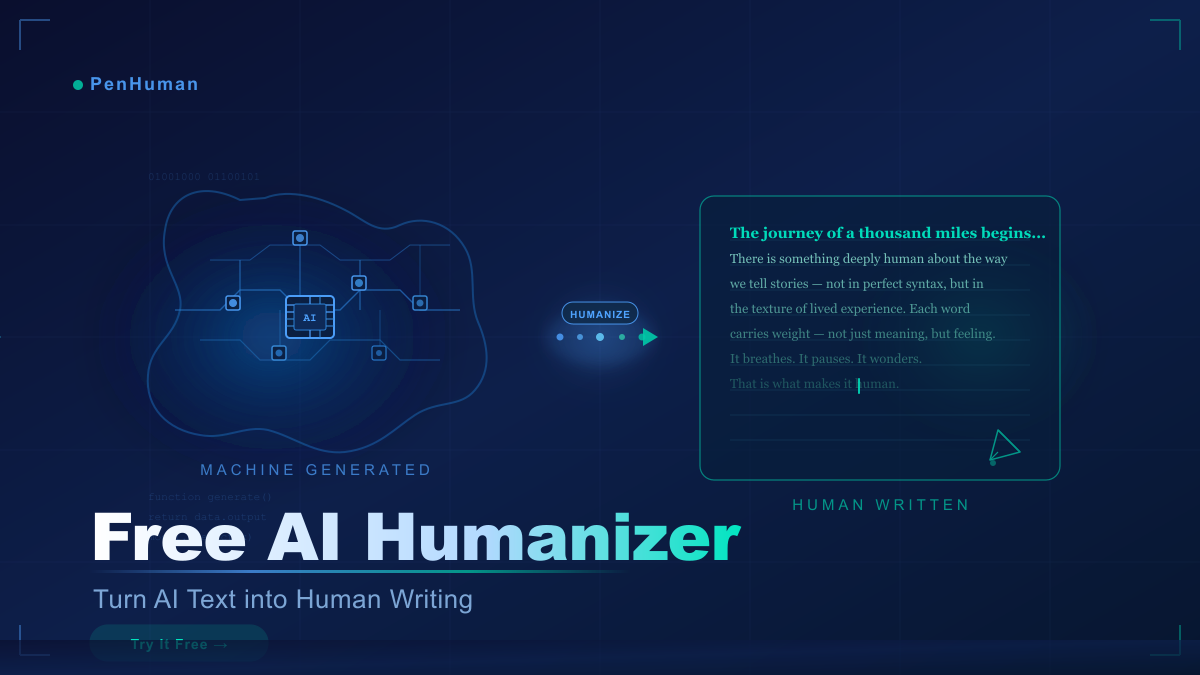
A free AI humanizer is an online tool that takes text generated by AI models — ChatGPT, Gemini, Claude, or any other — and rewrites it so it reads like it was crafted by a real human being. It strips away the telltale patterns that AI detection software picks up on: the robotic rhythm, the overly formal transitions, the suspiciously perfect sentence structure.
Think of it as a translator. The AI wrote the raw draft, and the humanizer polishes it into something that has personality, flow, and the kind of natural imperfection that makes writing feel alive. A good free AI humanizer doesn't just swap synonyms — it restructures sentences, adds tonal variety, injects natural pacing, and makes the overall voice sound more, well, human.
The "free" part matters for a lot of people. Premium tools can cost $9 per month, which adds up fast. For students, early-career freelancers, or small bloggers, access to a genuinely capable free AI humanizer is the difference between a usable tool and an out-of-reach luxury.
Quick definition: A free AI humanizer takes AI-generated text and rewrites it to sound like a natural, human-written piece — bypassing AI detectors and improving readability — without charging you anything upfront.
Why Do You Actually Need a Free AI Humanizer?
This is the real conversation. A lot of people assume the only reason to humanize AI content is to "cheat" or bypass detection. That's a narrow — and honestly inaccurate — view of what's really going on. There are at least four very legitimate reasons why a free AI humanizer has become an essential tool in 2025.
1. AI Detection Is Everywhere Now
Universities, content platforms, and even clients are using tools like Turnitin AI, GPTZero, and Originality.ai to flag AI-generated writing. If you're using AI as a drafting tool (which is completely reasonable), having a free AI humanizer ensures your final output doesn't get unfairly penalized for the way it was written.
2. Readability Directly Affects Engagement
Raw AI output tends to be dense and monotonous. The sentences are technically correct, but they lack the kind of rhythm that keeps a reader scrolling. When you run content through a free AI humanizer, you're not just dodging detectors — you're creating something people actually want to read. That matters whether you're writing a blog post, a newsletter, or a product description.
3. Google Rewards Human-Feeling Content
Google's Helpful Content System is designed to prioritize content that feels genuinely useful and human-authored. Flat, formulaic writing — even if technically accurate — struggles to rank. A free AI humanizer helps your content hit the tone, variety, and depth that Google's algorithms (and human readers) reward.
4. Professional Credibility Is at Stake
If you're a freelancer or content agency, sending a client a piece that reads like a chatbot wrote it could cost you the contract. Using a free AI humanizer as part of your workflow ensures the final deliverable sounds polished and professional — because it does.
The Real Benefits of Using a Free AI Humanizer Tool
Beyond the obvious — passing AI detection — there's a surprisingly rich list of things a high-quality free AI humanizer can do for your content and your workflow.
It saves time without sacrificing quality. You get the speed of AI-generated drafts combined with the polish of human-style writing. For someone managing a content calendar with dozens of posts, that combination is genuinely game-changing. You're not starting from scratch, and you're not publishing raw AI output either.
It also improves the emotional resonance of your content. Human writing has warmth, humor, and personality. AI writing often doesn't. A good free AI humanizer adds the tonal shifts and conversational cues that make readers feel like there's a real person on the other side of the screen.
Finally, it democratizes access. Not everyone can afford a professional editor or a premium writing tool. A free AI humanizer gives students, creators, and small business owners access to high-quality content refinement that was previously out of reach.
Who's Using Free AI Humanizers — and How
The honest answer? Pretty much everyone who creates content for the web. But let's look at some specific groups who are getting the most out of these tools right now.
🎓
Students
Using AI to brainstorm and draft, then humanizing the output to ensure it passes detection and maintains their authentic voice — without crossing academic lines.
✍️
Bloggers & Content Creators
Scaling their output with AI drafts, then running everything through a free AI humanizer to keep posts engaging, readable, and Google-friendly.
📣
Digital Marketers
Generating ad copy, email campaigns, and landing page content at scale — then refining it to sound persuasive and personal rather than robotic.
💼
Freelance Writers
Speeding up their workflow with AI assistance while ensuring client deliverables still sound like genuinely crafted, professional writing.
The common thread across all these groups is this: they're not replacing their judgment with AI. They're using AI to accelerate their process, and a free AI humanizer to make the output worthy of their name.
Free vs. Paid AI Humanizers: What's the Real Difference?
This is a fair question, and it deserves an honest answer. Free AI humanizer tools are genuinely useful — but they're not all created equal, and there are some meaningful differences between free and paid options worth knowing about.
Feature | Free AI Humanizer | Paid AI Humanizer |
|---|---|---|
Basic text humanization | ✓ Yes | ✓ Yes |
Bypass AI detection tools | ⚡ Limited | ✓ Advanced |
Tone customization | ⚡ Basic | ✓ Full control |
Word/character limits | ✗ Often capped | ✓ Unlimited |
Plagiarism-free output | ✓ Yes | ✓ Yes |
SEO optimization | ⚡ Limited | ✓ Enhanced |
Cost | ✓ Free | ✗ $10–$50/mo |
The bottom line: if you're a casual user who needs to humanize occasional pieces, a free AI humanizer is more than enough. If you're producing high-volume content professionally, the investment in a paid plan pays for itself quickly. The good news is that some platforms — like PenHuman — offer genuinely powerful free tiers that feel closer to paid tools than the average free option.
5 Practical Tips to Humanize AI Content More Effectively
No tool does all the work for you. The best results come from pairing a good free AI humanizer with some smart habits on your end. Here's what actually makes a difference.
- Don't humanize first-draft AI output. Edit the AI draft yourself first — fix factual gaps, adjust the structure, add your own ideas — then run it through the humanizer. The tool performs better when it has something thoughtful to work with.
- Choose the right tone setting. Most free AI humanizers offer tone options (conversational, formal, academic, etc.). Matching the tone to your audience makes the output feel more intentional and less generically processed.
- Break up long, compound sentences before humanizing.AI tends to write in long, elaborate sentences. Trimming these down before humanizing gives the tool more room to add natural variety rather than just reshuffling the same wordiness.
- Add your own examples and anecdotes after humanizing. The one thing no humanizer can do is add your personal experience. Sprinkle in a real story, a specific example, or a genuine opinion after the tool has done its work — this elevates the content dramatically.
- Run the output through an AI detector after humanizing. Don't assume it worked — verify it. Tools like GPTZero or Originality.ai will tell you if the content still reads as AI-generated. If it does, repeat the process or adjust the sections that got flagged
Meet PenHuman — The Free AI Humanizer Built for Real Results
There are a lot of tools out there that promise to humanize your AI content. PenHuman actually delivers. Built with a deep understanding of what makes writing feel genuinely human, PenHuman doesn't just swap words — it rewrites your content from the inside out, preserving your meaning while eliminating every trace of robotic phrasing.
What makes PenHuman different isn't just the technology. It's the experience. The interface is clean and instant. The output is natural. And the free tier is genuinely generous — not a watered-down teaser designed to frustrate you into upgrading.
✓ Bypasses GPTZero & Turnitin✓ Multiple tone modes✓ SEO-friendly output✓ No sign-up required for free use✓ Plagiarism-free results✓ Instant processing
Whether you're a student who needs peace of mind, a blogger who needs to scale, or a marketer who needs to sound human at volume — PenHuman is the free AI humanizer that fits your workflow without slowing it down.
The question isn't whether to use AI in your writing process anymore. That ship has sailed. The real question is whether the content you're producing with AI is actually doing its job — engaging readers, ranking on Google, and passing the scrutiny of detection tools. That's where a free AI humanizer becomes an indispensable part of your toolkit.
When used thoughtfully, humanizing AI content isn't about deception — it's about craftsmanship. It's about taking a powerful but imperfect tool and refining its output until it meets the standard your audience (and the algorithms) expect. That takes the right tool, the right habits, and a little bit of your own voice added on top.
The good news is that you don't have to spend a lot of money — or any money at all — to start doing this well. With PenHuman, a free AI humanizer is a few clicks away, and the difference it makes is immediate.