Free vs Paid AI Humanizer: Compare Limits Before Upgrading
Free vs paid AI humanizer: start with the task
A free vs paid AI humanizer comparison begins with your draft, the available allowance and the review you are prepared to do. This is a PenHuman guide to comparing options, not an independent ranking of competing products. It uses our published limits as a concrete example and gives you questions to ask of any service. A tool that produces fluent wording can still change a fact or condition. Start with the job you need done, then decide whether its suggestions are useful enough to keep.
Record three things before comparing plans: the length of a typical draft, how often you expect to revise one, and the editing control you need. A one-off email and a recurring set of long reports are different workloads. Look for evidence of the actual limits instead of treating free, unlimited or professional as complete descriptions. Keep unknown competitor details marked unknown until you check their current documentation. The point of a comparison is a supported decision for your own work, rather than naming one winner for every writer.
What PenHuman Basic includes, and what it does not
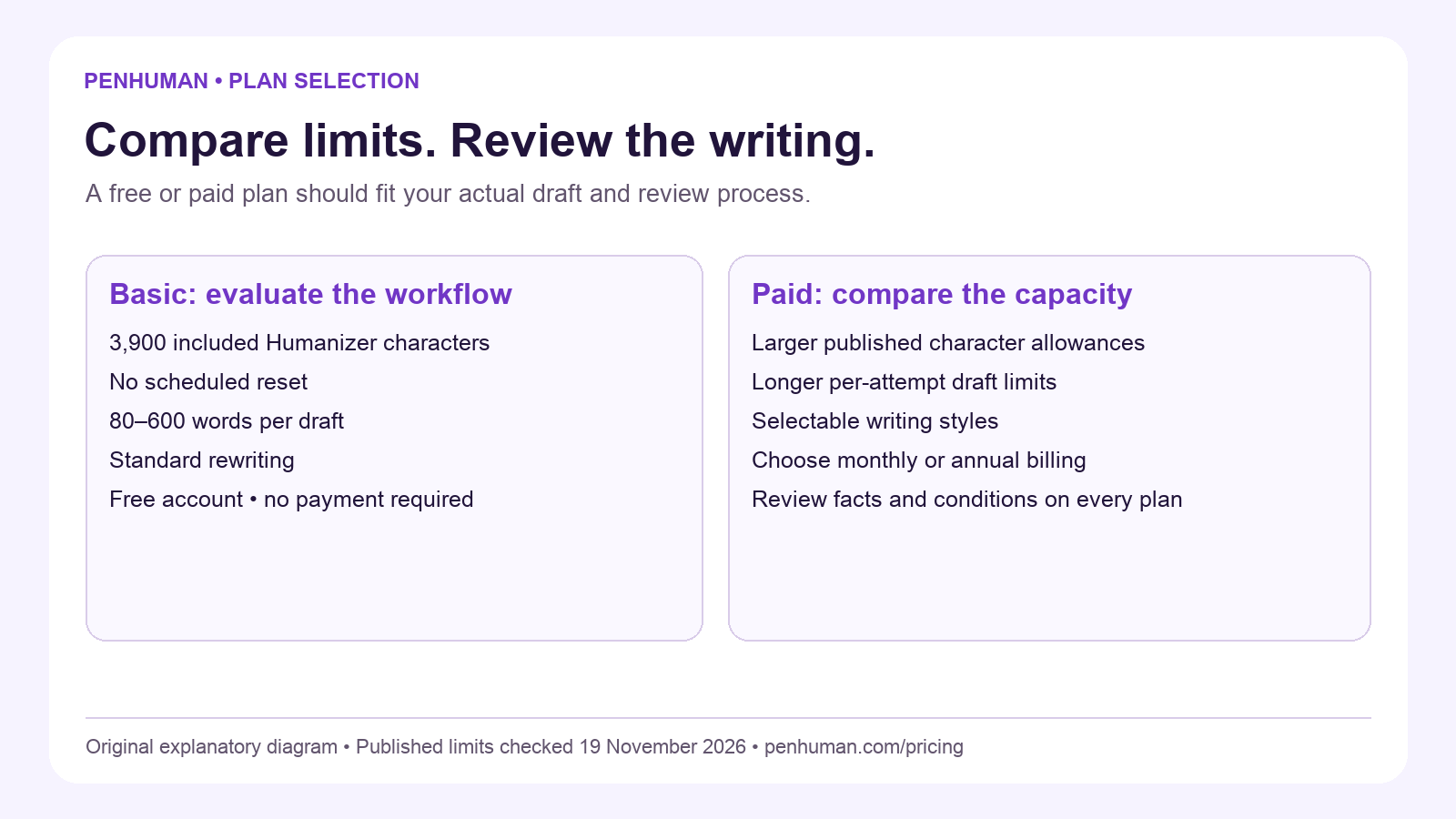
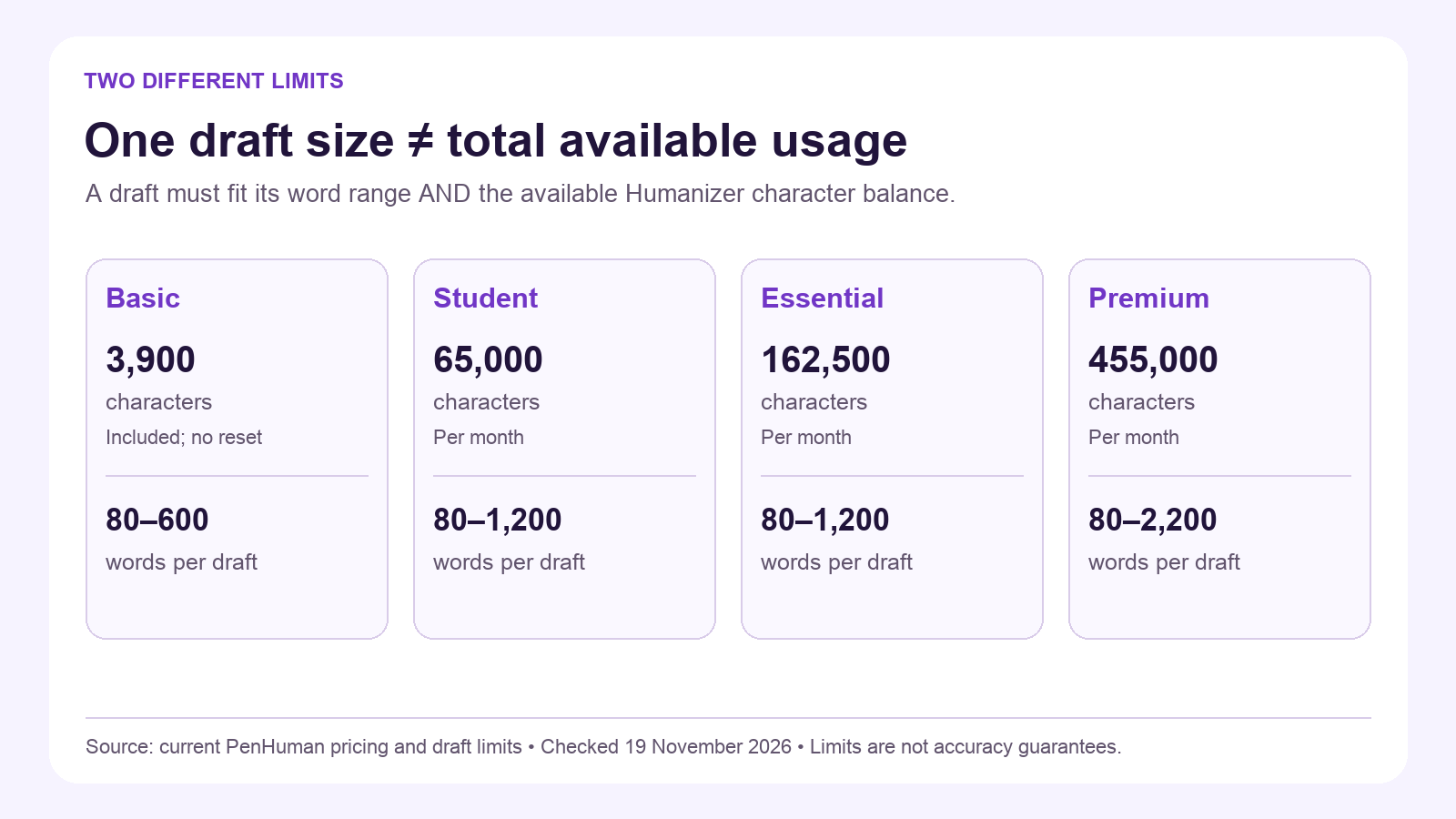
PenHuman Basic includes 3,900 Humanizer characters with no scheduled reset. A free account is required, but no payment is required to try that allowance. Basic uses standard rewriting. Each draft must contain 80–600 words and fit within the remaining character balance. These limits serve different purposes: the word range describes one draft, while the character balance constrains available usage. A draft can fit the word range and still be too large for the remaining allowance. Check both before starting an attempt instead of assuming that a free rewrite renews every day or month.
Use the included allowance on a representative, complete draft whose facts you can check. Avoid spending it on unrelated filler simply to reach the minimum. A short heading or subject line can be edited manually; it does not become a suitable Humanizer task merely because a tool is available. If you only need to measure length, the free word counter works without an account. The separate free editing guide covers the step-by-step workflow. Here, the decision is whether standard rewriting and the remaining allowance fit the task you actually have.
What changes when you compare paid plans
As checked on November 19, 2026, Student lists 65,000 Humanizer characters per month and a 1,200-word per-attempt limit. Essential lists 162,500 characters per month with the same 1,200-word limit. Premium lists 455,000 characters per month and a 2,200-word limit. These figures describe different usage capacities, not a ranking of factual accuracy. Compare the current plan limits before subscribing because the live offer is the reference for a purchase decision. A larger total allowance does not remove the limit on one draft or the need to review the result.
Paid plans also provide selectable styles, including Formal, Casual, Academic, Persuasive, Narrative and Descriptive. Choose a style only when it serves the intended reader; its name does not certify that a document meets professional, academic or client requirements. Compare monthly and annual billing separately from usage limits. An annual price displayed as a monthly equivalent is charged for the year, not as that smaller monthly payment. Check the selected cycle and the full amount on the pricing page. Paying for more capacity or styles is not a guarantee of better factual fidelity.
Use a small workload sheet before choosing an allowance
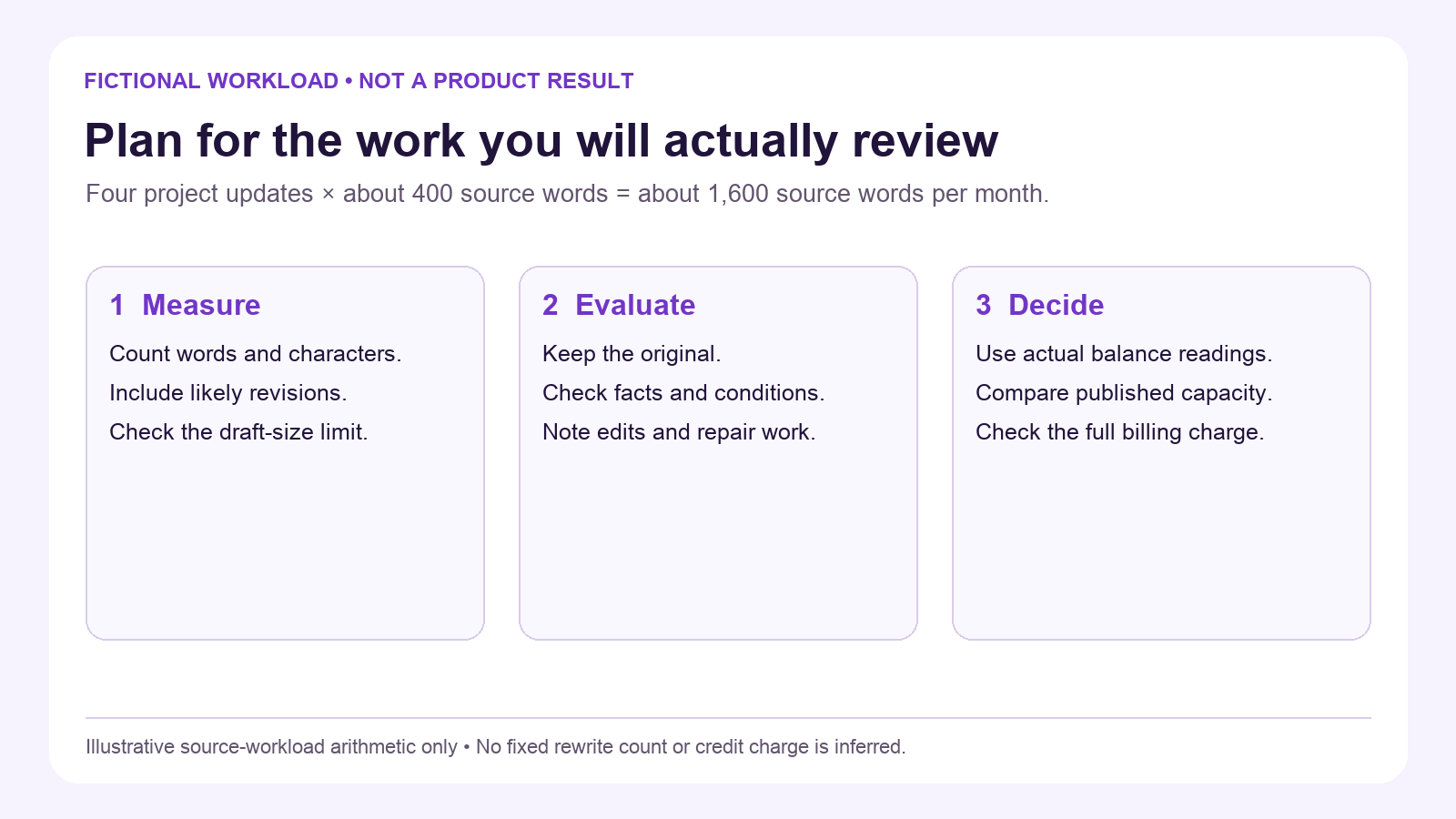
Imagine an explicitly fictional writer preparing four project updates each month, with each complete source draft about 400 words. The source workload is about 1,600 words before any revisions. That multiplication is a planning example, not a claim that one plan covers a fixed number of updates. Character lengths vary, rewritten output can differ in length and repeated attempts use available credits. Count representative drafts and record the balance shown around actual work. Do not convert an approximate word total into a promise about the exact number of rewrites you will receive.
For this fictional workload, start by checking whether a rewrite reduces unnecessary repetition without changing the update. Note which suggested edits you retain and which need repair. If the result is useful, compare expected recurring work with the published allowance and per-attempt limit. If most time goes into restoring facts or fixing tone, a larger allowance alone does not answer that problem. Manual editing may remain the better choice for that task. Keep the decision tied to useful approved writing, not the quantity of text a service can produce.
- Draft size: record both words and characters for a representative complete draft.
- Frequency: include likely revisions instead of counting only first attempts.
- Useful result: record the changes you kept and corrections still required.
- Commitment: compare the billing cycle and full charge before choosing a plan.
Evaluate meaning before deciding that an output is better
Compare a candidate with the original and its underlying evidence before evaluating the smoother wording. Check names, numbers, dates, quotations, exclusions and conditions. For a fictional example, a source that says a recording may be shared if the speaker agrees must not become a promise that a recording will be sent to everyone. That change would alter both certainty and permission. This is a manual evaluation example, not a recorded product output. A paid style or a more natural sentence does not make the changed promise correct.
Next, assess whether the revised wording helps the intended reader: can they identify the point, understand the sequence and find the next action? Keep the original when a suggested change removes necessary precision. Google Search guidance asks publishers to check accuracy, quality and relevance, including manual review of generated material. That supports reviewing the content itself; it does not mean that humanizing a passage guarantees rankings or traffic. Detector scores are also not a substitute for checking facts or following the rules that apply to the document you plan to submit.
Compare ease of use without skipping the review
Ease of use also covers the steps after a rewrite appears. Can you retain the original, compare both versions and recover a sentence that was better before? Can you understand the word limit and available allowance before another attempt? Use a permitted draft for that evaluation and record where you needed manual correction. A page that is quick to operate is helpful only when the resulting workflow supports the task. Neither speed nor fluent prose establishes that text is ready to publish without review, and this guide does not claim otherwise.
Review account requirements, relevant service terms and your permission to share the material before using any tool. Do not put confidential client information into an evaluation just to make it realistic; an original synthetic example or nonconfidential draft can test the workflow. If a school, employer or publisher restricts AI assistance, follow its rules and disclose help where required. When comparing another provider, read that provider’s current documentation rather than assuming it follows PenHuman’s limits or practices. Missing information belongs on your question list, not in a guessed comparison cell.
Choose the next step that matches the evidence
Choose manual editing when the task is a short line, the draft is already clear or the material should not be shared. Try the included Basic allowance when a complete eligible draft is a suitable way to evaluate standard rewriting. Consider paid capacity when that workflow is useful and you need the published larger allowance, longer drafts or selectable styles. These are different reasons to choose a tool; none requires pretending every free user needs an upgrade or that most writers will never need one. Your workload and review result should guide the decision.
To evaluate PenHuman, save a copy of an eligible draft and its important facts, then open the PenHuman AI Humanizer. Compare the suggested rewrite with your source and make the final editorial decision yourself. Use the current plan limits when capacity becomes relevant, and check the live billing selection before paying. If you are comparing several services, apply the same factual checks to each and retain the dates of the documentation you used. Choose from evidence you can explain, rather than a guarantee of effortless output or a supposedly universal best tool.
Frequently Asked Questions
Does a paid AI humanizer automatically produce more accurate writing?
No accuracy improvement is established just by choosing a paid plan. For PenHuman, the documented differences considered here are allowance, draft size and selectable styles. Review the suggested text against your source regardless of plan. An edit that changes a quantity, condition or level of certainty still needs repair even if the tone sounds appropriate. Evaluate a representative permitted draft before deciding whether more capacity would help. This guide does not present a comparative model test or claim that one subscription removes the need for editorial judgment.
Can I keep using the free allowance every month?
Basic includes 3,900 Humanizer characters with no scheduled reset; it is not a fresh monthly allowance. Drafts must meet the 80–600-word range and fit the remaining balance. Account access, the size of one draft and available credits are different questions. Check the displayed balance before attempting more work and use the pricing page when you need to compare paid capacity. The public word counter is separate and can help measure a draft without requiring an account or a Humanizer request.
How should I compare free tools when their limits are unclear?
Check current first-party information about included usage, renewal rules, draft limits, account requirements and the full billing commitment. Mark anything you cannot verify as unknown. Then evaluate a permitted draft with facts you can check, retaining the original for comparison. Record useful edits and repair work rather than treating a fluent result as proof of accuracy. This PenHuman guide gives a selection method and our documented offer; it does not provide an independently tested competitor ranking or promise the same result for every writer.