Can Turnitin Detect ChatGPT in 2026? Here's the Real Answer
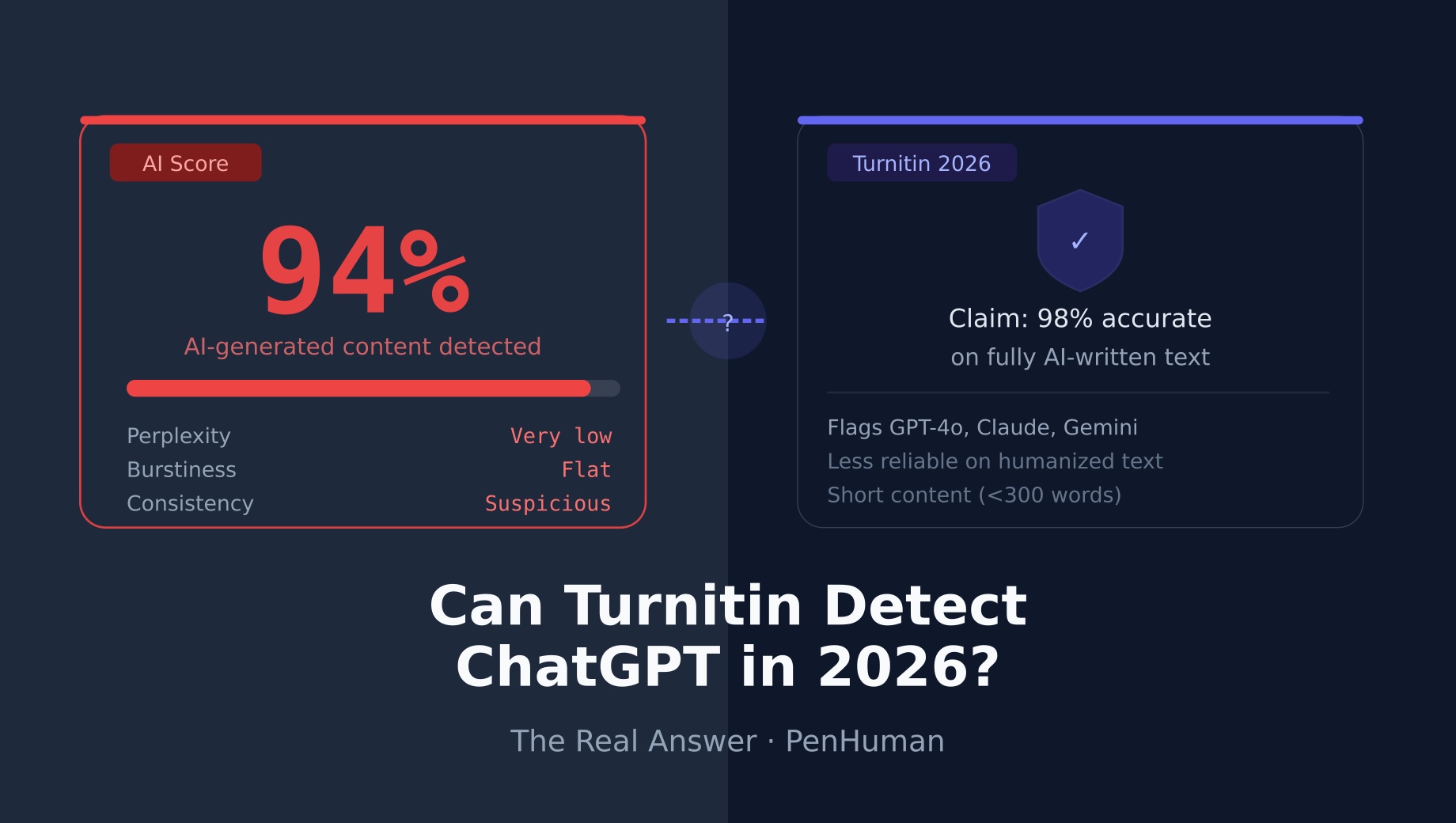
Short answer: Yes, Turnitin can detect ChatGPT-generated writing in 2026 with a claimed accuracy rate of around 98% for fully AI-written content. However, its false positive rate and limitations with mixed or humanized content make the picture more nuanced than a simple yes or no. Here's everything you need to know.
If you've used ChatGPT to help write an essay, a report, or any academic work, you've probably wondered: will Turnitin catch it? It's one of the most-searched questions among students in 2026 — and the answer matters a lot.
This guide breaks down exactly how Turnitin's AI detection system works, how accurate it really is, what it flags and misses, and what you can do if you're a legitimate writer who gets caught in a false positive.
Short Answer: Yes — Here's How Turnitin Detects ChatGPT
Turnitin launched its AI detection capability in April 2023 and has continued improving it through 2026. According to Turnitin's official documentation, the system is trained specifically to identify writing patterns produced by large language models, including ChatGPT (GPT-4o and earlier), Claude, and Gemini.
The tool scores each submission on a scale from 0–100%, indicating what percentage of the text it believes was AI-generated. Instructors and institutions set their own thresholds for what triggers a review — there is no single universal "pass/fail" line.
Turnitin does not automatically accuse anyone. It flags content for instructor review, and the final judgment is always human.
How Turnitin's AI Detection System Actually Works in 2026
Understanding the mechanics helps you understand both the tool's power and its limitations.
Perplexity Analysis
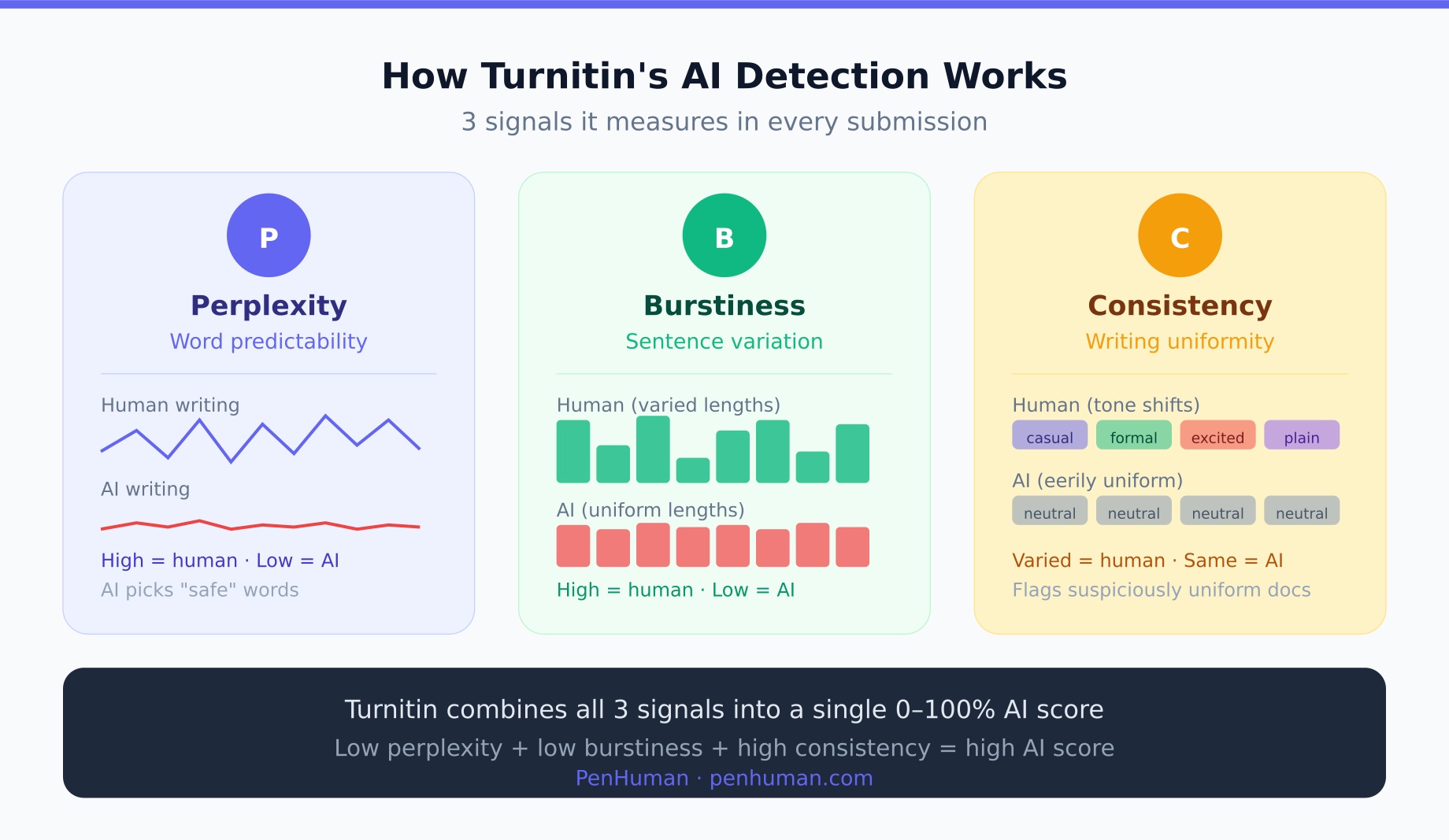
"Perplexity" in this context is a linguistic measure of how unpredictable the text is. Human writing tends to be higher in perplexity — people make unexpected word choices, break grammar rules casually, and take creative leaps that are statistically unlikely.
AI language models, by contrast, are optimized to choose the most probable next word. This makes AI-generated text statistically low-perplexity — it's predictable, smooth, and flows in ways that are common in training data.
Turnitin analyzes perplexity patterns across sentences and paragraphs. A consistently low perplexity score across a long passage is a strong signal of AI authorship.
Burstiness Scoring
Burstiness refers to the variation in sentence complexity and length throughout a piece. Human writing is naturally "bursty" — we write short, sharp sentences, then sprawling complex ones. We slow down to explain something, then pick up pace. We get excited and fragment a thought. Or write one that runs on for longer than it perhaps should.
AI text tends to have unnaturally low burstiness: sentence lengths hover in a comfortable middle range, complexity stays consistent, and the rhythm rarely varies dramatically.
Turnitin scores burstiness and combines it with perplexity. Low scores on both is a reliable signal of AI generation.
Writing Pattern Consistency
Beyond perplexity and burstiness, Turnitin's system looks at consistency across the whole document. Human writers are inconsistent in subtle ways — a particular word choice early in an essay that doesn't appear again, a sudden tonal shift in the third paragraph, a slightly different sentence construction style in the conclusion.
AI writing is eerily consistent throughout. The same vocabulary range, the same structural approach, the same tone from start to finish. Turnitin flags documents where the writing is suspiciously uniform at a level humans rarely achieve.
How Accurate Is Turnitin at Detecting ChatGPT?
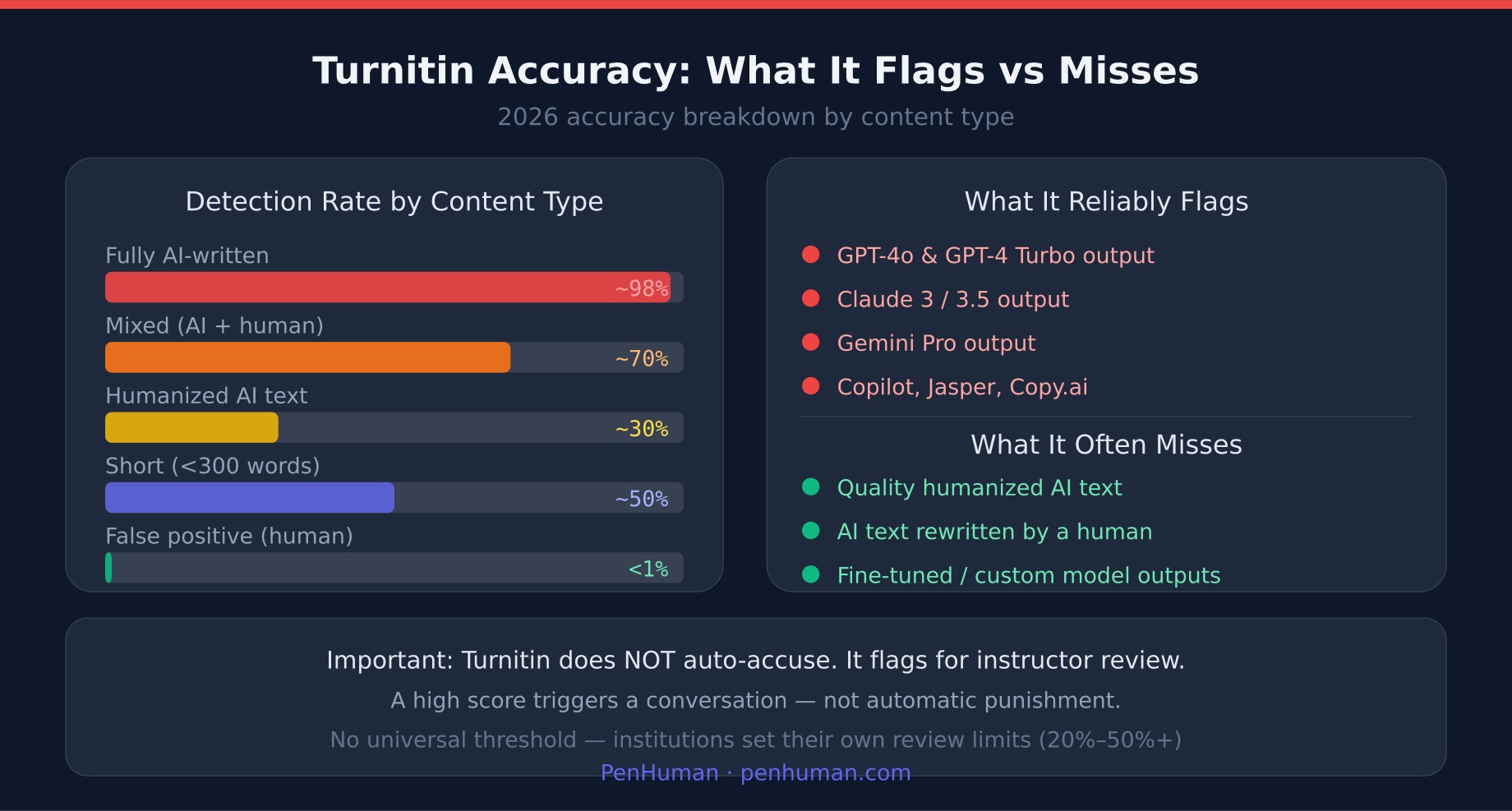
Turnitin claims roughly 98% accuracy for fully AI-generated content, with a less than 1% false positive rate on purely human-written text. These are significant numbers — and they're broadly supported by independent testing.
However, accuracy drops in specific scenarios:
Mixed content (some AI, some human) is harder to detect reliably. If a student writes an essay themselves but uses ChatGPT to draft a couple of paragraphs, those paragraphs may be flagged, but the overall AI percentage score will be lower and potentially below an instructor's review threshold.
Humanized content — text that has been run through an AI humanizer — significantly reduces detection accuracy. Tools like PenHuman work precisely because they alter the perplexity, burstiness, and pattern consistency that Turnitin relies on.
Short passages (under 300 words) are less reliably assessed. Turnitin itself notes that short-form submissions produce less confident results.
Non-native English speakers face an important caveat: some patterns in non-native academic writing (more formal vocabulary, consistent structure, careful grammar) can superficially resemble AI patterns. This is the core of the false positive concern that has drawn criticism from educators.
What Types of AI Content Does Turnitin Flag?
Turnitin's detection is trained on output from the major LLMs. As of 2026, it reliably flags:
- GPT-4o and GPT-4 Turbo output — ChatGPT's most common versions
- Claude 3 and Claude 3.5 output — Anthropic's models
- Gemini Pro output — Google's AI
- Copilot-generated text — Microsoft's AI, which runs on GPT-4
- Jasper, Copy.ai, and similar tools — which use the same underlying models
It is less reliable at detecting:
- Older GPT-3 text (less common now but still used)
- Highly customized model outputs with fine-tuning
- AI text that has been substantially rewritten by a human
- AI text processed through a quality humanizer
What to Do If Your Legitimate Writing Gets Flagged
False positives happen. If your genuine human-written work gets flagged by Turnitin, here's how to handle it.
Don't panic. Turnitin explicitly states its tool is not definitive evidence of AI use. It is a signal for instructor review, not a verdict. Most institutions have formal processes for this.
Document your writing process. Keep drafts, notes, outlines, and research materials. If you can show a progression of versions, that's compelling evidence of human authorship.
Request a conversation with your instructor. AI detection false positives are well-documented and most instructors are aware of them. Come to the conversation with your drafts and a clear explanation of how you wrote the piece.
Understand what triggered it. Highly polished academic writing — especially in a second language — can score similarly to AI text. If your writing style is naturally formal and structured, it's worth discussing this context with your instructor.
Know your institution's policy. Many universities now specify that a Turnitin AI flag alone is not sufficient basis for an academic misconduct proceeding. Know your rights and the exact policy language.
How Humanizing AI Text Affects Turnitin Detection
If you've used AI to draft content and want to reduce the risk of detection, humanizing is the most effective approach available in 2026.
Tools like PenHuman's AI humanizer work by systematically modifying the patterns Turnitin detects — increasing perplexity, introducing burstiness, and varying writing consistency in ways that mirror natural human writing.
When done well, humanized content typically scores well below the AI detection threshold on Turnitin. The key word is well — a low-quality humanizer that simply swaps synonyms won't be effective. Genuine structural rewriting, combined with manual additions of personal perspective or original examples, produces the most consistently clean results.
For a full walkthrough of how to humanize AI text effectively, see our guide: How to Humanize AI Text for Free. For guidance specific to students and academic contexts, check out our AI humanizer for students guide.
It's also worth noting the ethical dimension: using AI to write academic work and then humanizing it to avoid detection is a different matter from humanizing AI-assisted drafts that you've substantially edited and built upon. Understanding your institution's specific AI use policy — many now distinguish between prohibited AI use and permitted AI assistance — is essential before submitting anything.
Frequently Asked Questions
Can Turnitin detect ChatGPT with 100% accuracy?
No. Turnitin claims approximately 98% accuracy on fully AI-generated content, but this drops for mixed, short-form, or humanized content. False positives also occur, particularly with non-native English writing styles. Turnitin itself advises that its scores should be used as one input for instructor review, not as a definitive determination.
Does Turnitin flag ChatGPT specifically, or all AI writing?
Turnitin is trained on a broad range of LLM outputs, not just ChatGPT. It flags patterns common across GPT models, Claude, Gemini, and other major tools. It doesn't typically identify which AI was used — just that AI patterns are present.
What percentage on Turnitin is considered AI-written?
There is no universal threshold. Different institutions set their own review thresholds — some might investigate anything above 20%, others above 50%. Check your institution's specific policy. A high AI score triggers review, not automatic punishment.
Can a VPN or different account fool Turnitin's AI detection?
No. Turnitin's AI detection analyzes the content of the writing itself, not metadata, IP addresses, or account information. A VPN has zero effect on AI detection scores.
Is it possible to beat Turnitin AI detection completely?
Substantially rewritten content processed through a quality humanizer, combined with original human additions, reliably scores low on Turnitin's AI detection in current testing. However, detection technology continues to improve, and there are no permanent guarantees. The most reliable approach remains writing your own content with AI as a research and brainstorming aid rather than a ghostwriter.
What happens if Turnitin flags my work as AI-generated?
The flag goes to your instructor, who reviews it in context alongside your other work. Most institutions require a formal process before any academic misconduct finding. You have the opportunity to provide evidence of your writing process. A Turnitin AI flag alone is generally not sufficient for a misconduct ruling.
Concerned about your AI detection scores? Try PenHuman's AI humanizer to transform your content before submission. Already humanizing but want to understand the student perspective more deeply? Read our complete AI humanizer guide for students.