Edit a Project Update Around Decisions, Owners and Dates
Find the decision in a project update
You coordinate walking tours for a fictional museum. A sample visitor map has arrived, but you still need a color proof to check the bridge symbol. Can the guides rehearse with the sample? If you send the project update in the order things happened, the person who needs to answer may stop reading before reaching the question. Put the decision first. Then give the reader just enough evidence to understand what using the sample would mean for the rehearsal.
The example below follows a fictional map from receipt to a rehearsal decision. Read the original note as if you were Leon, the person asked to decide. Underline the first sentence that tells you what to do. Mark the point where you have enough information to answer. Look at the material between those points. If it explains a constraint on the choice, it earns its place. If it merely announces that a discussion took place, try taking it out.
Read the long note before cutting it
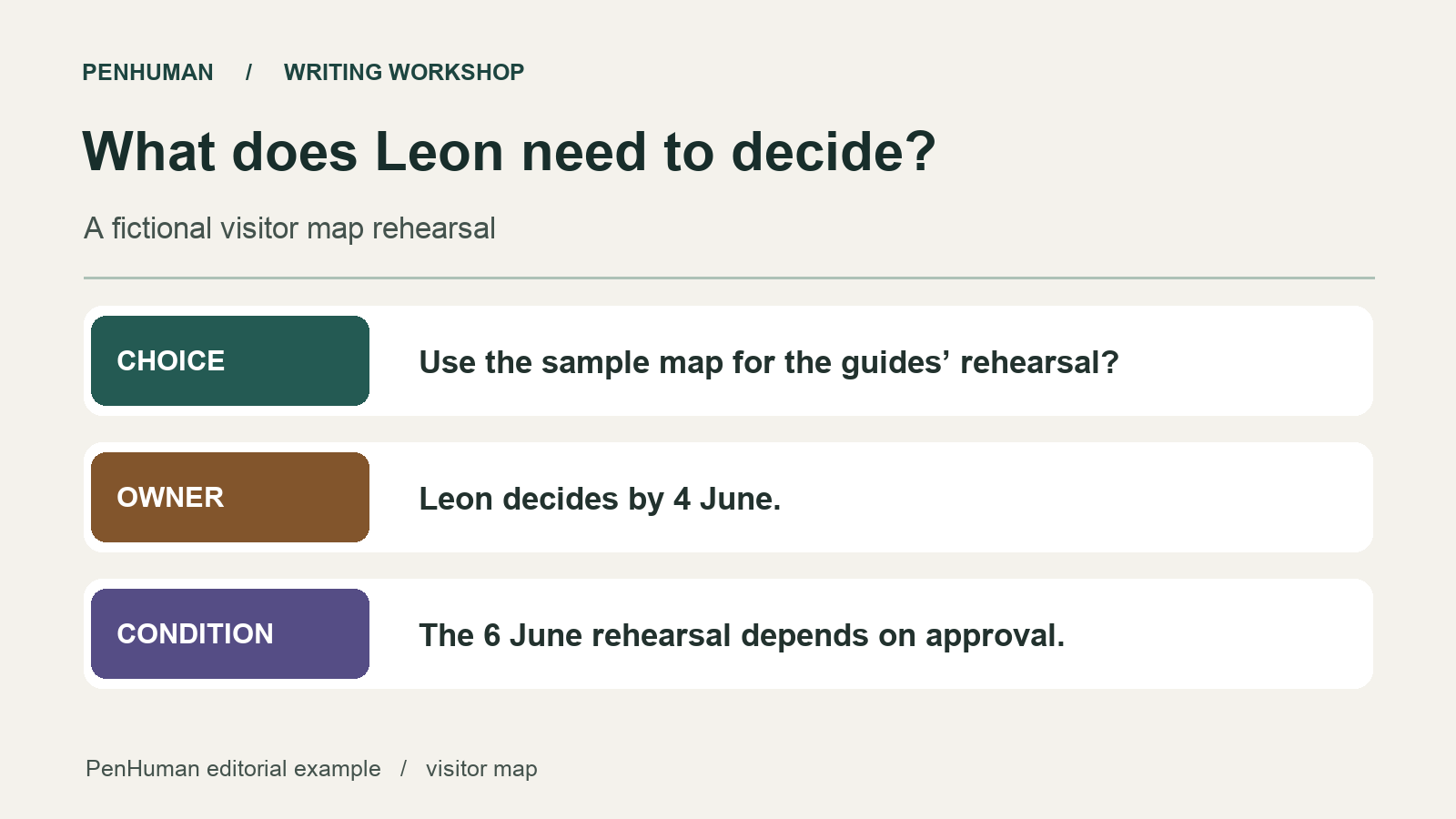
Read the fictional source note below and keep it beside the edit for comparison. "I wanted to bring everyone up to date on where things stand with the visitor map and the rehearsal we talked about. The sample map arrived on 2 June. Isha checked the English place names against the route list and they match. She still needs the printer's color proof to check the bridge symbol. The printer hasn't given us a delivery date. There was some discussion about using the sample for the guides' rehearsal. Leon needs to decide by 4 June whether to use it. We're holding 6 June for the rehearsal if Leon approves. Isha will follow up with the printer on 5 June."
Put the note aside and answer from memory. What happens on 5 June? If your answer is that the proof arrives, read the last sentence again. The writer has promised a follow-up with the printer. The printer has given no delivery date. That difference is more important than saving a line of text. The next person to use the note might book a review slot around an arrival that nobody promised. Underline the action attached to each date while the original wording is still in front of you.
List the facts the edit has to carry
Give each fact a short label on a scrap of paper. Beside it, copy the wording that supports it. For the map, separate receipt, check completed, check outstanding, decision, tentative event and follow-up. This makes it harder to let a statement about part of the work become a claim about the whole map. A match between English place names and the route list says nothing about the bridge symbol. Keep the scope of the completed check even if you remove most of the surrounding explanation.
Check who has authority to take each action. Isha checked the names and owns the printer follow-up. Leon decides about using the sample for rehearsal. Neither person has agreed to a print run or approved publication of the finished map. Imagine forwarding the note to a print coordinator who missed the meeting. Which sentence could make that person think it was time to print? Narrow its verb or add the missing object until a reader can distinguish permission to rehearse from permission to print.
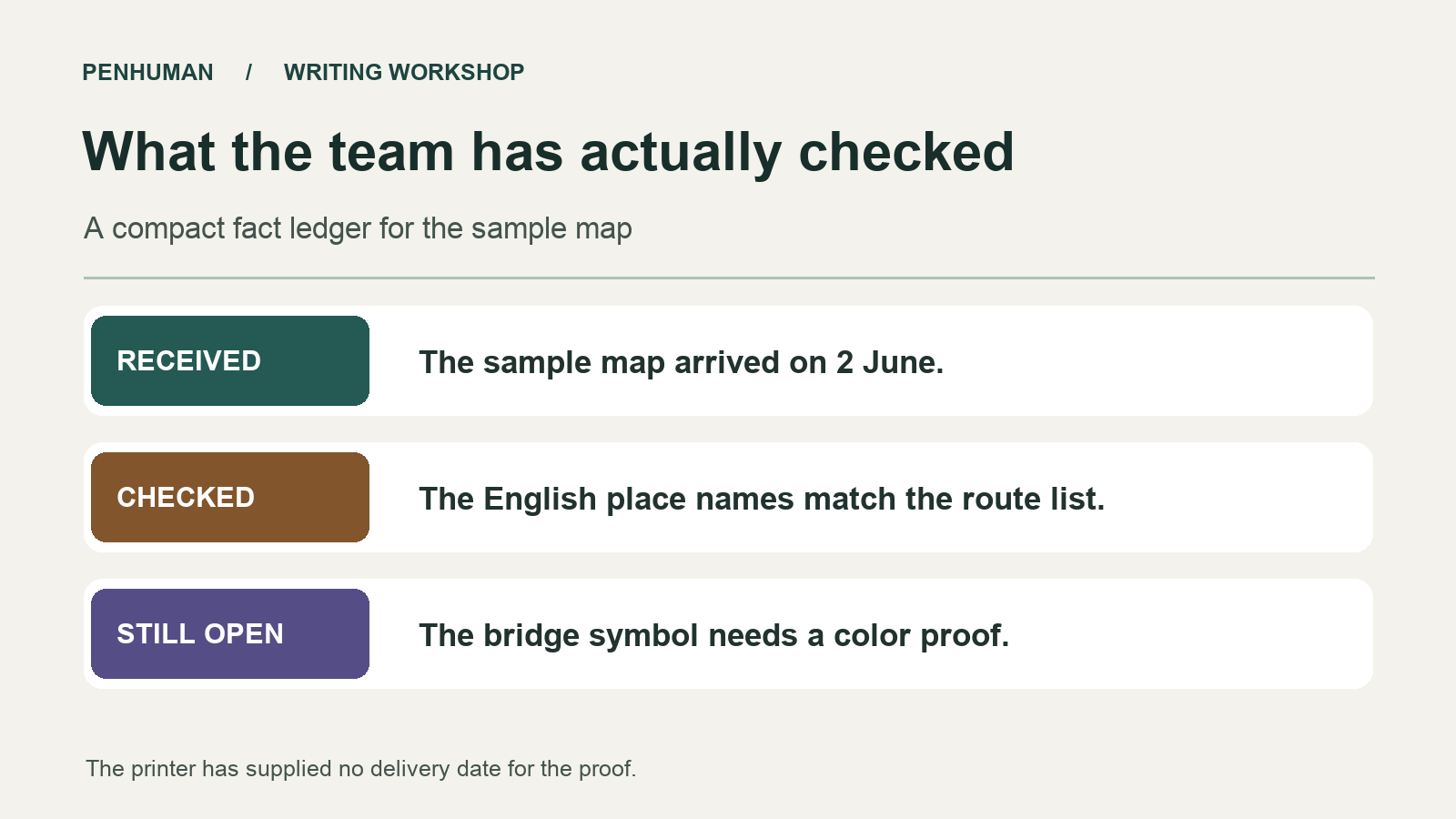
- 2 June — sample received. English place names match the route list.
- Still open — Isha needs the printer’s color proof to check the bridge symbol. Delivery date unknown.
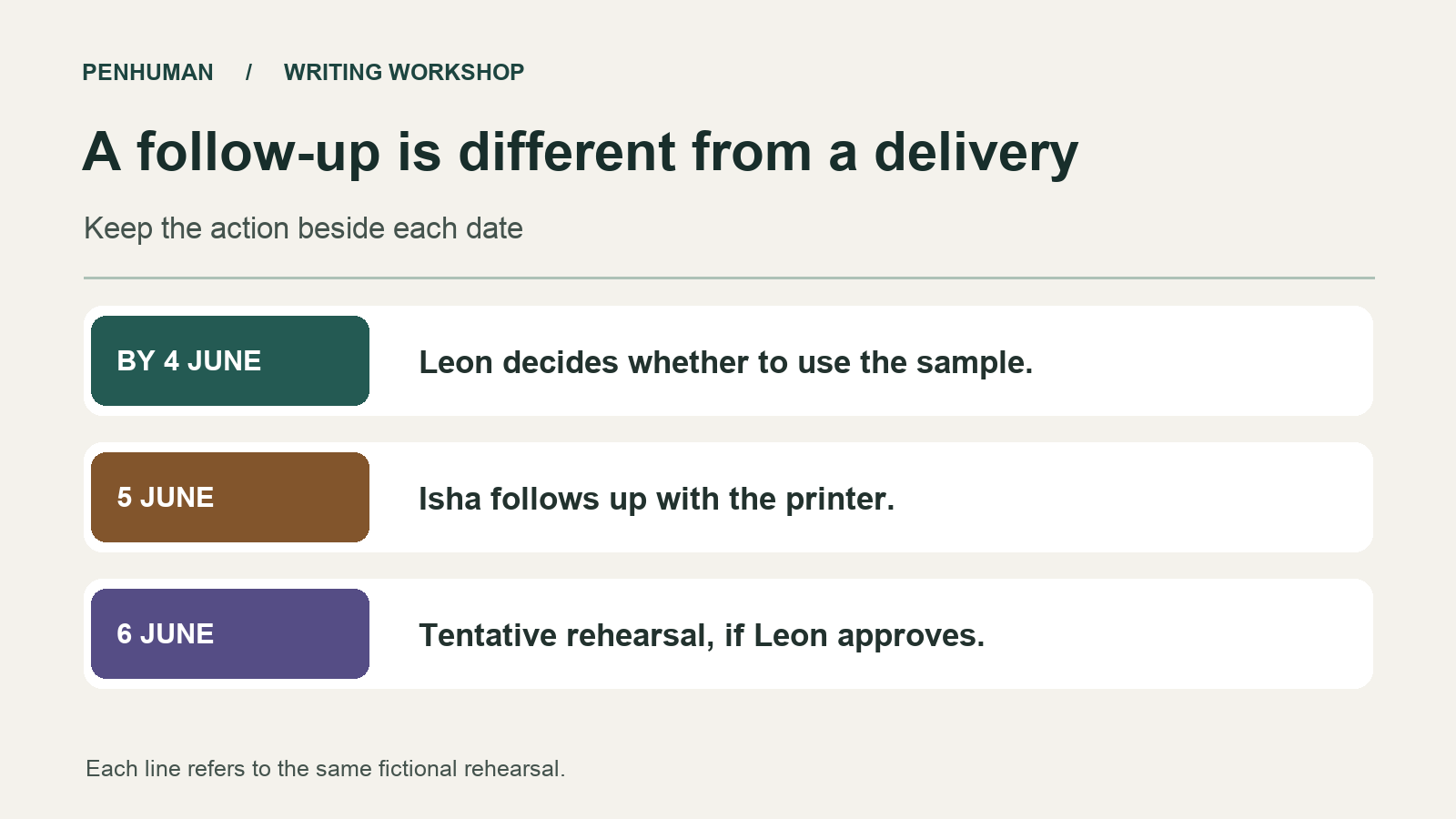
- 4 June — Leon’s deadline to decide whether the guides can rehearse with the sample.
- 5 June — Isha follows up with the printer.
- 6 June — tentative rehearsal, conditional on Leon approving the sample for that purpose.
Write the version the decision owner can use
Address the request directly to Leon. The passage in quotation marks is the complete edited message. "Leon, decide by 4 June whether the guides can rehearse with the sample visitor map. The rehearsal is penciled in for 6 June if you approve. The sample arrived on 2 June. Isha checked the English place names against the route list. They match. The bridge symbol still needs a color proof. The printer hasn't supplied a delivery date. Isha will follow up on 5 June."
Read the first line the way it might appear in a message preview, on its own. Leon sees his name, the choice, the object of that choice and the date he needs to answer. The next line tells him what approving the request would allow. If the message will appear on a board where several people read it later, replace the direct address with Leon’s name as the subject and change the pronoun in the following sentence to match. The route list and unresolved symbol stay in either version.
Give every date a verb
List the dates on separate lines. For each one, say aloud what happens on that date. Received on 2 June describes a past event. Decide by 4 June sets a deadline for an answer. Follow up on 5 June schedules an action Isha controls. Hold 6 June if approved describes a provisional booking. In a very short summary it is tempting to keep the dates and drop the small words connecting them. Try that on the rehearsal line and notice how quickly the tentative booking begins to sound firm.
Suppose the printer replies the following week. The printer now expects the proof to leave the workshop on Tuesday. In the next update, describe that as the printer’s expected dispatch. A reader arranging a review needs to know when the proof will arrive, which is a different event. If nobody has provided an arrival estimate, leave that question open. Before replacing the earlier note, keep its date or preserve the original in the project history so readers can tell when the new information became available.
Use a count to check space after the edit
Copy the original note into the PenHuman Word Counter, leaving out the surrounding commentary. For the text between the quotation marks, it shows 105 words and 571 characters, including spaces. Replace that with the edited note, again omitting the quotation marks. The edited version has 66 words and 363 characters. The apostrophes and single spaces are part of these samples. Copying the introduction or adding a line break changes the character total. If the receiving form imposes a limit, check the exact text in that form before sending.
When space is tight, decide what Leon needs to learn from the preview alone. If he can open the full note, the request and decision deadline belong in the visible part. Put the remaining evidence in the linked record and check that the people deciding actually have access. If the message has to stand alone, give the open check and uncertain date room even when that means a longer note. The guide to word and character limits explains how to choose a count when a form specifies its own unit.
Test the handoff with the people who will read it
Ask a colleague to read the edited note without the original. What would they enter on the team calendar? A firm delivery appointment on 5 June signals a problem. So does a confirmed rehearsal on 6 June. Ask them what Leon needs to decide and what Isha will do while the proof is missing. Their answers point to the line that needs repair. Atlassian’s weekly updates play recommends recording what needs input and what happens next. Here those fields are the rehearsal decision and the printer follow-up.
Google’s guidance on active voice describes a simple way to show who performs an action. Apply it to the lines where responsibility matters. For the print follow-up, start with Isha’s name and use the verb that describes her next step. For the rehearsal decision, use Leon’s name and the choice he faces. Now look at the sentences that leave the actor unnamed. If the source gives no arrival date, naming a person in the sentence cannot create one. Leave the timing open and name only the next action someone has actually agreed to take.
- Can the recipient answer the opening request without guessing which decision is theirs?
- Does the completed check retain its original scope?
- Does each date still describe the same event as the source?
- Is it clear what depends on approval and what remains unknown?
- Can a later reader find the evidence and the next follow-up?
Frequently Asked Questions
What if the source note gives no decision owner?
Tell the reader that the decision still needs an owner. If a coordinator has agreed to find one, name that person as the contact for routing the request and describe that limited action. A coordinator who passes a note along has a different responsibility from the person authorized to approve it. In the museum example, Isha’s knowledge of the map and contact with the printer give readers a reason to ask her about the proof. Those facts alone would give her no authority to approve the rehearsal.
How do I handle a deadline that has already passed?
Keep the original deadline visible. Check the current decision record before sending another note. If 4 June has passed and there is no recorded answer from Leon, describe the decision as outstanding as of the time you checked. Ask for a revised answer date or a recorded decision, depending on what the team needs. Do not assume that silence authorized the rehearsal. Once a reply arrives, attribute it and keep its scope, especially if the approval covers only a rehearsal with the sample map.
Which details belong in a longer project record?
Keep the source material a later reader might need to reconstruct the decision. For the map, that could include the version of the sample, the route list used for the name check, the request for a color proof and Leon’s eventual answer. Include those items when they actually exist and the intended readers can access them. The brief message needs enough context to act today. A later reviewer may need the original note and a dated record of what changed after the printer replied.