Give Clear Editing Feedback the Writer Can Act On
Agree on the purpose of your editing feedback
Useful editing feedback helps a writer make a decision. A comment such as "Make this more human" expresses an impression but leaves the writer to guess whether the problem is the opening, an unfamiliar term, a missing fact or a tone preference. This worksheet turns that impression into a located observation, a reader question and a revision request. It uses an original fictional community notice, not a customer story or raw PenHuman output. Keep the source brief beside the draft so that a more fluent revision does not quietly change what the notice promises.
The University of Wisconsin–Madison Writing Center recommends setting goals for feedback and asking specific questions about the kind of help needed. Apply this by agreeing on the reader, purpose and review scope first. For this exercise, the reader is someone considering a contribution to a community Memory Board. The writer wants help making the invitation clear while preserving the supplied facts. Reviewing those choices comes before detailed punctuation. If the writer instead requests a final proofreading pass, make that narrower scope explicit rather than treating every review as an invitation to redesign the document.
Read a small source record before judging the wording
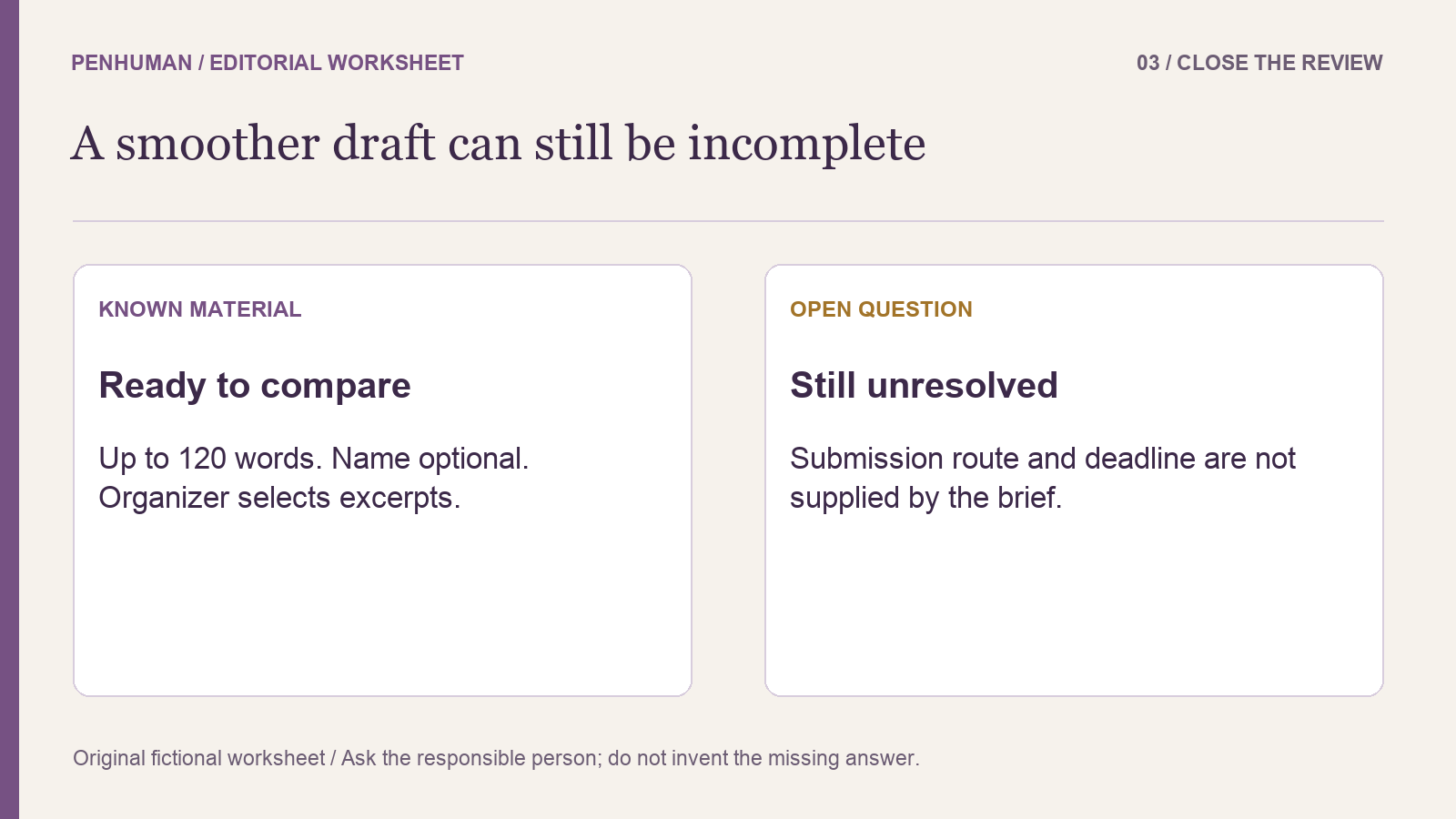
The fictional source brief says that the Memory Board accepts up to 120 words about a local place. A contributor’s name is optional. The organizer selects excerpts for the board, so the brief does not promise that every contribution will appear. It gives no submission address or deadline. These fictional facts define the exercise; they are not instructions for a real event. Record the known facts and open questions in separate columns. The missing address is a question for the organizer, not a detail the reviewer can safely complete from common practice.
Here is the draft to review: "We are excited to offer an opportunity for you to share. Send your memory of a local place. They will check it and everything will appear on the board. Include your name and send it soon." Read it once before adding comments. The invitation omits the length limit, leaves "they" unexplained, turns selection into a promise of publication and makes an optional name sound required. "Soon" also suggests timing without providing an actionable deadline. A friendly tone does not resolve those problems, and adding an invented email address would create another one.
Replace a verdict with a located comment
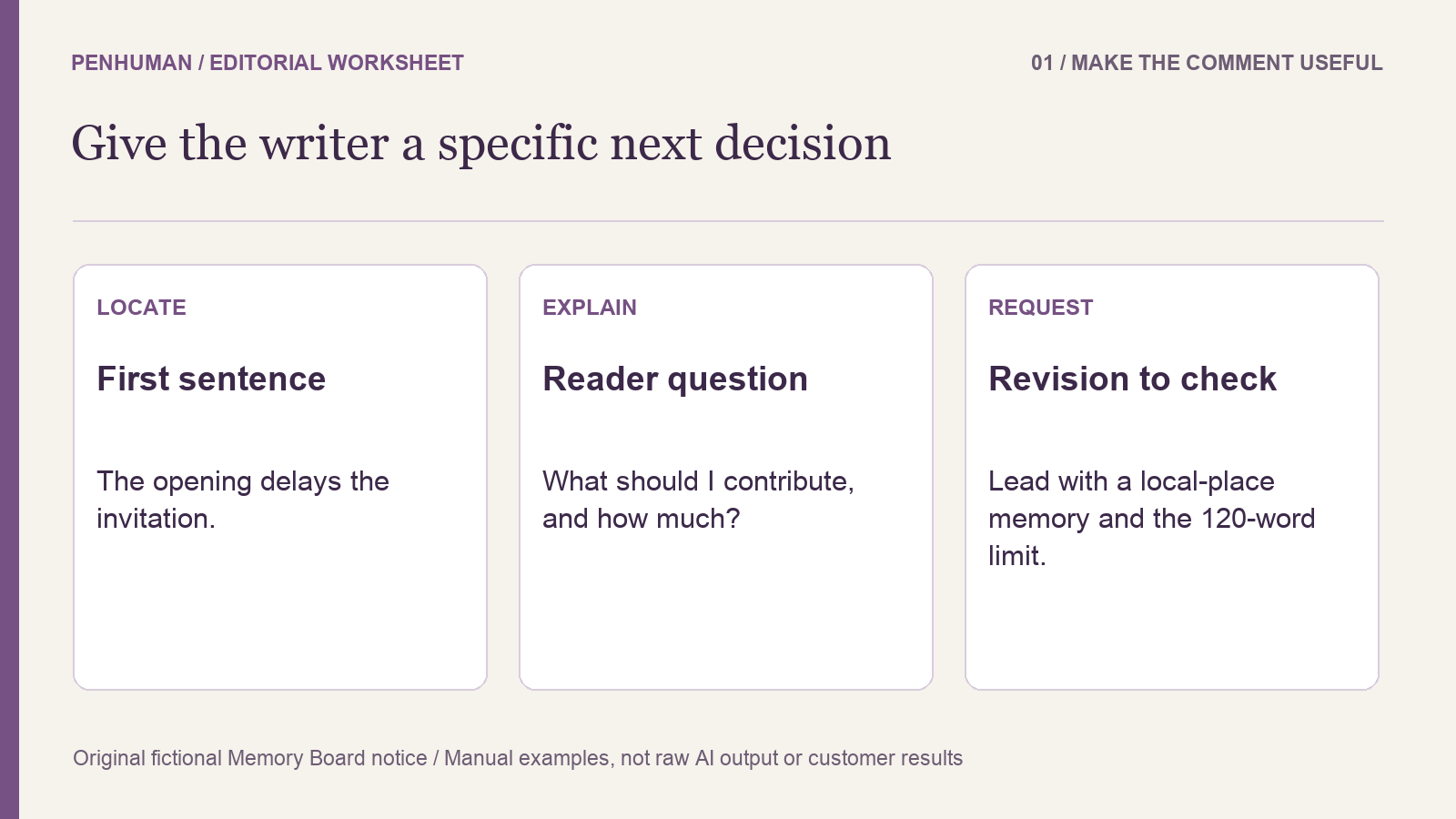
Use three parts when drafting editing feedback: identify the passage or location, describe the reading problem, then request a specific revision or answer. For the opening, write: "In the first sentence, I still cannot tell what to contribute. Could you lead with the local-place memory and the 120-word limit?" That comment points to an observable gap and gives the writer a clear next step. It does not insist on a complete replacement paragraph or claim that every reader will react identically. The writer can respond to the issue while retaining control of the final wording.
Compare that with "This sounds robotic." The shorter comment could refer to almost anything in the passage. If that is your first reaction, identify what produced it before sending it. Perhaps the abstract opening delays the concrete invitation; perhaps repeated promotional phrases conflict with the requested tone. Name the feature you can point to in the draft. In the Memory Board example, moving the task and limit into the opening is a more testable request than making the notice sound more authentic. Do not add a fictional participant, personal anecdote or testimonial to manufacture that impression.
Separate corrections, questions and preferences
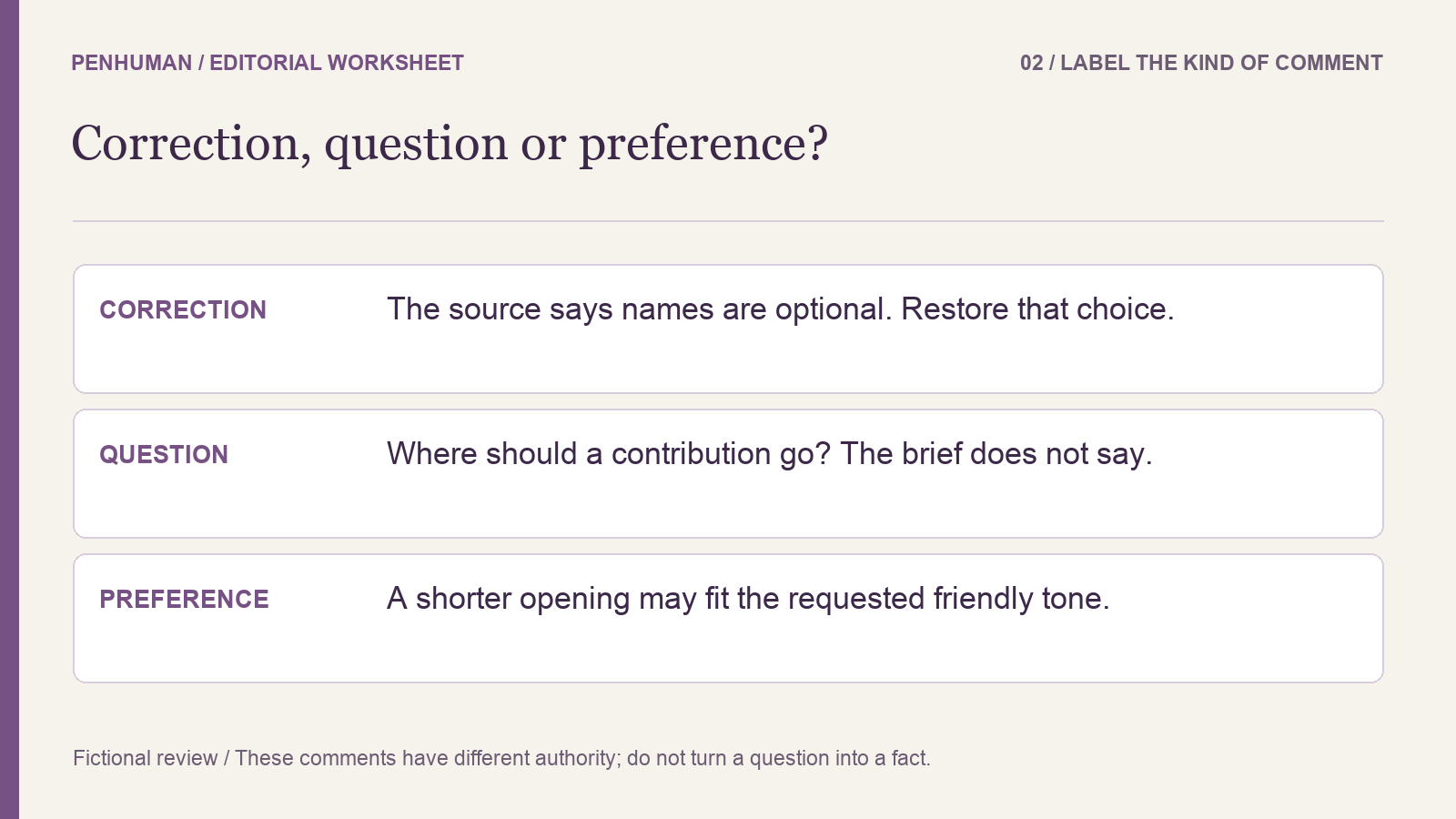
Label the kind of comment as well as its location. A correction has source support: "The brief says names are optional, but Include your name sounds required. Please restore the choice." A question identifies an evidence gap: "Where should a contributor send the memory? The brief does not specify an address." A preference proposes an option: "A shorter opening may fit the friendly tone you requested." Those comments have different authority. Treating all three as mandatory corrections can make the writer invent facts or mistake one reviewer’s taste for an established requirement.
Keep unanswered questions visible in the revision record. For "send it soon", ask whether the organizer has a deadline and, if so, which exact wording is approved. Do not replace it with Friday merely because a date would be clearer. Likewise, the source supports selecting excerpts but says nothing about a notification process or selection criteria. The reviewer can ask for those details if the task needs them. The next draft may improve the known wording while still carrying a private question that must be answered before the notice is ready to publish.
Prioritize comments and explain what already works
UMGC’s writing guidance recommends reading the whole draft, giving specific focused comments, explaining why changes are needed and recognizing effective parts. Use that approach to prioritize this review. Start with the unsupported publication promise and the optional-name conflict, then address the missing submission route and length limit. Minor wording preferences can follow. A reviewer does not need to mark every possible sentence change to provide useful help. The purpose is to make the important decisions visible, not to demonstrate how much text the reviewer could rewrite in a different voice.
Positive feedback is more useful when it identifies something to preserve. Instead of "Nice work", write: "The phrase local place makes the subject concrete; keep that focus when shortening the opening." This tells the writer which wording supports the reader’s task. Avoid praise that implies a tested response or audience result you do not have. In our fictional notice, nobody has submitted a contribution or measured engagement. A reviewer can explain why a phrase fits the stated brief without predicting that it will produce more entries or claiming that a real community preferred it.
Turn comments into revision decisions
The writer can give each comment a decision: accept, ask for clarification or defer with a reason. Accept the name correction because the source establishes optionality. Ask the organizer for the submission route because the reviewer cannot supply it. Consider the shorter opening as an editorial choice, then read it against the agreed purpose. Keep a short record with the comment, decision and resulting change. This is a manual review worksheet, not a claim that PenHuman automatically imports comments, resolves disagreements or manages a collaborative approval process for the writer.
A manual revision of the supplied material is: "Share up to 120 words about a local place. Your name is optional. The organizer selects excerpts for the Memory Board." This candidate restores the length limit, preserves the naming choice and removes the guarantee that everything will appear. It is still not a complete publishable notice because the source has not supplied a submission route or deadline. Leave those questions in the review record. A cleaner sentence and a finished communication are different outcomes; do not mark the task complete merely because the candidate reads more fluently.
Check the revised draft against the brief
After revising, compare the revised draft with the source again. Check the number, optional wording, responsible person and selection condition; then confirm that the requested task is visible. The numbers, negations and conditions worksheet offers a related source-comparison method. Read the complete notice aloud to catch a confusing transition, while remembering that a fluent reading cannot supply missing facts. If reviewers disagree, identify whether the disagreement involves source evidence, the agreed purpose or a preference. Return an unresolved factual question to the person who can answer it instead of settling it through a more confident rewrite.
For an eligible longer draft, the AI Humanizer can provide a candidate for manual comparison. Basic accepts complete drafts of 80–600 words within the available allowance, with 3,900 included Humanizer characters and no scheduled reset. The short notice and comments here are manual exercises; do not pad them to meet a minimum. The Word Counter can help check a documented word limit, but it cannot decide whether the feedback or revised facts are correct. Retain the original, candidate and editorial changes separately. Neither a rewrite nor a reviewer’s confidence replaces the source check.
Frequently Asked Questions
What should I write instead of make this more human?
Identify the feature behind your reaction. If the opening delays the task, identify that sentence and ask for the action earlier. If the problem is an unfamiliar term, name it and describe what the intended reader needs explained. In the fictional Memory Board notice, a useful request is to lead with a memory of a local place and the 120-word limit. That gives the writer a specific change to make and check. It does not require an invented personal story, a fake testimonial or a promise that different wording will persuade everyone.
Should a reviewer rewrite the whole paragraph?
A short example can clarify a comment, but keep it labeled as a suggestion and explain the issue it addresses. In this exercise, the manual replacement shows how to restore the limit, optional name and selection condition. It does not resolve the missing submission route. Replacing the whole paragraph without that explanation could hide which changes are necessary and which are stylistic choices. Agree on the scope of help with the writer, keep the source record and let the writer ask about or adapt the proposed wording before accepting it.
Can an AI rewrite decide which feedback to accept?
Treat a rewrite as material to review, not a decision about whose comment is correct. A source-backed correction, an unanswered question and a tone preference need different decisions. The fictional example requires the writer to preserve optional names and selective publication while asking for a submission route. A candidate that invents an address has not answered that question responsibly. Check any changed wording with the brief, explain the chosen edits and leave unsupported details unresolved until evidence is available. The writer or authorized reviewer remains responsible for approving the final communication.