Edit Survey Questions Without Leading the Respondent
Start survey questions with the decision you need to make
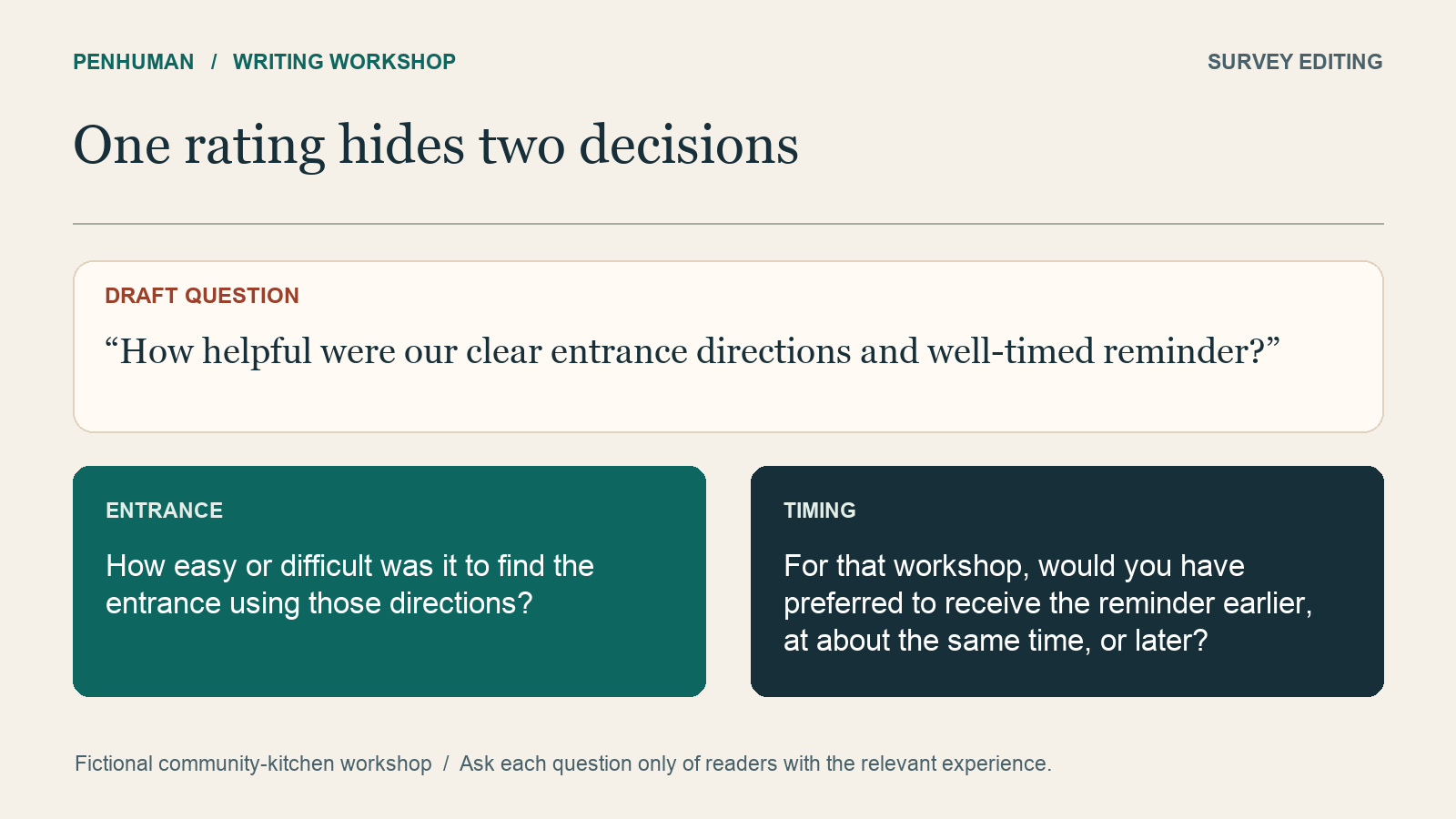
Imagine a community kitchen that emails participants before each cooking workshop. The organizer is deciding whether to rewrite the entrance directions or change when the reminder arrives. The first draft asks, "How helpful were our clear entrance directions and well-timed reminder?" The choices are very helpful, somewhat helpful and a little helpful. A participant who found the entrance easily but received the reminder too late has nowhere to record that combination. To edit survey questions like this, start with the decision each answer needs to support.
Write the intended decisions in the margin. The organizer can revise the directions and can change the reminder schedule. Each decision calls for different evidence. Use the most recent workshop as the reference throughout the form so a regular attendee knows which email to consider. Underline terms that reveal what the organizer already assumes, then circle the separate tasks the question asks people to judge. The point of the revision is to let a participant describe their experience in terms the organizer can act on.
Remove praise and assumptions before shortening the question
In the draft, clear praises the directions before a participant has rated them. Well-timed makes a judgment about delivery. Removing those adjectives is a useful first edit, but the opening still asks for a degree of helpfulness, and every choice assumes some help. Read the question aloud from the perspective of an attendee who got lost. Can that person describe a difficult experience in the available answers? The UK Government Analysis Function’s questionnaire guidance recommends balanced wording that leaves room for people to take a different view.
Reversing the praise would simply reverse the pressure. An organizer who calls the entrance confusing is still making a judgment. Refer to an observable task instead. The attendee tried to find the entrance using the email, so ask about the ease or difficulty of finding it. Leave the organizer’s explanation for the problem out of the question. A participant might have followed the written directions accurately and still found the outside sign difficult to see. A later optional comment gives the attendee room to explain what happened.
Give directions and timing separate answers
For people who used the directions, ask, "How easy or difficult was it to find the entrance using those directions?" For people who read the reminder before attending, ask, "For that workshop, would you have preferred to receive the reminder earlier, at about the same time, or later?" These questions have different jobs. The first concerns completing a task with the directions. The second asks for a timing preference. A participant can report an easy entrance and request an earlier reminder without averaging those opinions into a vague helpfulness score.
Pew Research Center’s guide to writing survey questions explains why a response is difficult to interpret when the question combines several concepts. Try a simple editing test on your own draft. Give each part of a sentence an opposite answer and check whether the form accepts both. If one answer box would erase a difference that matters to the decision, split the item. If two phrases name the same activity, keep a single question and remove the repetition. Here, the reason to split is that directions and timing lead to different changes.
Check who actually used what you are asking about
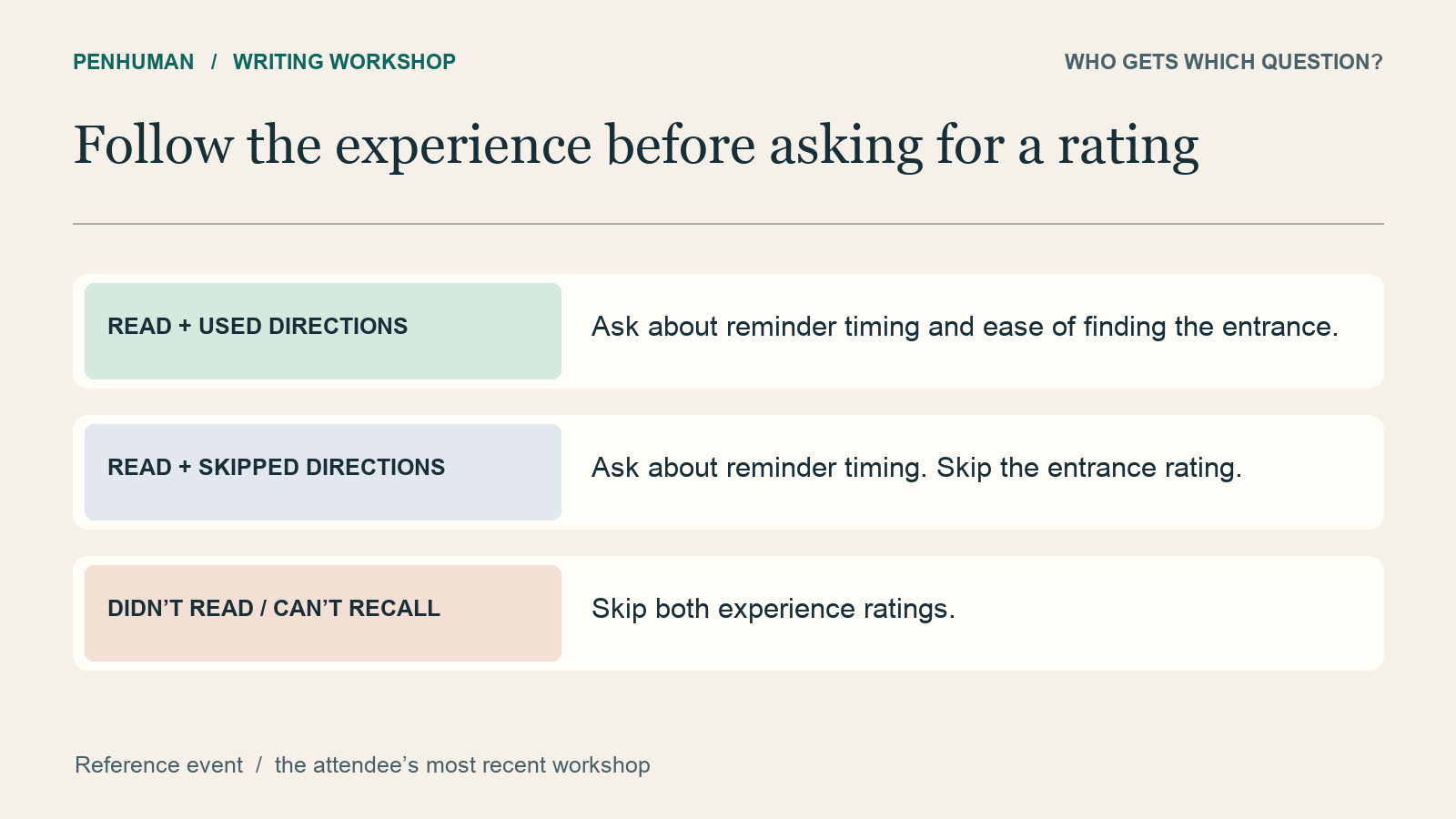
Begin this section with, "Did you read the reminder email before your most recent workshop?" Offer Yes, No and I don’t remember. Present the timing question to readers who answer Yes. Add another check for the directions question. Ask those readers, "Did you use the directions in that email to find the entrance?" Only those who answer Yes to that check receive the ease question. Someone who read the email for the time and already knew the way in still gets a place to report a timing preference.
Someone who missed the email entirely takes a different path. Skip both experience ratings for that person. If the organizer also wants to investigate delivery, add a separate question about where the participant checked for the message. A missed message alone does not establish whether it was sent or delivered. Keep an uncertain answer separate from a neutral rating. Someone who cannot remember reading an email has different information from someone who read it and has no preference about the delivery time.
- Read the email and used its directions — answer the timing and entrance questions.
- Read the email and skipped the directions — answer the timing question.
- Did not read the email or cannot recall reading it — skip both experience ratings.
Write response options that fit the task
For the entrance question, offer a balanced scale running from very easy through a middle choice to very difficult. Add a separate response for a person who cannot remember. For timing, the useful choices concern a change to the schedule. Earlier, about the same time and later describe that change. Give someone with no preference a way to say so, and let a reader who forgot the arrival time record that uncertainty. Read every choice as a response to the question immediately above it.
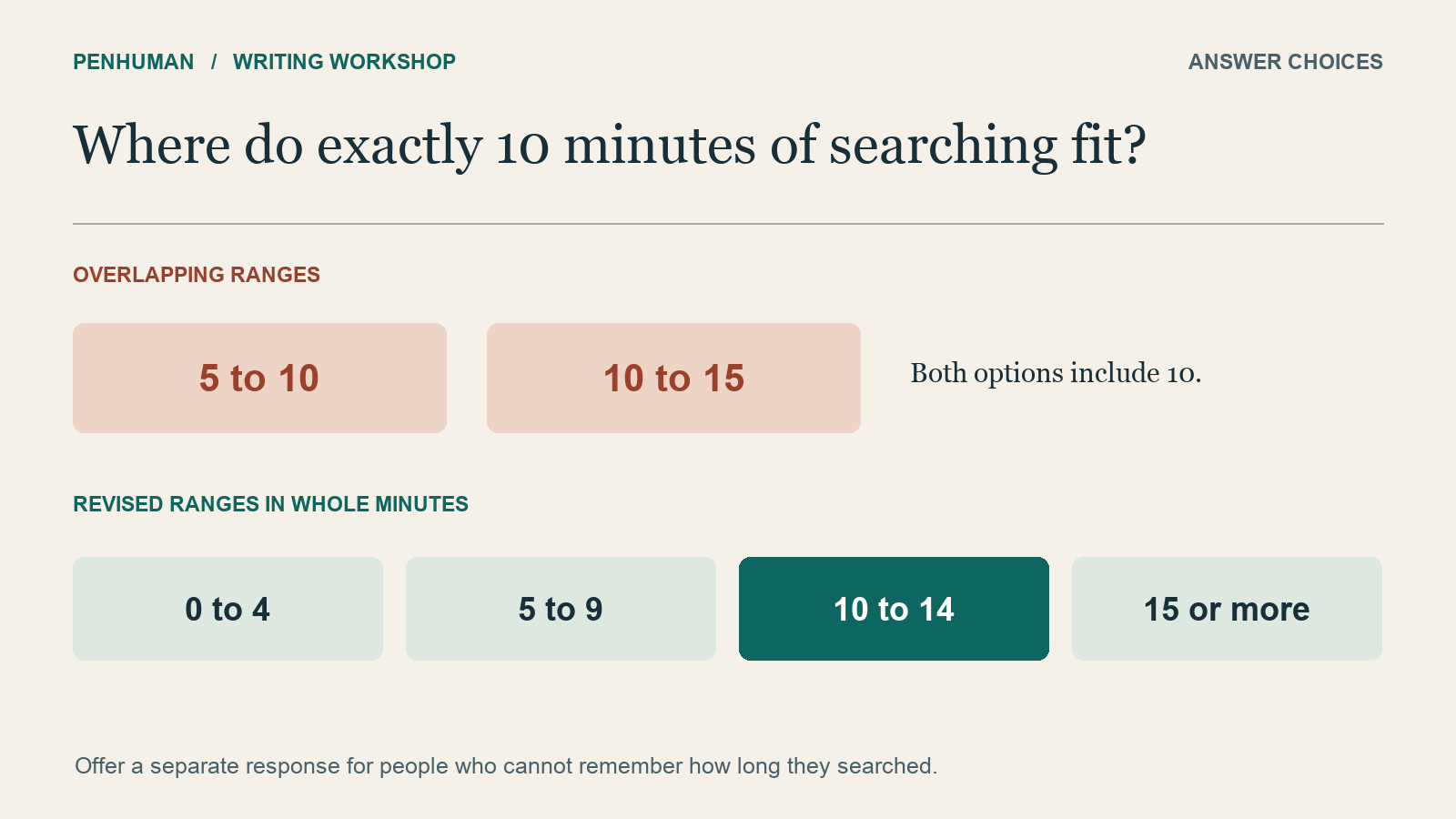
Numeric options need a boundary check too. Suppose the kitchen separately asks how many whole minutes people spent looking for the entrance after reaching the building. The ranges 5 to 10 and 10 to 15 both accept an answer of 10. Use 0 to 4, 5 to 9, 10 to 14 and 15 or more, with a separate choice for people who cannot remember. Retain the unit in the question. A number such as 5 means little once it is separated from what was counted.
Walk through the revised form before sending it
Test the paths using explicitly hypothetical answers. Start as someone who read the email, used the directions, found the entrance fairly easily and would have preferred an earlier reminder. Both questions appear and each has an appropriate answer. Then take the form as a returning attendee who read the email but walked in from memory. That person gets the timing question and skips the entrance rating. Finally, try someone who missed the email. The form should carry them onward without requiring an invented opinion about its contents.
Check the actual form after entering the text into the survey platform. Making an optional choice required or setting the wrong skip rule can undo a careful rewrite. Follow each path on a narrow screen and read long choices all the way to the end. If the form limits the space for a prompt, use the PenHuman Word Counter to check the final wording. Retain the reference to the most recent workshop and the words identifying the email. Removing either to save space changes what someone is answering.
Keep a record of the wording you tested
Before inviting participants, ask a colleague to paraphrase the entrance question. Listen for which workshop, which email and which entrance they have in mind. Ask how they chose between the middle rating and the option for an uncertain memory. If their interpretation differs from yours, examine that wording in the next edit. The task is to check whether the question communicates what you intended. This exercise supplies no survey responses about the kitchen and gives you no estimate of how common an experience is among its attendees.
Record the exact prompts, choices and skip rules with the date used. If the organizer later replaces the combined helpfulness item with separate entrance and timing questions, label that change when reviewing results across workshops. The earlier score cannot reliably explain how people felt about either part on its own. Save a copy of the previous form so a later reviewer can trace the difference. The guide to word and character limits can help when a shorter field forces another change to the wording.
- Could someone who disliked the experience answer plainly?
- Does each rating cover a single task or preference?
- Can someone skip a task they never tried?
- Do all reasonable options have a place, with clear boundaries?
- Does the saved questionnaire match the version participants saw?
Frequently Asked Questions
Is every question containing “and” asking two things?
Consider what the answer represents. If a participant might rate the two parts differently and the distinction would change your next action, give the parts separate answers. In the workshop example, an attendee can find the entrance easily and still want a different reminder time. One helpfulness rating hides that distinction. A phrase such as pots and pans, on the other hand, might simply name a category the kitchen already treats as a unit. Read the entire question before deciding whether to split it.
When should I offer an option for an uncertain memory?
Offer that option when a participant might have had the relevant experience but cannot reasonably recall the requested detail. Someone who remembers reading the reminder may have forgotten when it arrived. A person who remembers its timing but has no preference about a change has a different answer. Make the choices clear enough for a respondent to express either situation. If reading the email is itself uncertain, use the earlier screening question so the person can move on without rating a message they cannot recall.
Can I use an open comment instead of a rating?
Pick the format that fits the decision. If the kitchen needs to know which part of the route caused confusion, an optional prompt asking what, if anything, made the entrance hard to find gives people room to explain. A closed rating serves a different purpose when the organizer needs a consistent response to the same task across workshops. If both are included, specify which question is optional and which group sees it. Retain the original wording alongside any summary of the comments.