Read a Draft Aloud to Find and Edit Awkward Sentences
Read a draft aloud with a question in mind
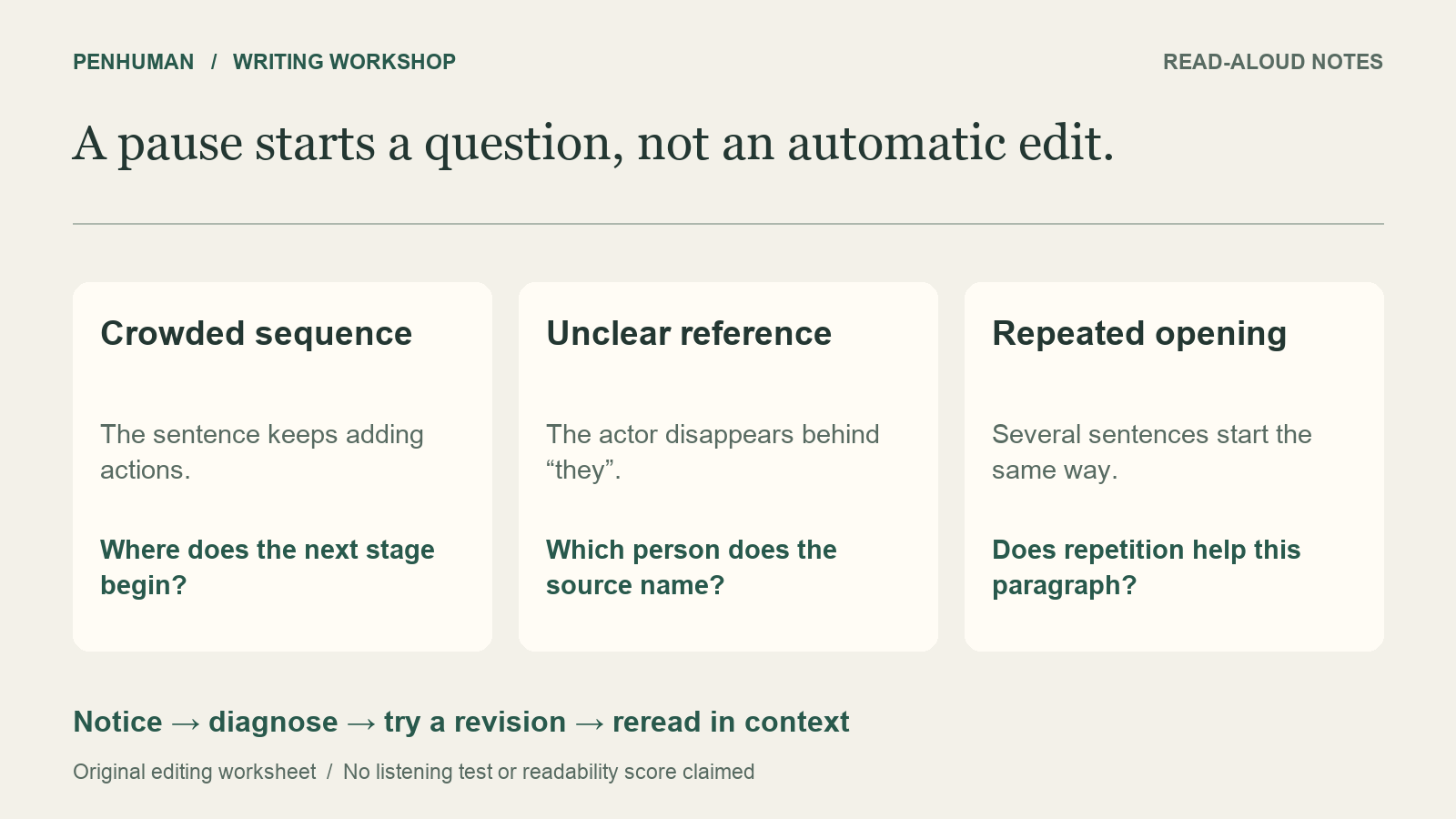
Read a draft aloud to notice a passage that deserves another look, then decide what the passage needs. A hesitation might signal a crowded sentence, an unclear reference or an unfamiliar name. It is a clue, not an automatic instruction to shorten the sentence. Choose a paragraph whose purpose you can state plainly. In the fictional workshop welcome below, the reader needs to find a seat, collect a worksheet and understand how the practice begins. The editing question is whether the order of those actions is easy to follow.
The University of Wisconsin–Madison Writing Center recommends reading out loud during proofreading and addressing larger organizational problems before polishing individual sentences. Treat that advice as a practical editing method, not a measured readability test. This guide offers original rough passages, a small source brief and manual revisions for a fictional poster-writing workshop. They are teaching examples, not recordings of a real session, customer writing or raw PenHuman output. No reader study or listening test was conducted, and the examples make no claim about comprehension scores or sales results.
Listen first and leave a specific editing note
Read the paragraph as written at a comfortable pace. Resist the temptation to supply a missing word or silently repair the sentence from memory. Mark a place where you restart, lose the subject or meet the same opening repeatedly, then finish the paragraph before editing. A brief note such as actor unclear is more useful than bad sentence. If a term is unfamiliar but necessary, verify it rather than replacing it just because it was difficult to pronounce. Your reading experience supplies a question to investigate; the intended audience and source determine the answer.
Make a simple note containing the passage, what you noticed and a change to try. For example, write that the instruction keeps adding actions before reaching a stop, then test a division between arrival and practice. If listening is not useful or accessible for your workflow, inspect the sentences separately on the page or ask a reviewer to identify unclear passages. The point is to examine the wording closely, not to prove that everyone can read it aloud in the same way. Keep the original beside the revised text so that each revision remains a choice you can compare.
Give a crowded sequence clear stopping points
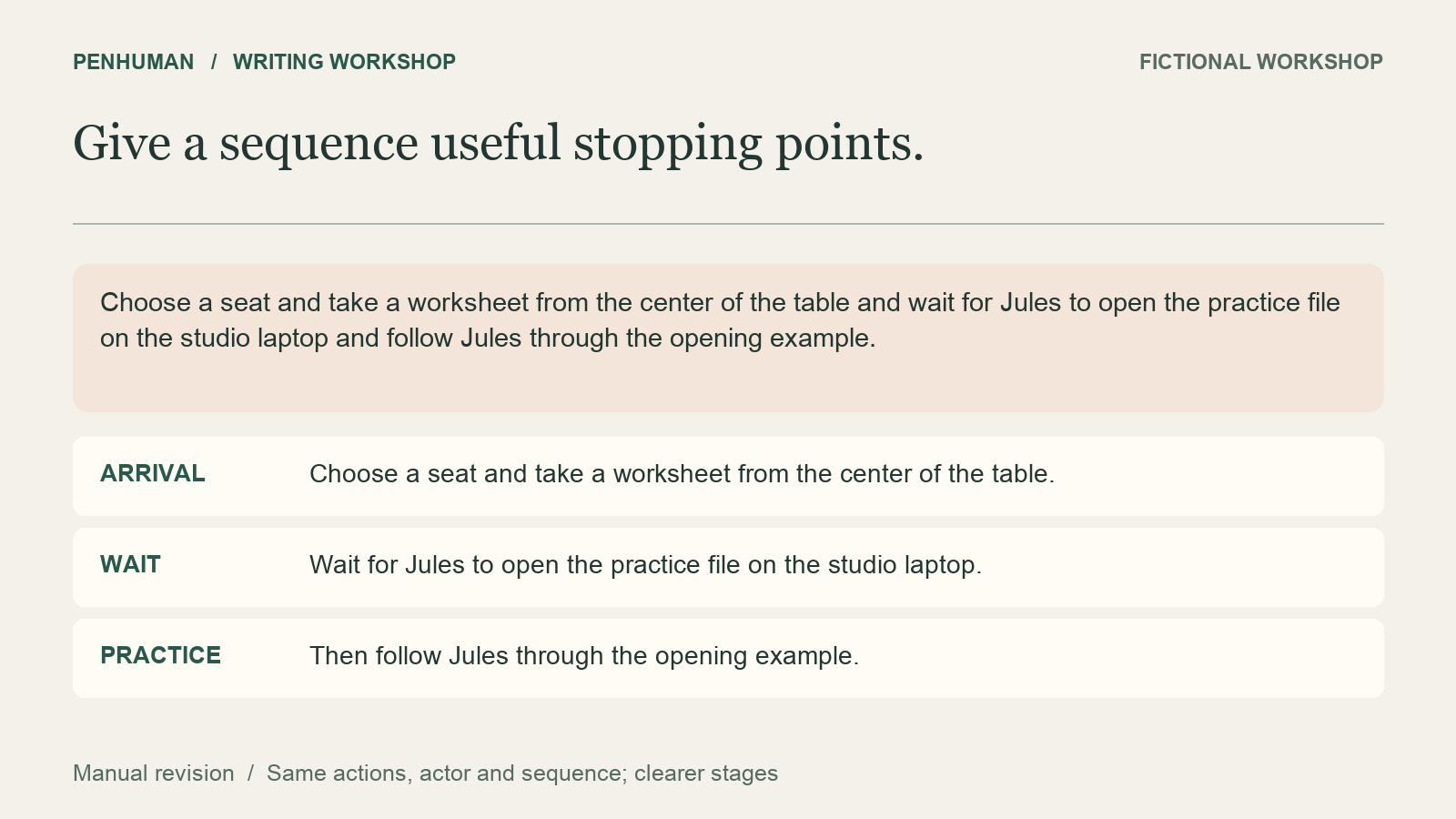
Start with this fictional source brief: participants choose a seat, take a worksheet from the center of the table, wait for Jules to open the practice file on the studio laptop, and then follow Jules through the opening example. Jules gives Noor the question sheet before Noor begins recording questions on that separate sheet. The rough welcome compresses the participant sequence into this sentence: "Choose a seat and take a worksheet from the center of the table and wait for Jules to open the practice file on the studio laptop and follow Jules through the opening example." The actions are all present, but their repeated joins make the sequence worth examining.
Try this manual revision: "Choose a seat and take a worksheet from the center of the table. Wait for Jules to open the practice file on the studio laptop. Then follow Jules through the opening example." The first sentence groups the arrival actions, the next marks the wait, and the last starts the guided practice. This is not a rule that every action needs its own sentence. The seat and worksheet instructions stay together because they form a compact arrival step. Before judging their rhythm, compare both versions against the brief: the person, equipment and sequence remain intact.
Name the actor when a pronoun has two possible owners
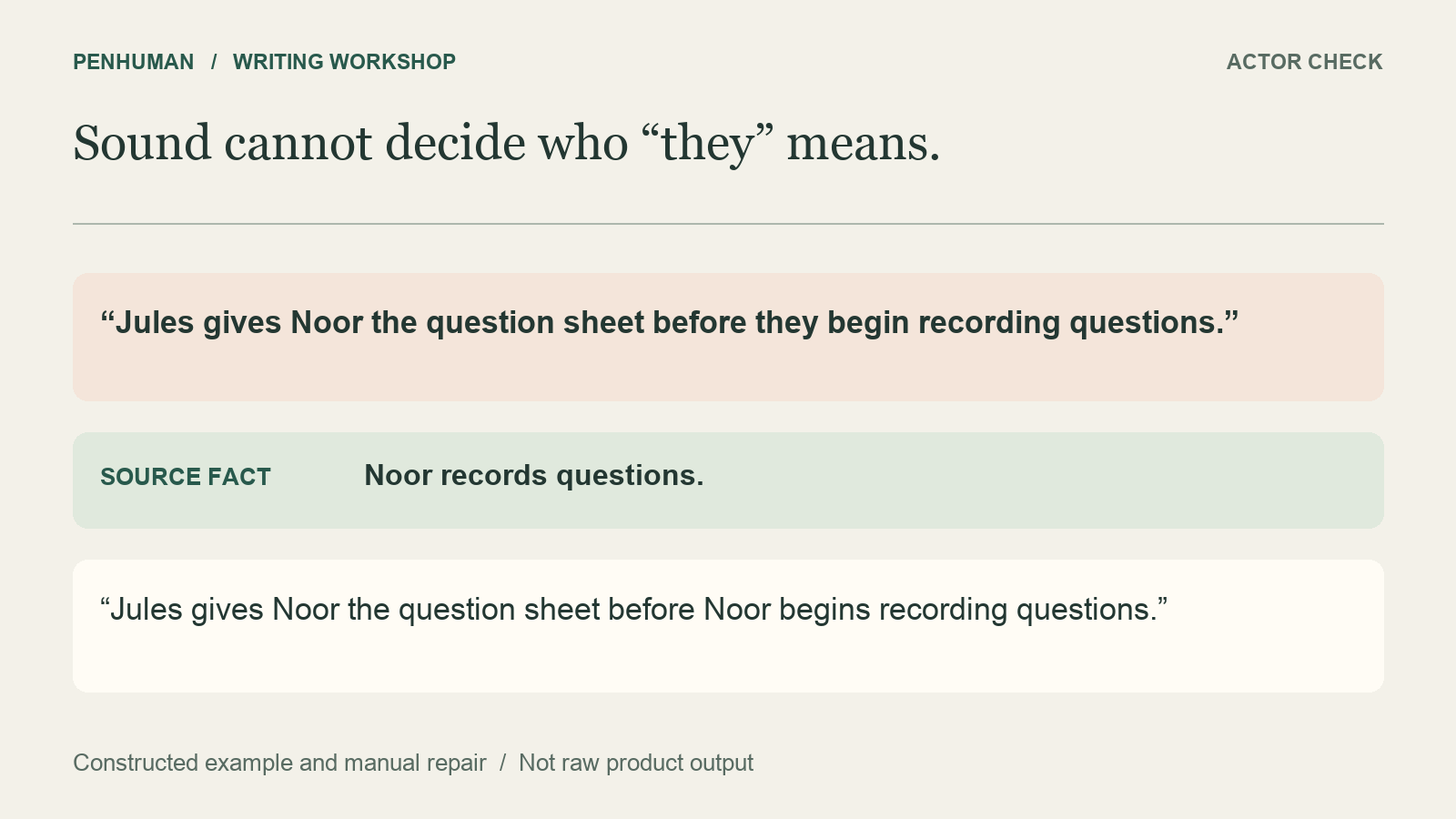
Read another rough sentence from the same fictional brief: "Jules gives Noor the question sheet before they begin recording questions." The pronoun they could point to Jules, Noor or the pair. Reading the sentence aloud may draw attention to the uncertainty, but the sound cannot settle who records the questions. The brief supplies that fact: Noor does. A manual repair is: "Jules gives Noor the question sheet before Noor begins recording questions." The repeated name helps because the reader needs a definite actor, not a more varied set of words.
Trace a questionable pronoun to the noun it is intended to replace. The Wisconsin proofreading guidance suggests checking pronouns and their references as a separate pass. Retain a pronoun when its reference is clear; replacing every it or they with a full name can make a paragraph unnecessarily heavy. In this example, repairing the subject is enough. There is no reason to invent a new facilitator, change who hands over the sheet or add a promise about when questions will be answered. If the source does not identify the actor, ask for clarification before rewriting.
Vary sentence starts when the emphasis needs it
A follow-up workshop note reads: "The worksheet introduces the poster topic. The worksheet provides space for a headline. The worksheet includes a box for questions." These are more imaginary source facts. The repetition at the start is easy to read, but emphasises the worksheet the same amount every time. Try this manual edit: "The worksheet introduces the poster topic and provides space for a headline. A box at the bottom holds your questions." The example brief puts the box at the bottom; the edit does not guess its placement from the rough sentences themselves.
Purdue OWL explains that sentence length and opening patterns affect rhythm and emphasis. Apply that idea to the paragraph’s purpose rather than mechanically alternating lengths. Repetition may be useful in a checklist where each line needs to stand alone. In continuous prose, grouping related functions can leave more room for the next point. Read the revised passage with its neighbors so a changed opening still connects to what came before. Do not replace worksheet with several decorative synonyms merely to avoid repetition; use a structural edit when the name still identifies the right object.
Treat a pause as a clue, not a comma rule
An audible pause does not tell you by itself which punctuation belongs there. In the fictional sentence "The worksheet with the wide headline box is on the table", the subject reaches all the way through box before the verb is. Inserting a single comma after box would separate that subject from its verb. The MLA Style Center discusses this problem: a pause can tempt a writer to insert a comma that breaks the sentence’s structure. Before deciding on punctuation, read the words around the pause and identify how they fit together.
If the sentence still feels cumbersome, try changing its structure instead of adding punctuation by instinct. "The worksheet is on the table. It has a wide headline box" is a possible manual revision when those are the intended facts and the worksheet is already identified. The emphasis changes: location comes first, and the box becomes a separate detail. That tradeoff may or may not suit the surrounding paragraph. Retain the original when its identifying description is important at that point. A useful revision makes a deliberate choice about meaning and emphasis; it does not simply remove every long phrase.
Reread the revised paragraph and compare the whole draft
After making a local change, reread the complete paragraph and the passage that follows. Check whether the new stopping point creates a fragment, whether the repeated name clarifies the actor and whether the reordered sentence changes the emphasis you intended. Retain a version only when it helps that particular passage. If a length limit applies, use the Word Counter to check the actual text after editing. A shorter count is not evidence of clearer writing. The draft-limits guide explains how word and character limits differ; neither count measures whether a reader understood the instruction.
When you use the AI Humanizer for a prose candidate, keep the original and review the result before adopting its wording. Basic accepts a complete draft of 80–600 words within the remaining allowance, with 3,900 included Humanizer characters and no scheduled reset. Use the short examples in this article for manual review; avoid padding them to reach the minimum. A successful rewrite uses the applicable allowance and still needs review. This article describes a manual reading-and-editing method, not a built-in audio review feature or a guarantee that a rewrite preserves the source.
Frequently Asked Questions
Should every sentence fit into a single breath?
No. Breath length is not a useful universal sentence rule. A reader may pause because of pace, an unfamiliar term or the way they are speaking. Look at the sentence’s structure and purpose instead. In the workshop example, the revision separates arrival from waiting and practice because those are useful divisions in the instruction. A longer sentence can still be appropriate when its parts clearly express one connected idea. Use your listening note to guide the review, not as a pass-or-fail score.
Does a smoother sentence prove that the meaning stayed accurate?
No. A fluent sentence can still give an action to the wrong person or add a detail the source never supplied. In the pronoun example, the brief identifies Noor as the person recording questions. The repair depends on that evidence, not on which name sounds better in the sentence. After editing, compare the original and candidate with the source. Keep sound and factual review as separate questions so that an appealing rhythm does not hide a changed instruction.
What should I do when several versions sound reasonable?
Evaluate them against the reader’s immediate task and the surrounding paragraph. One version may introduce the location first; another may identify the object before saying where it is. Both can be grammatical, but their emphasis differs. Choose the order that makes the next sentence easier to follow, while preserving the source facts. Retaining the original is reasonable if you cannot identify a useful difference. Save alternative wording separately when a later reader review could help resolve a specific uncertainty.