Turn an Interview Transcript into a Faithful Article Outline
Give the interview transcript one reader question
An interview transcript records the conversation's order, but an article needs an order that serves its reader. Before choosing a lively quotation, write down one question the finished article should answer. In this fictional exercise, a neighborhood tool library coordinator explains how collection works, why volunteers introduced reminder cards and what they still do not know. The proposed article asks: how does the current collection process work, and which changes remain undecided? That question sets the outline’s boundary. It does not require a success story, a product recommendation or a claim that the new cards improved returns.
This guide supplies an original invented interview, line labels and a manually constructed outline. No real coordinator, interview recording, customer experience or measured result is represented. Purdue OWL distinguishes an exact quotation from a paraphrase in the writer's own words and a shorter summary of main points; all three still need attribution when they use another person's material. Use that distinction while preparing your notes. Keep the fictional transcript separate from your working article, and label whether each note preserves the speaker's words, restates a point or asks for information that the conversation did not supply.
Keep a small source excerpt with stable line labels
Start with the complete fictional source excerpt for this exercise. Interviewer: What happens at collection? Rina, coordinator: [L1] "Members collect reserved tools at the desk on Saturday mornings." Interviewer: How long is a loan? Rina: [L2] "The loan lasts seven days. Volunteers check the tool when it comes back." Interviewer: Why did you introduce reminder cards? Rina: [L3] "At two sessions, several members asked us to repeat the return date. We added a card so they could take that date home." The labels identify passages within this invented text; they are not timestamps or proof of an audio recording.
Interviewer: Did the cards reduce late returns? Rina: [L4] "We have not measured late returns since we introduced the cards." Interviewer: Will evening collection be available? Rina: [L5] "We want to try evening collection, but we have not chosen a date." Interviewer: What should the article explain first? Rina: [L6] "Explain the current collection process before describing what we might try next." Read the complete excerpt before making an outline. L3 explains the reason for the cards, while L4 limits what can be said about their effect. Leaving out that neighboring answer would change the impression created by an otherwise accurate quotation.
Make an evidence card before writing a heading
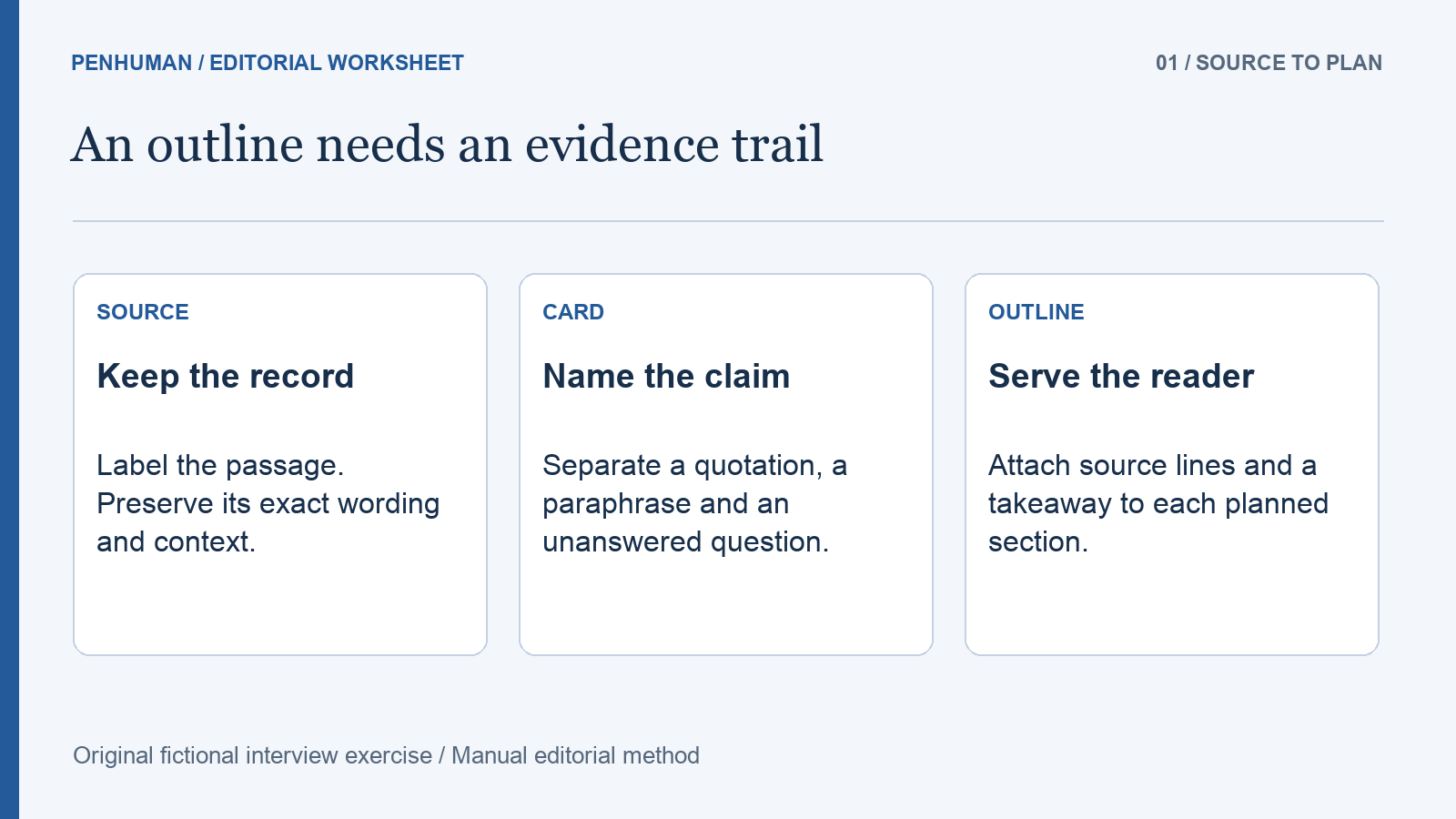
Make a brief evidence card for each point you may use: source line, exact excerpt, proposed paraphrase and open question. For L3, the exact excerpt includes two sessions and members asking for the return date to be repeated. A faithful paraphrase is that staff introduced take-home date reminders after hearing those questions at two sessions. The source does not give a count for several, and it does not say members had forgotten or missed their deadlines. Leave those possible explanations out. A useful card exposes the gap instead of filling it with a plausible story.
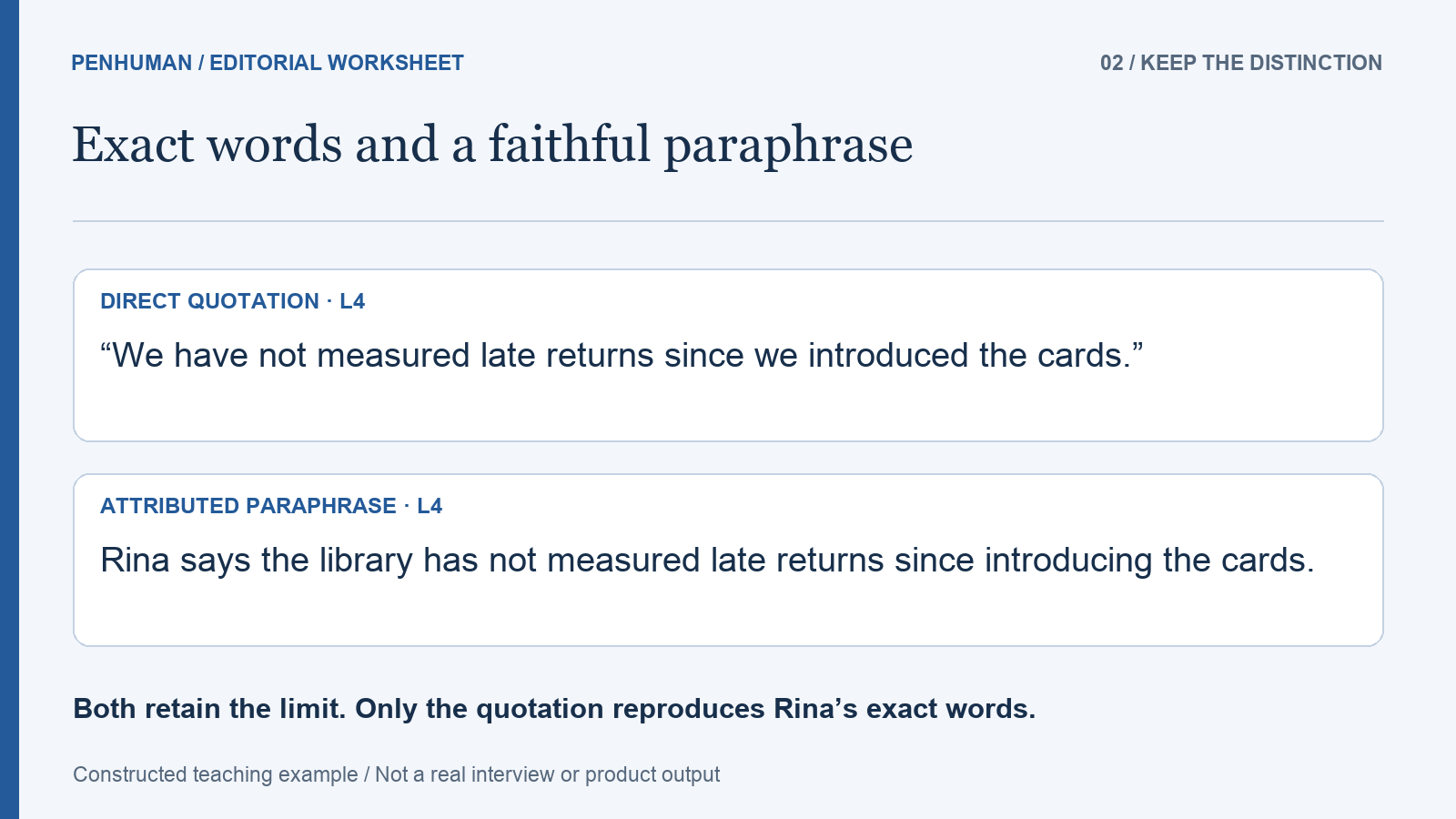
The Associated Press says quotations should retain their context and should not be silently rewritten to repair their language. Its guidance also distinguishes a faithful paraphrase from an unclear statement that cannot safely be paraphrased. For this exercise, an exact quotation from L4 reads: "We have not measured late returns since we introduced the cards." A paraphrase could read: Rina says the library has not measured late returns since introducing the cards. Do not put that rewritten sentence in quotation marks. Both forms preserve the limit, but only one reproduces the speaker's exact wording.
Put unanswered questions outside the reported claims
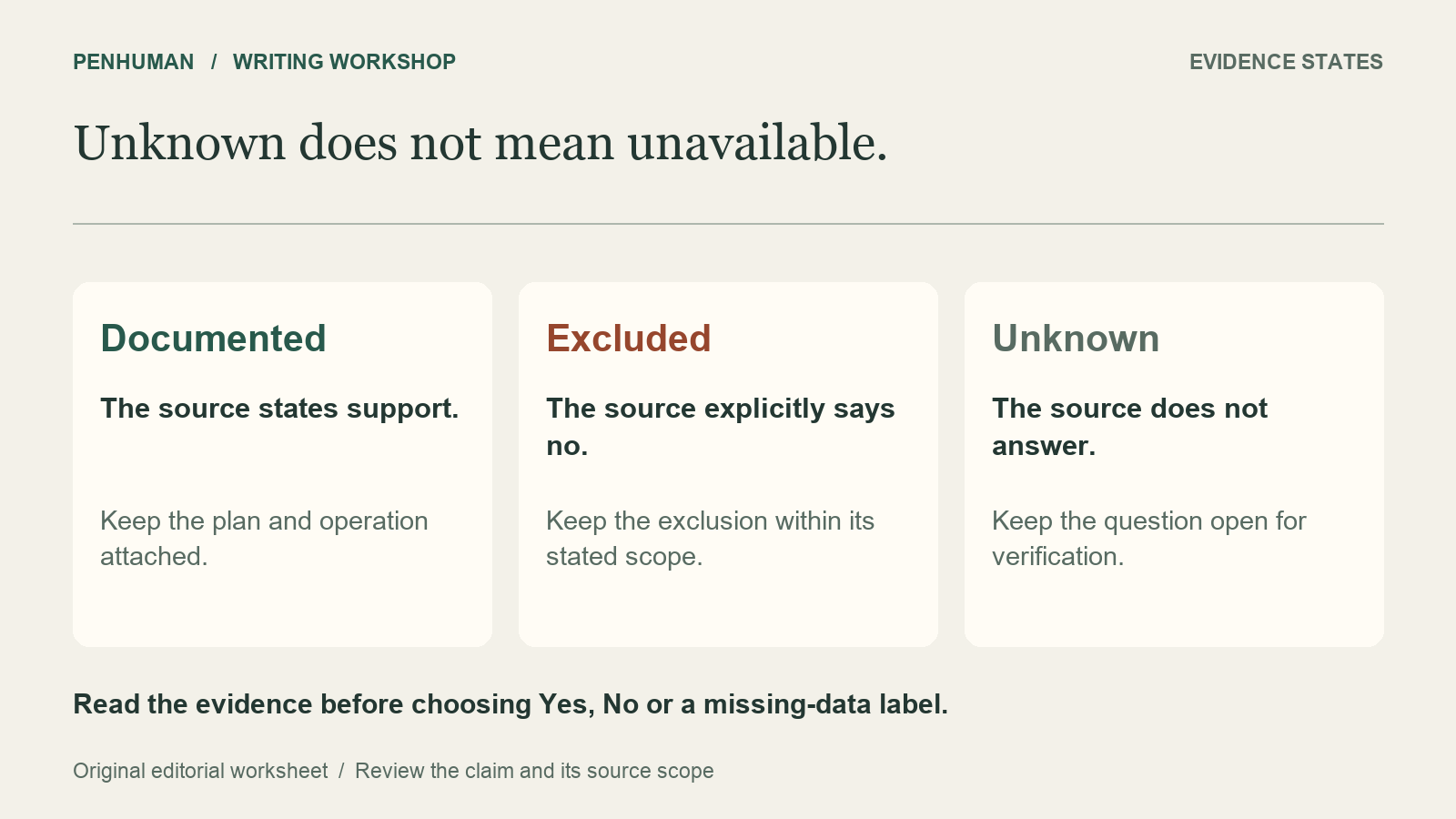
Create a separate follow-up list instead of using a stronger heading to conceal missing evidence. How many members asked about return dates? What period would a late-return comparison cover? Which staff and opening hours would an evening trial require? These are useful reporting questions, but none has an answer in L1–L6. The proposed heading Reminder cards cut late returns would therefore fail this exercise. A supported heading is Why the library introduced date cards, followed by the reason in L3 and the explicit measurement limit in L4.
Make the status of each note clear. A speaker's hope belongs under a proposed change; an observed action belongs under the current process; your follow-up question belongs in the reporting plan. L5 supports interest in a trial, not a scheduled launch. Even the phrase evening collection is coming soon would add timing that the excerpt does not provide. You can make the article useful now by explaining the present process clearly, while stating that a trial date has not been chosen. The absent date does not need an invented substitute or a promotional promise.
Arrange the outline around the reader instead of the interview
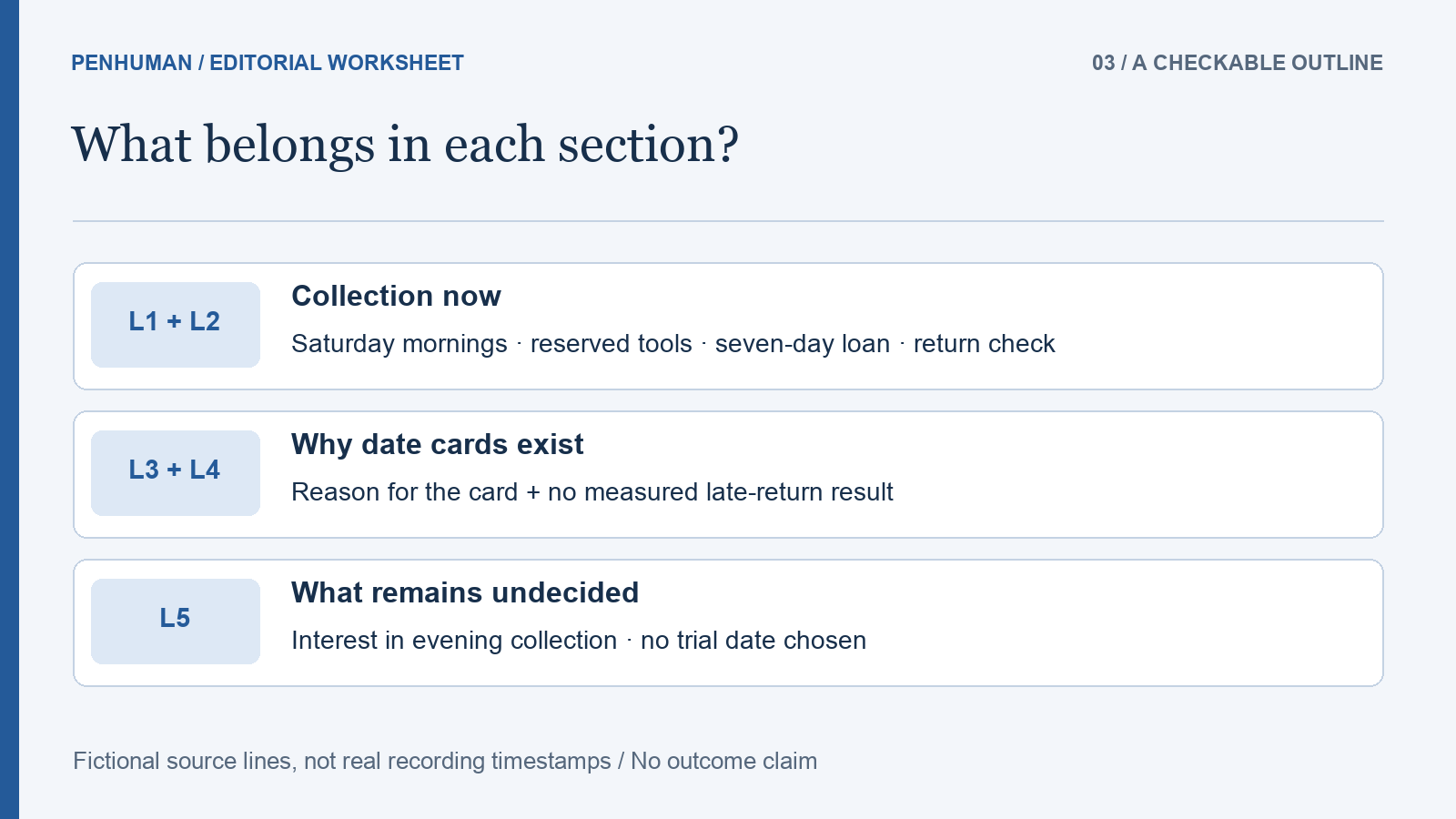
Use three outline sections for this narrow article. First, How collection works now: source L1 and L2; explain Saturday morning collection of reserved tools, the seven-day loan and the return check. Second, Why date cards were added: source L3 and L4; pair the reason with the absence of a measured late-return result. Third, What remains undecided: source L5; describe the proposed evening trial and the missing date. L6 supports giving the current process priority, but the writer still makes and owns the structural choice.
Beneath each section, add one planned reader takeaway and the evidence needed to support it. This turns the outline into a checkable plan, not a list of attractive titles. The date-card section should leave readers knowing why the cards exist and what their effect has not yet been shown to be. Do not scatter L3 and L4 so far apart that a positive introduction suggests an outcome before the limitation arrives. Reordering a conversation is a normal part of building an article; creating a different relationship between its claims is a separate choice that needs evidence.
Draft one section and trace every sentence back
Consider this possible manual paragraph for the second section: Rina says the library introduced take-home date cards after several members asked volunteers to repeat the return date at two sessions. The cards give members a written reminder, but the library has not measured late returns since introducing them. The first sentence traces to L3; the second combines the card's stated purpose with L4's limit. This is a manually constructed editorial example, not generated product output. The attribution tells readers whose account supplies the explanation, and the final clause prevents a purpose from becoming a result.
Next, test a faulty alternative: The popular new cards solved confusion and made members more punctual. Popular, solved and more punctual are unsupported by the excerpt. Replacing those words with softer versions such as helpful or likely improved would still need evidence. Repair the underlying claim instead of merely lowering its confidence. A useful final check is to point to the source line for each statement, then read the surrounding answers. Keep quotations exact and check that a transition such as therefore has not introduced causation that the interview never established.
Review your own prose without rewriting the source record
Retain the original interview transcript unchanged as you revise the article. In a real project, compare uncertain transcript wording with the authorized recording or ask the speaker for clarification through your established reporting process; this exercise supplies only invented text. Use your publication's attribution and quotation rules. Use the glossary guide when a name or technical term needs consistent treatment, and the numbers and conditions worksheet when a summary includes a duration or limit. The Word Counter can help with a length brief, but a smaller total does not prove that a summary remains faithful.
If you use the AI Humanizer for a candidate version of your own prose, retain direct quotations and source records separately and compare the candidate with the evidence cards before accepting it. Basic supports complete drafts of 80–600 words within the available allowance, with 3,900 included Humanizer characters and no scheduled reset. The brief exercise quotations are for manual review, not padding into a service request. Successful rewriting uses the applicable allowance and still requires review. This is an editorial planning method; it does not claim that PenHuman transcribes recordings, verifies interviews or automatically enforces a source ledger.
Frequently Asked Questions
Can I rearrange answers when I turn an interview into an article?
You can organize an article around the reader's questions without retaining the order of the conversation. Preserve each statement's context and attribution. In this fictional outline, the reason for the cards stays beside the answer about missing outcome measurement even though they come from separate questions. Keeping them together prevents a reader from mistaking an intention for a demonstrated result. Do not combine fragments into a new direct quotation or create a sequence of events that the speaker did not describe. Follow the publication's editorial rules for the final format.
Should I fix an awkward quotation before using it?
Keep a verbatim quotation separate from a rewritten sentence. If the meaning is clear but the wording is unsuitable for the article, a faithful attributed paraphrase may serve the reader better. The paraphrase belongs in your own prose, without quotation marks suggesting the speaker used those words. If the meaning itself is unclear, seek clarification or leave out the uncertain claim rather than guessing. In this exercise, L4 is already clear, so either its exact wording or the explicitly attributed paraphrase can preserve the measurement limit.
What if the interview does not support the headline I planned?
Revise the headline or continue reporting before making that claim. The excerpt supports an explanation of the current tool collection process and the reason for date cards. It does not support a headline about reduced late returns or an evening launch date. A narrower article can still answer a useful reader question. Keep the unanswered items in a follow-up list, and decide which ones must be resolved for the piece you actually intend to publish. A polished outline cannot supply evidence that is missing from the source.