Use a Reverse Outline to Fix a Draft’s Paragraph Order
Give the reverse outline a reader question
A reverse outline is a short map of a draft you have already written. Use it when the sentences sound clear but the reader still has to hunt for the point, meet the same information repeatedly or jump between unrelated details. For this exercise, the document is a fictional welcome note for a neighborhood photo walk. The reader needs to decide whether the activity fits their interest and arrive prepared. Save the original draft before moving anything. The aim is to improve the route through that information, not to make every paragraph the same length or remove every repeated word.
Purdue OWL outlines a revision method that records each paragraph’s topic and how it supports the overall argument. Northeastern University’s Writing Center stresses describing what is actually on the page rather than what the writer intended. This guide applies those ideas to an original fictional notice, with a rough draft, a paragraph map and a manual revision. The example is not customer writing, a real event announcement or untouched PenHuman output. It makes no claim about measured comprehension, registrations or sales. The paragraph decisions below are editorial judgments that you can check against the supplied brief.
Keep the brief beside the rough paragraphs
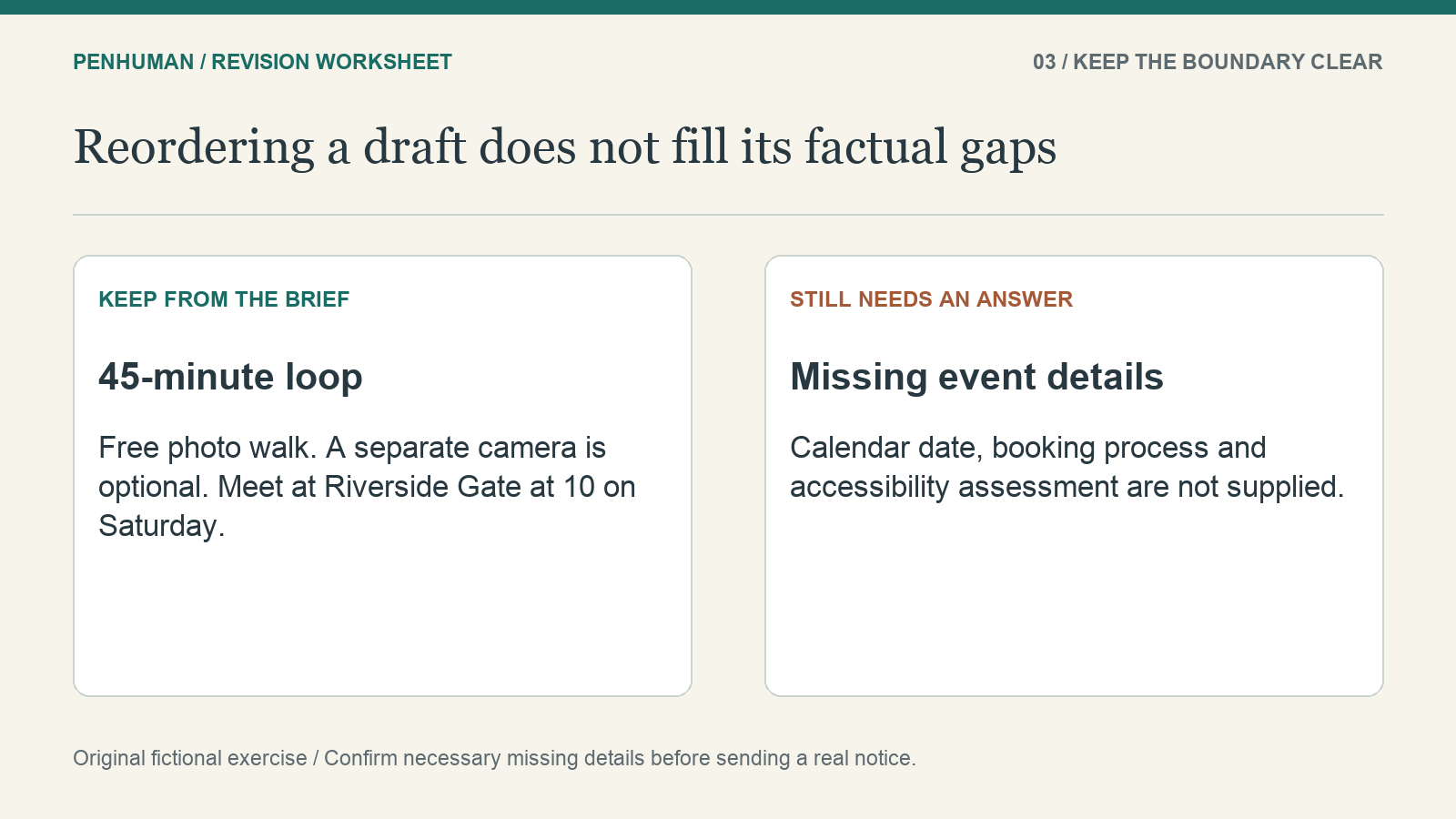
The fictional brief supplies the following facts: the photo walk is free and practices noticing how light changes familiar places. It follows a level paved loop, takes 45 minutes and ends at its starting point. Participants meet at Riverside Gate at 10 on Saturday and bring a charged phone. A separate camera is optional. The brief supplies no calendar date, booking process or accessibility assessment. Those omissions are questions for an organizer before a real notice is sent; they are not invitations to invent details during editing. For the structural exercise, keep the supplied facts fixed and list the gaps separately.
Here is the intentionally rough draft, separated by paragraph labels. A: "Meet at Riverside Gate at 10 on Saturday. Bring a charged phone. The walk follows a level paved loop." B: "The free photo walk takes 45 minutes and finishes at the same gate. A separate camera is optional." C: "Bring a charged phone; a phone camera is fine. The walk is free." D: "The purpose is to practice noticing how light changes familiar places. Meet at Riverside Gate." These short paragraphs mix several jobs and repeat details. They are a manual teaching sample, not a result to submit to a rewriting tool or a complete publishable event notice.
Label what each paragraph actually does
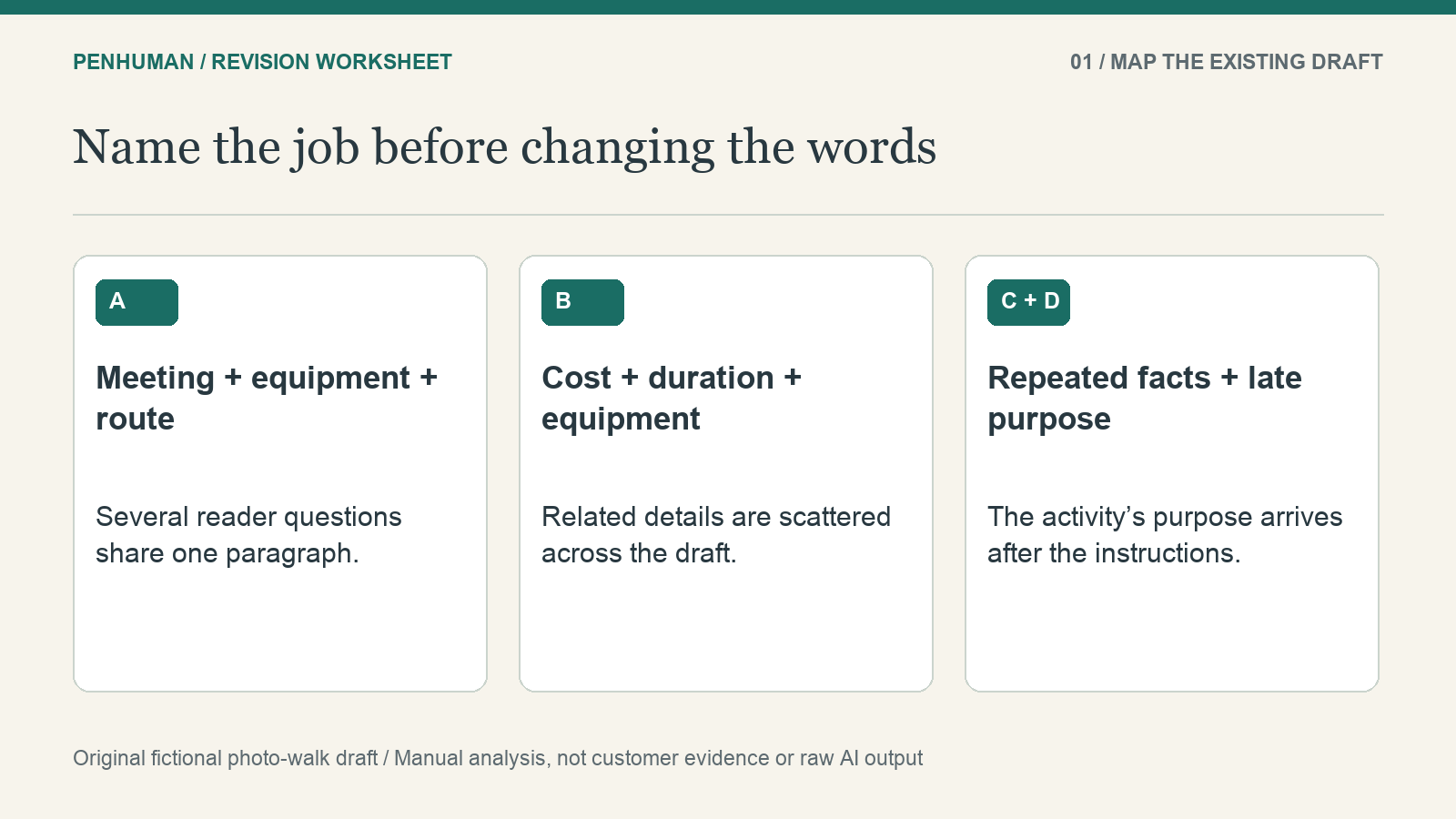
Assign each paragraph a plain label based on its whole contents. A covers meeting details, equipment and the route. B covers cost, duration, the finish and optional equipment. C repeats equipment and cost. D finally explains the purpose, then repeats the meeting point. A label such as useful introduction would hide these differences. These longer labels reveal mixed subjects; they are diagnostic notes rather than replacement headings. Keep the original paragraph letters while reviewing so that you can locate each sentence even after you begin testing another order. Do not force an inaccurate single-topic label onto a paragraph that still does several jobs.
Compare the map with the reader question. Someone learning about the walk meets arrival instructions before learning what the activity is for. Equipment appears in several places, while duration is separated from the route description. That does not prove the original order is always wrong: a reminder sent to confirmed participants might reasonably lead with the meeting point. This exercise is a welcome note for people evaluating the activity, so purpose and suitability belong earlier. Record that audience decision above the map. Otherwise, a later reviewer may rearrange the same paragraphs for a different reader without realizing the task has changed.
Choose a revision action for each piece of information
Use the map to make concrete editing decisions. Move the purpose from D to the opening. Place the free cost and optional-camera information near that explanation so the reader understands the offer. Group the paved loop, 45-minute duration and return to the starting point. Keep meeting time, meeting place and the charged-phone reminder together near the end. These choices require splitting A and B and merging information from several paragraphs. Simply dragging D above A would leave most of the mixing in place. A paragraph map helps locate the work, but the writer still decides where each sentence belongs.
Delete a duplicate only after checking whether it serves a separate purpose. In this short continuous notice, the second statement that the walk is free adds nothing new, so the revision can state it once. The meeting point has a different relationship to the route: readers need both the arrival location and the fact that the loop returns there. Preserve both facts without repeating the full arrival instruction. In a longer document with independently read sections, some repetition might be useful. This is a decision about the reader’s path through this particular draft, not a rule to delete every repeated phrase or name.
Build the new order and repair the joins
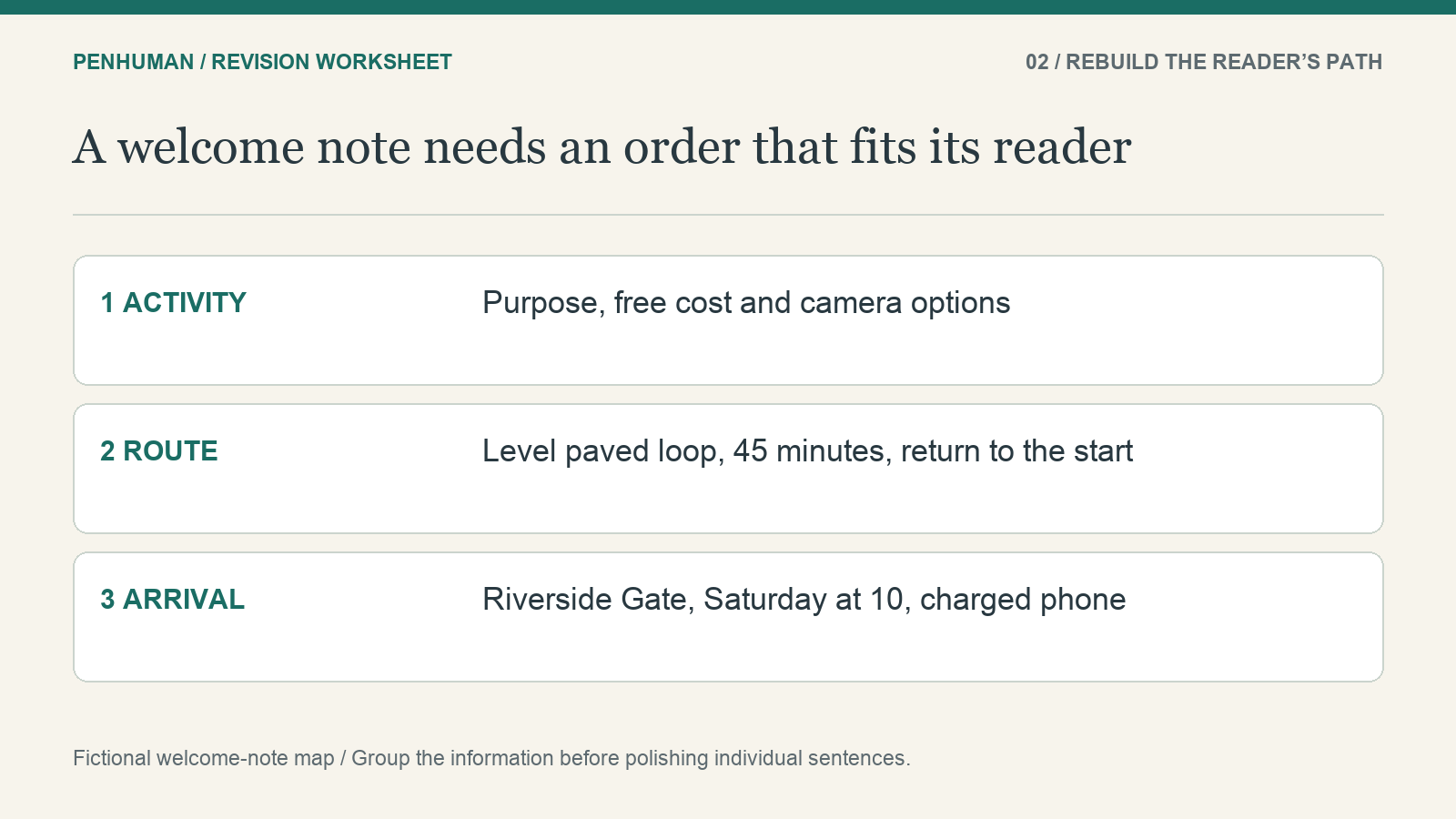
The new map has three jobs: introduce the activity and equipment options, explain the route, then give arrival and preparation details. A possible manual revision begins: "Join a free photo walk to practice noticing how light changes familiar places. You can use your phone camera; a separate camera is optional." The next paragraph reads: "The walk follows a level paved loop, takes 45 minutes and ends where it starts." The final paragraph reads: "Meet at Riverside Gate at 10 on Saturday. Bring a charged phone." The wording edits and regrouping are visible here; this is an editorial example, not raw product proof.
After moving text, check references that depended on the old order. The phrase same gate worked only when a previous sentence had named the gate. Ends where it starts makes the route relationship clear without depending on that earlier sentence. Check similar joins in your own draft: this approach, those requirements and the second option may no longer point to the right material. Do not cover a broken relationship with therefore or however unless the reasoning supports it. In this example, no transition word is needed between the activity, route and arrival paragraphs because each introduces a different practical question.
Compare the new map with the brief and the whole draft
Read the revised paragraph purposes in order, then verify the full text. The activity still concerns light and familiar places, remains free and allows a phone camera. The route is still a level paved loop lasting 45 minutes and returning to its start. The meeting instruction still says Riverside Gate at 10 on Saturday, with a charged phone to bring. A shorter note would be a poor revision if it lost the return point or made a separate camera compulsory. Keep the unanswered calendar-date and booking questions visible; rearranging prose does not establish the missing information or authorize a real event announcement.
The phrase level paved loop also does not establish that a route meets every participant’s access needs. If that matters for a real notice, ask the responsible organizer for the relevant information rather than expanding the phrase into a guarantee. This illustrates the difference between a structural edit and a factual addition. Once the organization is settled, the read-aloud guide can help with awkward sentences, while the editing-feedback guide can help a reviewer describe a remaining problem. Neither step replaces checking the source brief. End by asking whether a new reader can locate the activity, route and arrival instructions without assembling them from scattered paragraphs.
Use the map before spending time on another rewrite
For a recurring newsletter or welcome message, keep a small revision record containing the original paragraph jobs, your proposed order and the reason for a major move. On the next draft, start from its actual contents rather than forcing the old map onto a new purpose. A reminder, invitation and report may need different openings even when they concern the same activity. If a paragraph contains information that fits nowhere, decide whether the reader needs a separate note or whether a necessary connection is missing. Do not add a glib link between ideas merely to make every piece fit the outline.
After deciding on the structure, you can compare a candidate from the AI Humanizer with your own eligible prose. Basic accepts complete drafts of 80–600 words within the remaining allowance; its 3,900 included Humanizer characters have no scheduled reset. Keep the short photo-walk sample as a manual exercise; do not pad it just to meet a minimum. The Word Counter can help check draft length, but it cannot choose the paragraph order or verify missing facts. Save the original, any tool candidate and your final edits separately. This is a manual organization workflow, not a claim that PenHuman automatically builds or validates a reverse outline.
Frequently Asked Questions
How is a reverse outline different from an outline before writing?
An initial outline sets out what you want a document to do. A reverse outline records what the existing draft actually does, so the two can differ. In the photo-walk example, the intended welcome became a mixture of arrival instructions, equipment notes and repeated cost information. Mapping the draft exposes the mismatch without assuming the original plan was followed. You can then change the plan or the draft deliberately. Keep the reader’s current task in view, because a useful order for a welcome note might be unsuitable for a last-minute reminder to people who already know the activity.
Does every paragraph need exactly one topic and the same length?
Use the paragraph labels to inspect focus and order rather than to enforce matching paragraph lengths. Closely related facts can share a paragraph when they answer a clear reader question. The route paragraph in this exercise includes its surface, duration and return point because those details describe the walk together. A paragraph combining route details, camera options and a meeting instruction has a less clear job in this welcome note. Decide whether grouping or splitting improves that reader’s path; do not lengthen a short paragraph with filler simply to make it visually match the paragraphs around it.
What should I do when the map reveals information that is missing?
Identify the missing information in a separate question and identify who can confirm it. The fictional brief does not give a calendar date, booking process or accessibility assessment, so the structural revision cannot supply them. A polished draft can still be incomplete. If a missing fact is necessary for the reader to act, keep the real publication on hold until the responsible person supplies it. The paragraph map helps show where the answer belongs once known; it does not create evidence. Do not disguise the gap with a broad promise or assume that a fluent rewrite has resolved it.