Review a Rewrite for Numbers, Negations and Conditions
Review a rewrite against decisions, not a list of matching words
A revised note retains every number but sends the morning group away early. That is possible when the values survive but their subjects swap. When you review a rewrite, compare the decision a reader would make after each version. This guide uses a fictional reading-group organizer and deliberately flawed edits to practice that comparison. The source note, flawed candidates and repairs are constructed teaching examples, not PenHuman output or customer writing. Begin with the approved instructions below, then apply the worksheet to a passage you need to check.
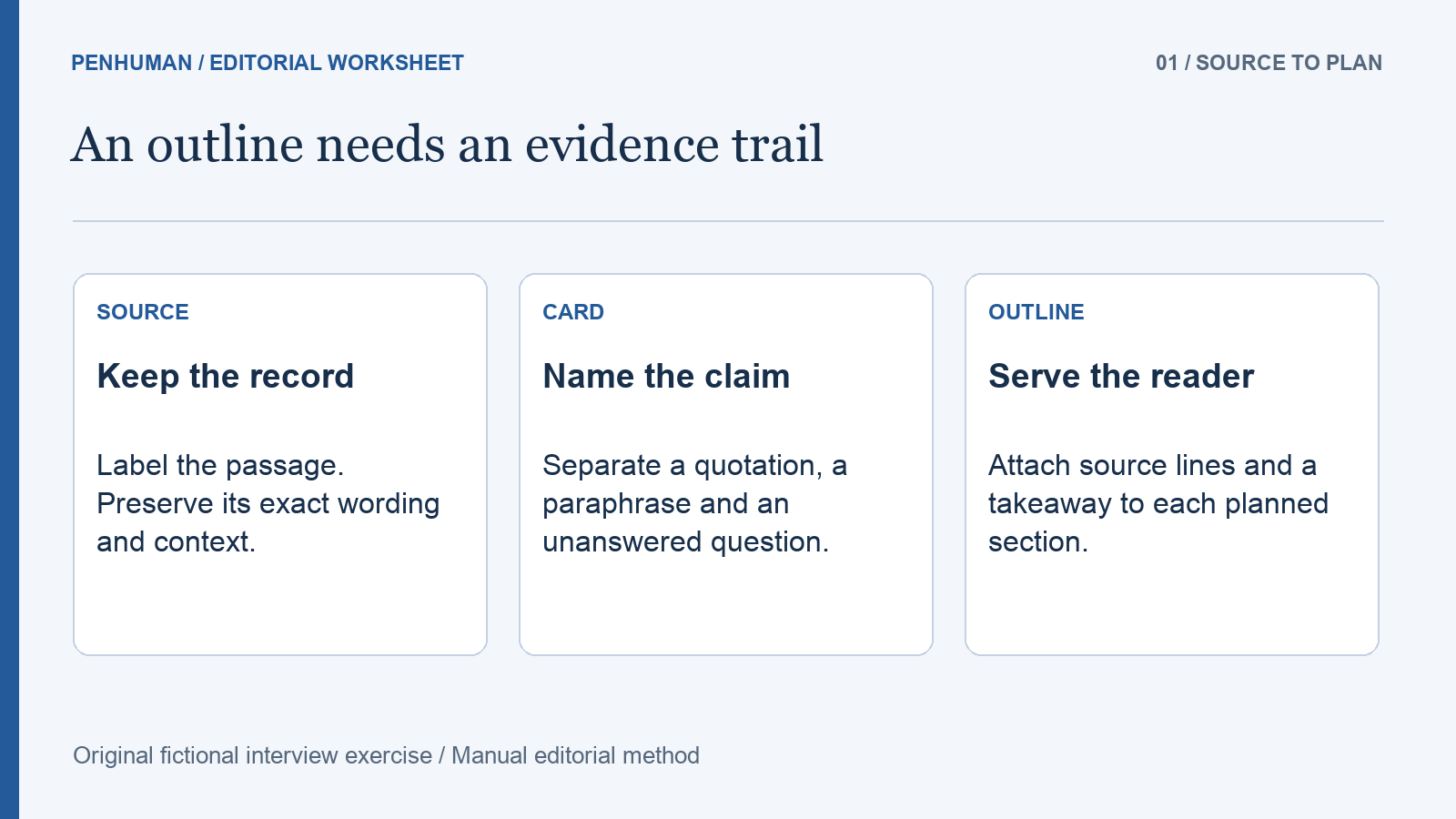
Keep the source and candidate beside each other. For each instruction, make a row recording its subject, action, value or deadline, and condition. For this exercise, the subjects include the morning session, the afternoon session and the public handout. Attach the values to those subjects. Leave a field blank if the source leaves it open. The reading-list deadline has a date but no stated time of day. An editor has no basis for adding a closing hour just to make the instruction seem complete.
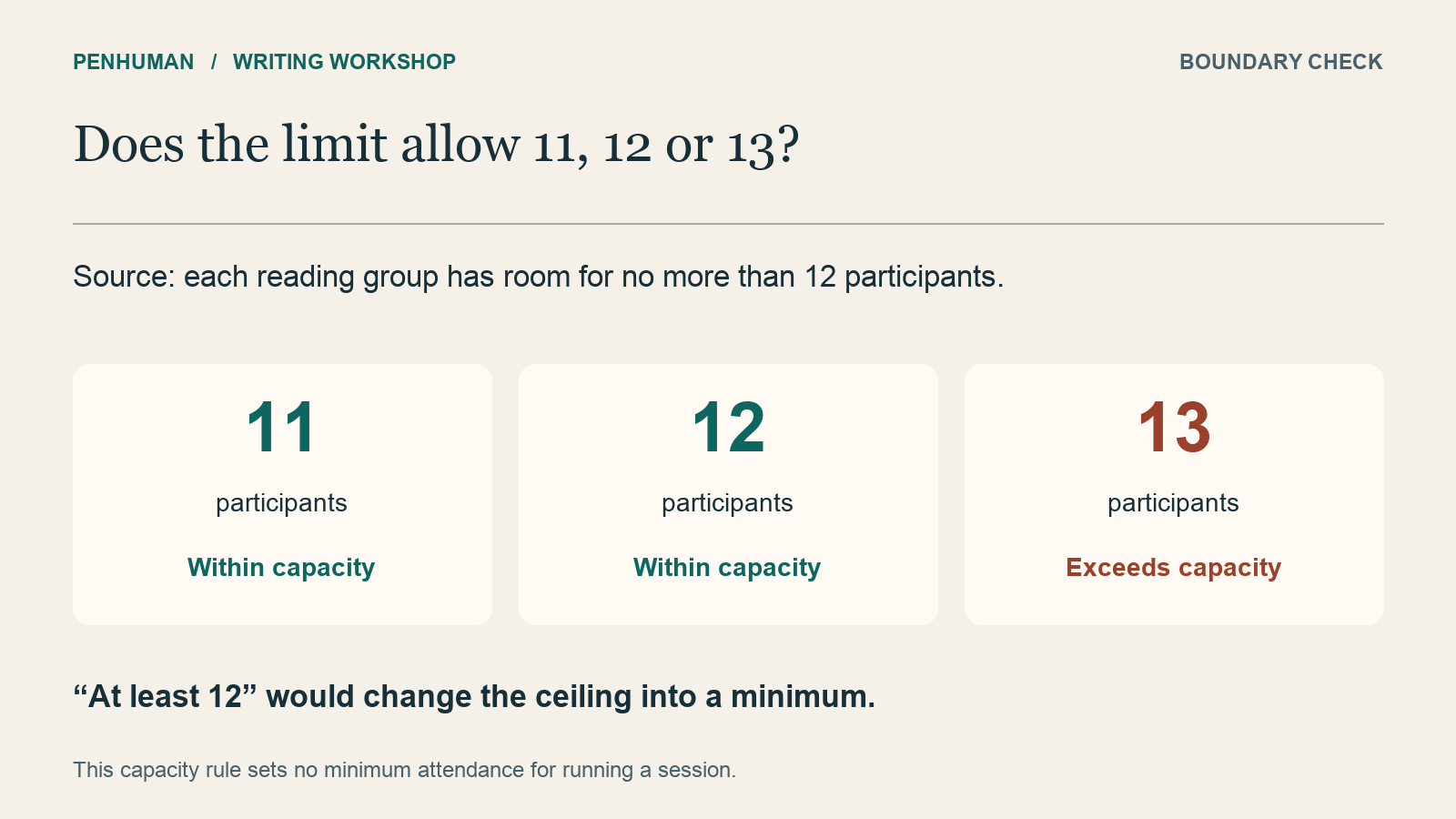
- Each reading group has room for no more than 12 participants.
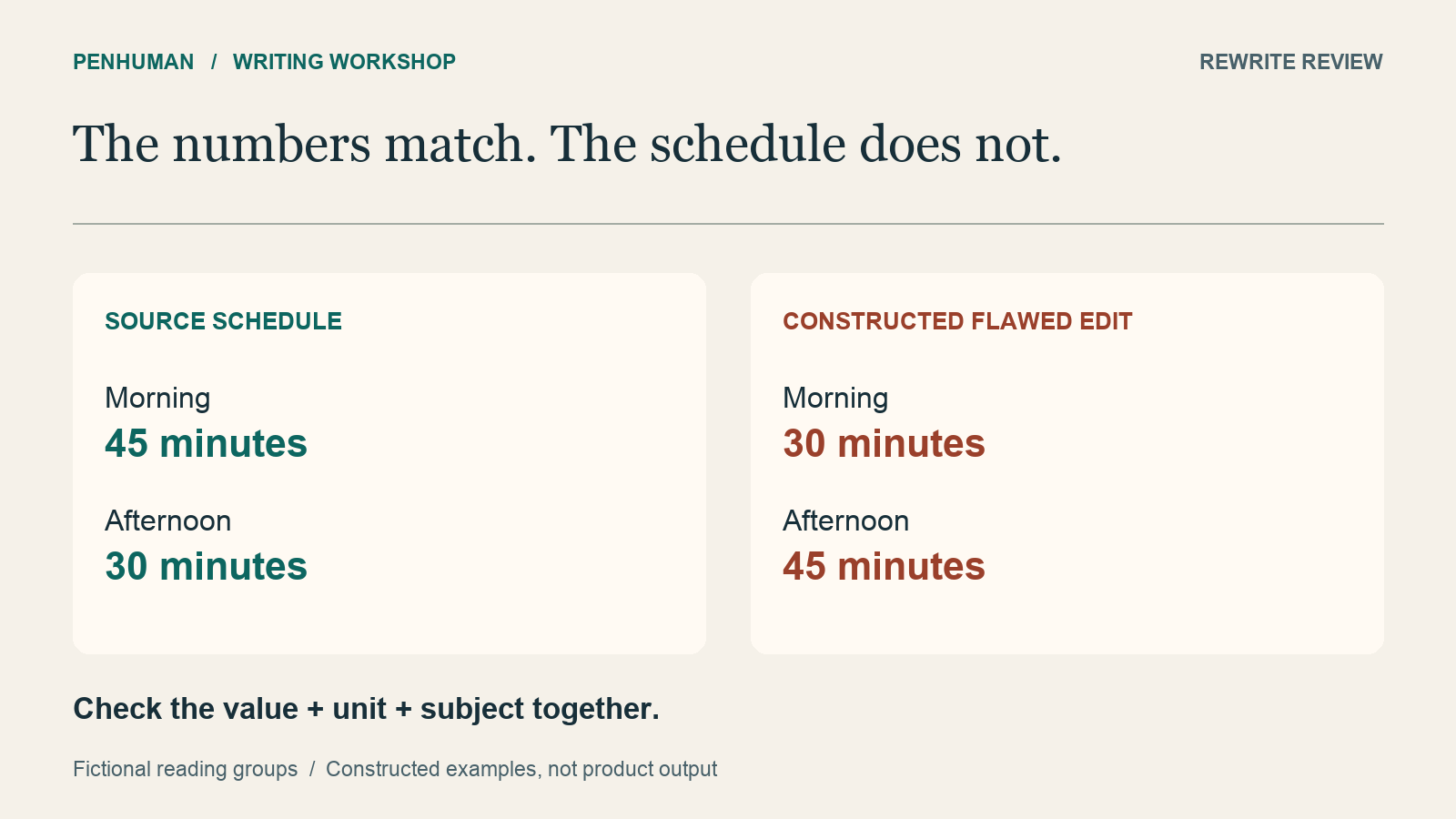
- The morning session lasts 45 minutes; the afternoon session lasts 30 minutes.
- Send the reading list by 18 September.
- Do not include participant email addresses in the public handout.
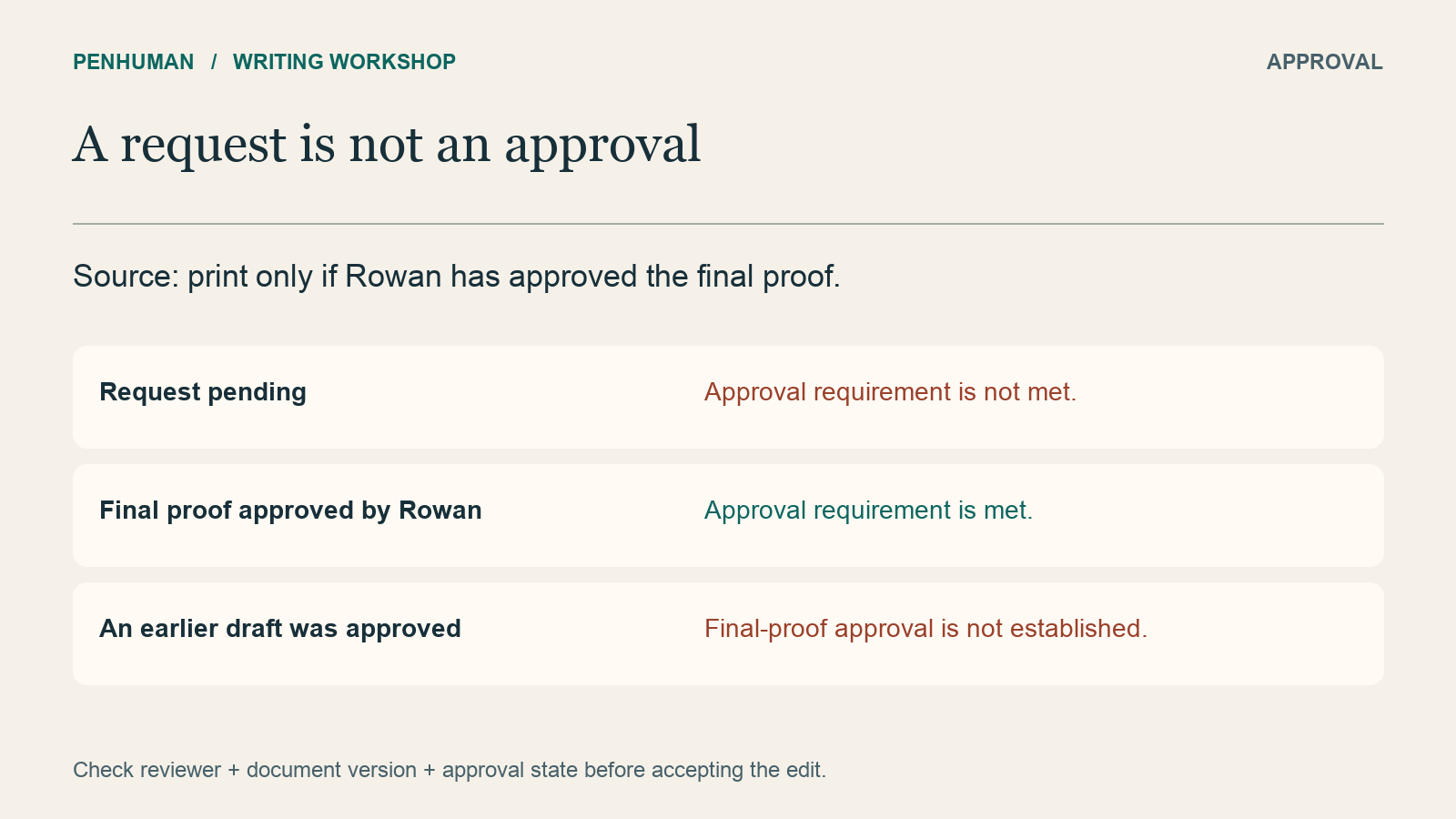
- Print the handout only if Rowan has approved the final proof. A request for approval does not count as approval.
Pair every number with its subject, unit and boundary
Compare the source schedule with this flawed candidate: "The morning session lasts 30 minutes; the afternoon session lasts 45 minutes." The digits and their unit survive, but the schedule is reversed. Before checking the candidate, write the duration beside morning and repeat the check for afternoon. Google’s numbers guidance recommends numerals for measurements and technical quantities; consistent notation helps you locate the values. Your review still has to connect each value to the right activity. Searching only for matching digits misses this error.
Give the capacity sentence its own check. A flawed edit says, "Each reading group needs at least 12 participants." This replaces a ceiling with a minimum. Test a group of 11, a group of 12 and a group of 13 against the original limit. The smaller groups fit the capacity; the largest exceeds it. The original establishes no minimum attendance requirement for running a session. Separate capacity from attendance decisions, and check at most, at least and exactly together with the numbers.
Keep a negative attached to the same action
Now compare the public-handout instruction with another flawed candidate: "Do not email the public handout to participants." The candidate still includes a negative, participants and email. It gives a different instruction. The source restricts what the handout contains; the candidate restricts its delivery method. A reviewer who merely counts negative words misses the difference. Read the verb with its object, then identify the scope of the restriction. In this example, the public document’s contents are restricted, while the source says nothing about how the document reaches readers.
A faithful manual repair is, "Leave participant email addresses out of the public handout." Different wording expresses the negative instruction while keeping the excluded information and its destination clear. Read the surrounding text before accepting the sentence. If a neighboring paragraph introduces a mailing list, the reference to the public handout still needs to remain explicit. Replacing that name with it could make the exclusion attach to the wrong document. Use the worksheet to record the preserved meaning, rather than accepting a sentence just because it contains not.
Test the condition before you approve the action
The proof instruction permits printing only after Rowan has approved the final proof. A flawed candidate says, "Send the handout to Rowan before printing." Sending the proof for review leaves its approval unresolved. Test the candidate while the request is still unanswered. It permits the next step even though the source’s condition has not been met. In the worksheet, distinguish the event that starts a review from the event that satisfies it. Record the named reviewer, the document version and the approval state together.
Google’s sentence-structure guidance recommends putting relevant circumstances or conditions before an instruction. This helps readers decide whether the instruction applies to them. A manual edit for this example is, "Only if Rowan has approved the final proof, print the handout." The condition moves, while its requirement stays the same. Retain the separate statement that requesting approval does not count as receiving it. A warmer request for feedback is too broad to express this rule. The review concerns explicit approval of the final proof, not a general conversation about the handout.
Use a small set of counterexamples to find drift
Use counterexamples to make a vague review concrete. Imagine the organizer sending the reading list on 17 September. That fits a deadline of 18 September, but it does not match an instruction to send on that date. Changing by to on narrows the permitted schedule. Now imagine a pending proof request and a handout containing addresses. Check which action each version allows in these situations. These are constructed checks of sentence meaning, not observed reader behavior or a measure of how accurately any tool performs.
Keep both versions visible while you complete the worksheet below. Fill the source rule from the original before looking for a convenient interpretation in the candidate. In each row, describe the smallest situation that reveals a difference. Record either a faithful match, a specific mismatch or a question for the source owner. An unclear source remains unresolved until someone provides the missing information. A candidate that confidently fills the gap is still adding a rule. Save the checked draft with the worksheet so later edits are compared with the right source.
- Row format: source rule → candidate wording → test situation → decision or unresolved question.
- Schedule: morning is 45 minutes → candidate assigns 30 minutes → end the morning session after 30 minutes → mismatch.
- Capacity: no more than 12 → candidate says at least 12 → consider 13 participants → mismatch.
- Handout: exclude addresses → candidate forbids emailing → inspect an address printed in the handout → mismatch.
- Approval: Rowan approved final proof → candidate requires sending only → request is pending → mismatch.
- Deadline: by 18 September → candidate says on 18 September → send on 17 September → mismatch.
Make the repair traceable and check the assembled note
Restore the specific relationship that changed, then read the sentence again for clarity. In the schedule example, restore the correct duration beside each session. In the handout example, restore the exclusion of addresses. Keep the raw candidate apart from your edited version so another reviewer sees the returned text and your changes. Label the text you accept as reviewed copy. If you are demonstrating a product, publishing your repaired wording as untouched output would hide the editing work and misrepresent the evidence behind the demonstration.
After checking the rows, read the assembled note. A duration restored in a paragraph is still confusing when a later summary repeats the swapped schedule. Trace each subject through the title, body, bullets and captions. Remove old wording that conflicts with the repair, rather than leaving readers to decide which version controls. The technical-documentation review guide applies this source-first discipline to commands and operational instructions. Use that separate guide when the passage includes executable examples; the worksheet here checks ordinary instructions and does not establish that a command or procedure works.
Apply the worksheet to an eligible Humanizer draft
Keep the original passage and decide which wording needs work before opening the AI Humanizer. Choose a complete draft within the current limits, run the rewrite and compare the output with the same source rules. Basic accepts 80–600 words per draft, subject to remaining Humanizer credits. Its included 3,900 characters have no scheduled reset. Use this guide’s short teaching sentences for manual comparison. Do not pad an isolated instruction just to meet the input minimum; use its real surrounding context.
Review the result in separate passes. First review the meaning using subjects, values, restrictions and conditions. Next, decide whether the wording is clearer for the intended reader. Keep useful wording, repair a specific mismatch from the source, or retain the original when the candidate offers no benefit. A successful rewrite uses the applicable allowance and gives you another candidate to review. Before sharing the note, reopen the exact version being sent and recheck any row affected by a late edit. A smooth paragraph is the start of that decision, not its evidence.
Frequently Asked Questions
Is a rewrite accurate if every number matches?
Matching values are a starting point. Their subjects, units and boundaries also matter. In the fictional schedule, both versions contain 45, 30 and minutes, yet they assign the durations to different sessions. A capacity limit also changes meaning when at most becomes at least. Put the value beside the thing it describes, then test a case close to the boundary. If the reader would schedule a different activity or admit a different group under the candidate, the numbers alone have not preserved the instruction.
Should every negative word remain exactly the same?
In an ordinary prose edit, a negative’s meaning matters more than its spelling. Leave addresses out and do not include addresses can express the same restriction when they refer to the same handout. Do not email the handout restricts a different action. Check what is prohibited, who acts and the object or destination involved. Retain exact wording when a quotation or approved fixed text requires it. The worksheet helps you explain a decision about ordinary prose; it does not authorize changing controlled wording.
What if the source instruction itself is unclear?
Flag the uncertainty and ask the source owner to supply the missing detail. A deadline written as a date without a time leaves that time unspecified; a rewrite should not invent it. Save the unresolved question beside the affected row so it remains visible through later edits. When the owner supplies a new instruction, save the revised source and compare the candidate again. That is a deliberate change to the underlying rule. It needs a new review against the updated source, rather than a note claiming that the original meaning stayed unchanged.