Write a Faithful Summary Without Losing the Source’s Point
Give the faithful summary a clear reader task
A faithful summary helps a reader understand a source’s main point without reading every supporting detail. Start by deciding what the reader needs to understand, then select information that serves that purpose without distorting the source. In this exercise, a colleague needs to know why a fictional arts group’s editor recommends keeping a printed bulletin alongside an online calendar. The task is to explain that recommendation and its limits. It is not to advertise the group, evaluate a real publishing system or prove that print performs better than digital communication. Keep that reader question in view while deciding which details to omit.
Purdue OWL distinguishes a summary’s short account of main ideas from a more detailed paraphrase, and says summarized ideas still need attribution. The Harvard Guide to Using Sources advises choosing the depth a reader needs while representing the source accurately. This article applies that guidance to an original fictional editor’s note, not a real organization or a customer example. The note, faulty summaries and repaired summary are manual teaching materials rather than raw PenHuman results. The useful outcome of the exercise is a summary whose selections you can explain, not a shorter passage that merely sounds confident or persuasive.
Read the complete fictional source before selecting details
Read the first part of the invented Cedar Arts editor’s note: "Cedar Arts publishes a printed bulletin beside its online calendar. The bulletin gives a short introduction to each activity and tells readers where to find more details. Copies sit on the welcome desk, and the editor groups the entries by activity type. This arrangement lets a visitor browse several activities without opening a device. The online calendar contains the fuller descriptions and current changes. The editor recommends keeping both formats because the short printed overview and the updateable online record serve different reading needs." Save this source separately from your working summary.
The note continues: "The printed bulletin is not intended to be the final authority for times or cancellations. Its footer directs readers to the online calendar before making plans. Volunteers say the print copies help them start conversations at the desk, but Cedar Arts has not measured whether the bulletin changes attendance. The editor would like to ask readers which details they use and which they still need to look up. That proposed feedback has not been collected. The note does not recommend ending the print bulletin or claim that either format works best for everyone." This is the complete fictional source; no hidden interview or additional findings are assumed.
Separate the central claim from support and background
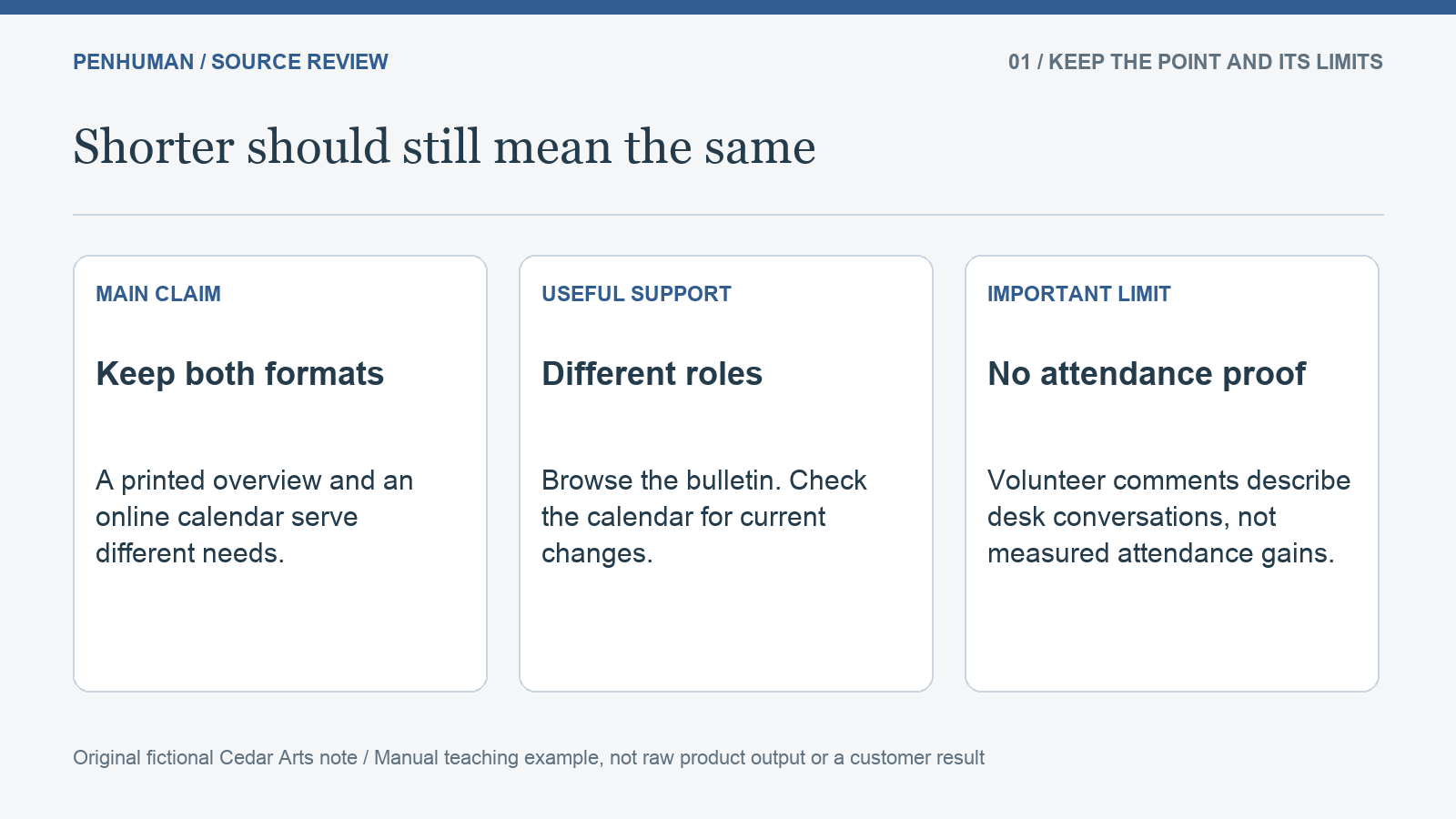
The editor’s main claim is that the printed overview and online record should remain together because they serve different reading needs. The practical support is that a visitor can browse the bulletin without a device, while the calendar carries fuller descriptions and current changes. Keep those roles connected in your notes. A list containing print, calendar and volunteers would name topics without explaining their relationship. The reader’s question concerns why the editor recommends both formats, so the summary needs that reasoning rather than an inventory of every sentence in the note or a simple count of the formats mentioned.
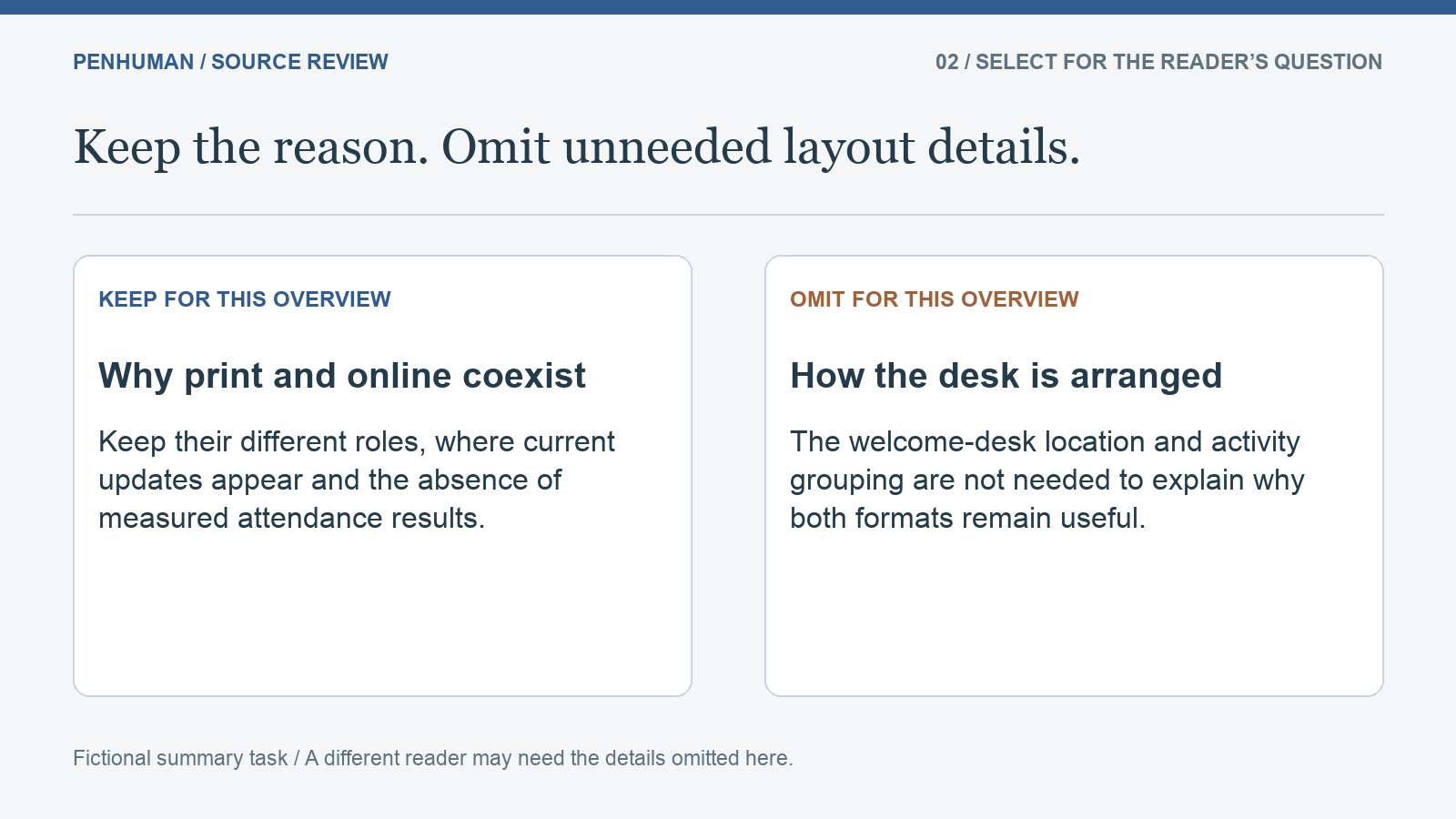
Next, identify which details affect the scope of that claim. The calendar is the place to check current times and cancellations; dropping this distinction could leave a reader with a mistaken expectation of the bulletin. Volunteer comments support a narrower observation about desk conversations, not a measured change in attendance. The welcome-desk location and grouping by activity type are background for this reader task, so a short overview can omit them. If you were summarizing instructions for a desk volunteer, those same details might matter. Selection depends on purpose, but it must not remove a qualification that changes what the source actually supports.
Draft from your notes and keep the source visible
Here is a possible manual summary: "In this fictional note, the Cedar Arts editor recommends retaining a printed overview alongside the online calendar because the formats support different reading needs. Readers should check the calendar for current times and cancellations. Volunteers report that the bulletin helps start desk conversations, but its effect on attendance has not been measured." The summary combines the main recommendation, the different information roles and the limit on the reported benefit. It leaves out the desk location, entry grouping and proposed feedback question because the assigned reader does not need every implementation detail to understand the recommendation.
Compare your draft with the source after writing it. You can change the sentence structure and choose a concise order without borrowing the source’s phrasing line by line. Keep names or necessary terms when replacing them would make the reference less clear. Cedar Arts and online calendar identify the subject; decorative substitutes would not improve the summary. In real writing, identify the author and source with an appropriate citation or link for the document you are producing. The invented note here has no external publication to cite, so its fictional status is explicit rather than supported by a fabricated URL or author biography.
Check whether shortening changed the source’s meaning
Consider this intentionally faulty summary: "Cedar Arts replaced its online calendar with a more effective printed bulletin." It is short, but it changes the recommendation from keeping both formats to replacing one. More effective also introduces an unsupported comparison. Repairing the sentence requires returning to the source, not finding a softer synonym for effective. The editor recommends complementary formats; the note gives different uses for them and no measured attendance benefit. A summary can retain the right organization name and still be wrong about the source’s main relationship. Check the action and the reason together, rather than only looking for matching words.
Another faulty version reads: "Volunteers proved that the printed bulletin increased attendance, so the editor wants to expand it." The source reports conversations at the desk, not proof of attendance gains, and it supplies no expansion plan. Separate the reported observation, the unknown result and the recommendation before revising this version. You do not have to retain every caveat in every kind of summary, but a claim about effectiveness needs the limitation that prevents it from becoming stronger than the source. The numbers and conditions worksheet offers another review method when your own source includes a quantity, exclusion or condition that might disappear during compression.
Keep your response separate from the source summary
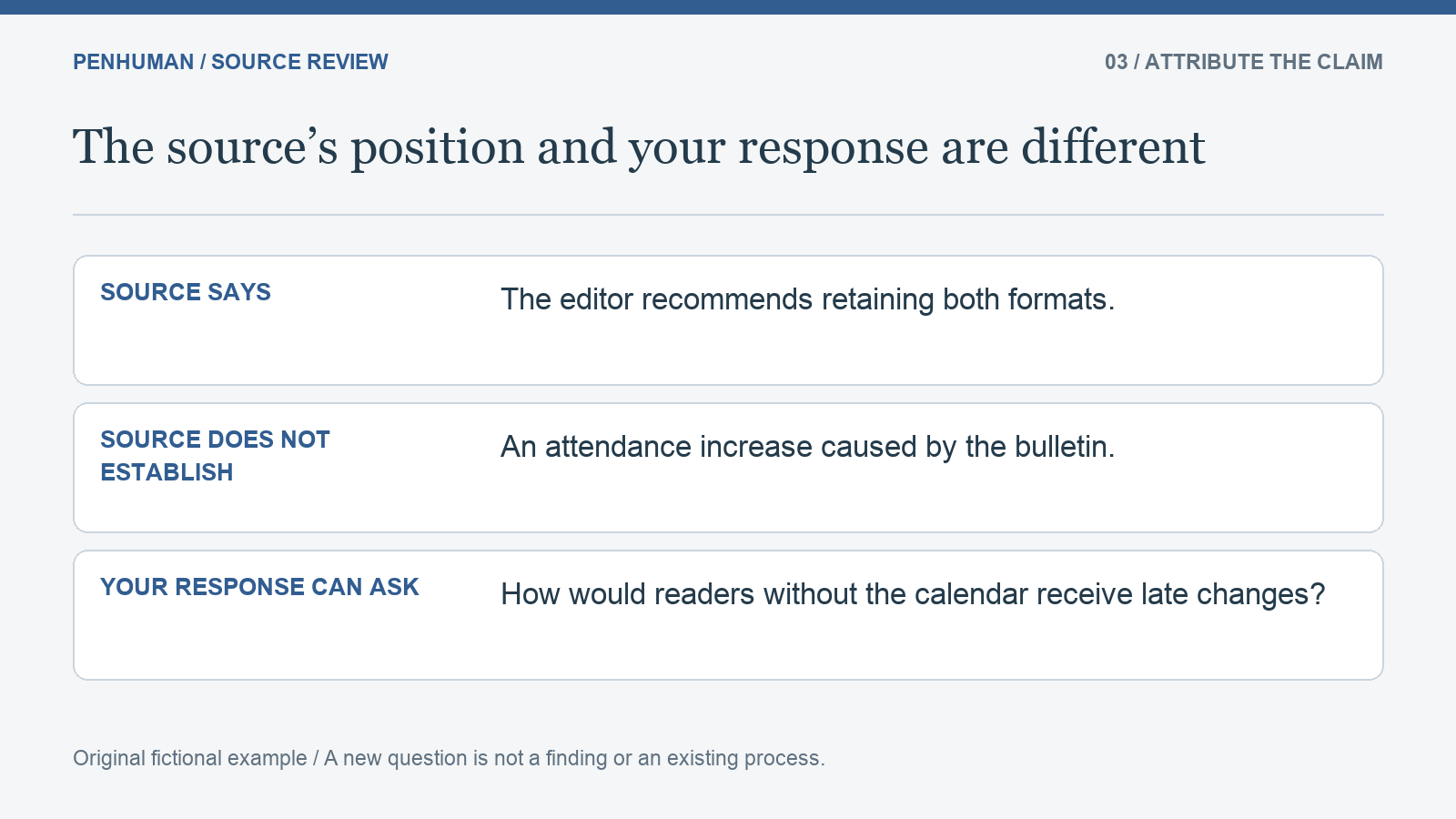
After summarizing the note, you might ask a new question: how would visitors who do not use the online calendar learn about a late change? That is your response to an unanswered issue, not a finding in the source. Label it as a question for the editor rather than adding a claim that a backup process exists or that visitors routinely miss updates. The note does not establish either statement. A clear distinction lets a colleague distinguish what the original writer said from what you think deserves attention. It also makes a later revision easier when the responsible person supplies more information.
Do not mix your reaction into the attribution. Writing that the editor admits the bulletin fails would change the tone and invent an admission; writing that the editor brilliantly solves the problem would add your approval. The source recommends a combination and acknowledges an unmeasured result. Use wording that describes that position without strengthening it through praise, blame or a new causal story. If your assignment requires evaluation, put the evaluation in a separate sentence and state its basis. A summary can be accurate even when you disagree with the author, and it can mislead even when you support the same recommendation.
Review the summary before polishing its wording
Read the summary independently and check whether it answers the original reader question. Then return to the full source and trace each statement back to a supporting passage. Check whether the selected details make the recommendation seem more universal or more certain than it was. Keep a short note explaining a major omission, such as leaving out entry grouping because the reader needs the purpose of the two formats. For a longer draft, the reverse-outline guide can help separate paragraphs that summarize the source from paragraphs that contain your response. A smaller word count is useful only after the important relationship remains clear.
When reviewing your own eligible prose, you can compare an AI Humanizer candidate with the source and your editorial notes. Basic accepts complete drafts of 80–600 words within the remaining allowance; it includes 3,900 Humanizer characters with no scheduled reset. The short summary in this exercise is for manual review, so do not pad it to meet the tool’s minimum. The Word Counter can help check length, but it cannot decide which source details matter or verify attribution. Save the source, any candidate and the final reviewed wording separately. This workflow does not claim an automatic summarizing or source-verification feature in PenHuman.
Frequently Asked Questions
How short should a faithful summary be?
Choose a length that lets the intended reader understand the source’s important point at the required level of detail. A brief overview for a colleague may need less background than a summary supporting a detailed analysis. In this exercise, the reader needs the reason for keeping both formats and the limits on the reported benefit. The desk arrangement can be omitted without changing that purpose. If a strict limit forces you to remove a qualification that changes the claim, narrow what you are summarizing or state the limitation rather than presenting a misleading conclusion as a complete overview.
Should a summary include my opinion about the source?
Keep the source’s position separate from your response. You can follow a summary with an evaluation or question when the task calls for it, but the reader should be able to identify who is responsible for each claim. The question about visitors receiving late changes is a response to the fictional note, not something the editor answered. Presenting it as a question preserves that distinction. Do not turn disagreement into an admission by the author or agreement into evidence that a recommendation works. State the basis for your evaluation separately from the material you are summarizing.
Can I copy a key sentence if I name the source?
If you keep a source’s exact wording, treat it as a quotation and attribute it appropriately; naming the source does not turn copied wording into your own paraphrase. A summary usually uses your own wording to convey the main ideas, while a quotation is useful when the original language itself matters. Follow the citation requirements of the document you are producing. The quoted note in this exercise is original fictional teaching material, not an excerpt from a real arts organization. Its manual summary remains visibly separate so that you can compare selection and wording against the full supplied source.