Write a Decision Memo That Separates Evidence and Advice
Give the decision memo one question to answer
A decision memo helps someone choose what to do. Before polishing it, write the question that person must answer and the limits of their authority. This guide works through an original fictional repair workshop deciding how to handle demand for its next Saturday session. It compares keeping the current arrangement, trying advance booking and adding a Wednesday session. The numbers, roles and records are invented for the exercise. They are not customer evidence or raw PenHuman output. The goal is a recommendation whose reasoning the reader can check, not a confident paragraph that makes the choice look settled.
Harvard Kennedy School’s memo guidance recommends evaluating options against criteria, supporting claims with data, stating qualifications and describing next steps. Apply that structure to a focused question: which arrangement should the workshop coordinator approve for the next session? The memo is not permission to expand the whole program or buy new equipment. Place that boundary near the opening. A writer can recommend a limited trial while explaining what would still need confirmation. If a draft begins with a long history of meetings, find the actual request and move it where the coordinator can see it first.
Build a small record before comparing options
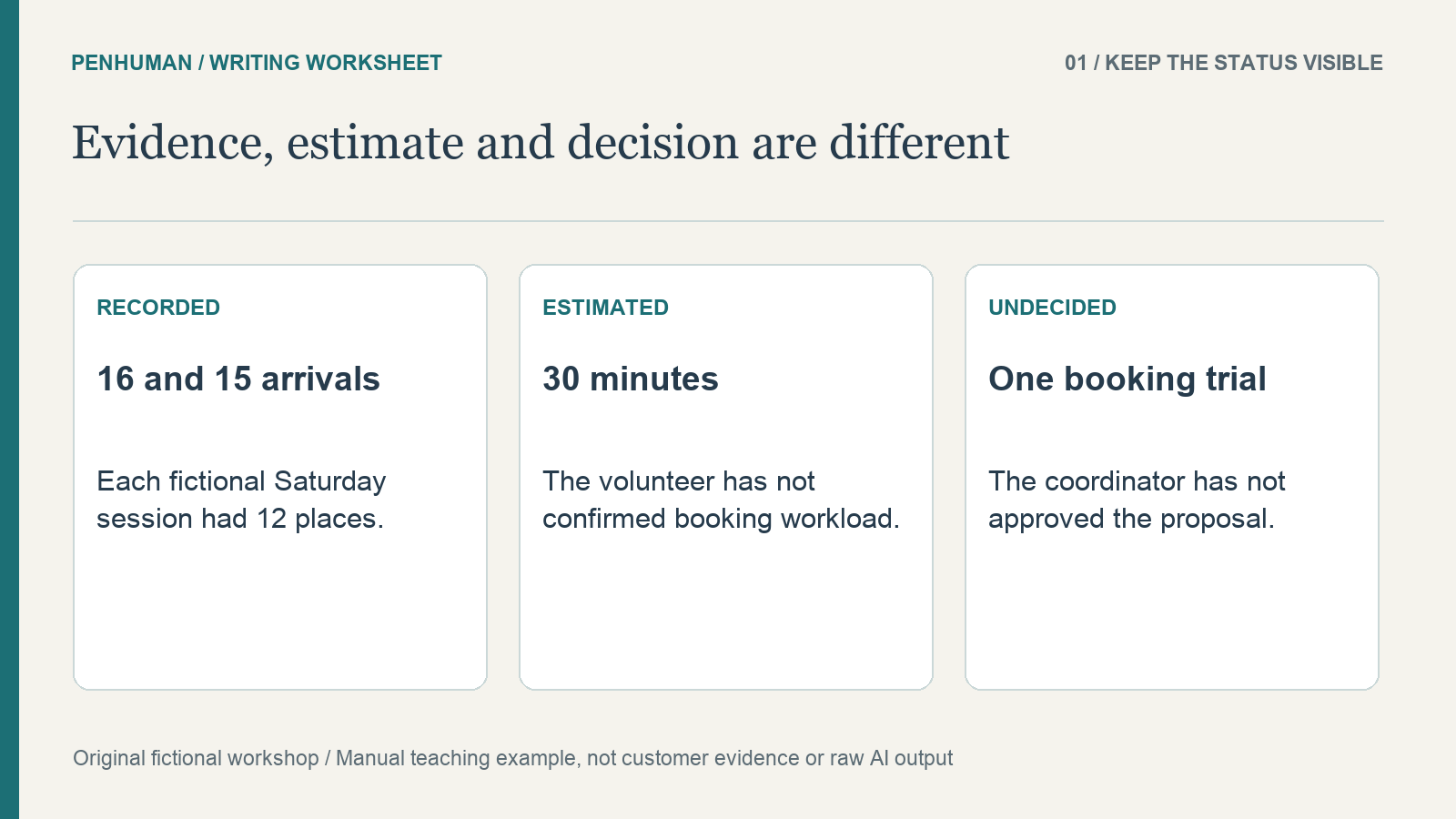
The fictional attendance record says that 16 people turned up at one Saturday session and 15 at the next. Each session had 12 places; four people at the first and three at the second could not join. The same room and instructor are confirmed for the next Saturday, still with 12 places. A Wednesday room is available, but no instructor is confirmed for it. A volunteer estimates that managing advance bookings would take 30 minutes. This is the complete fictional evidence set for the exercise. It supplies no booking trial, no measured waiting time and no prediction of future attendance.
Identify the status of each note before turning it into prose. The attendance counts describe recorded events in the fictional brief. The 30-minute workload is an estimate, not a timed result. Instructor availability is confirmed for Saturday and unresolved for Wednesday. A sentence such as Advance booking will eliminate disappointment combines several unsupported assumptions: people will book, attend and prefer the new process. Keep those assumptions separate from the evidence. A useful memo can explain why a limited trial is worth considering without claiming that its outcome has already been demonstrated or that the past two sessions represent every future week.
Use the same criteria for every option
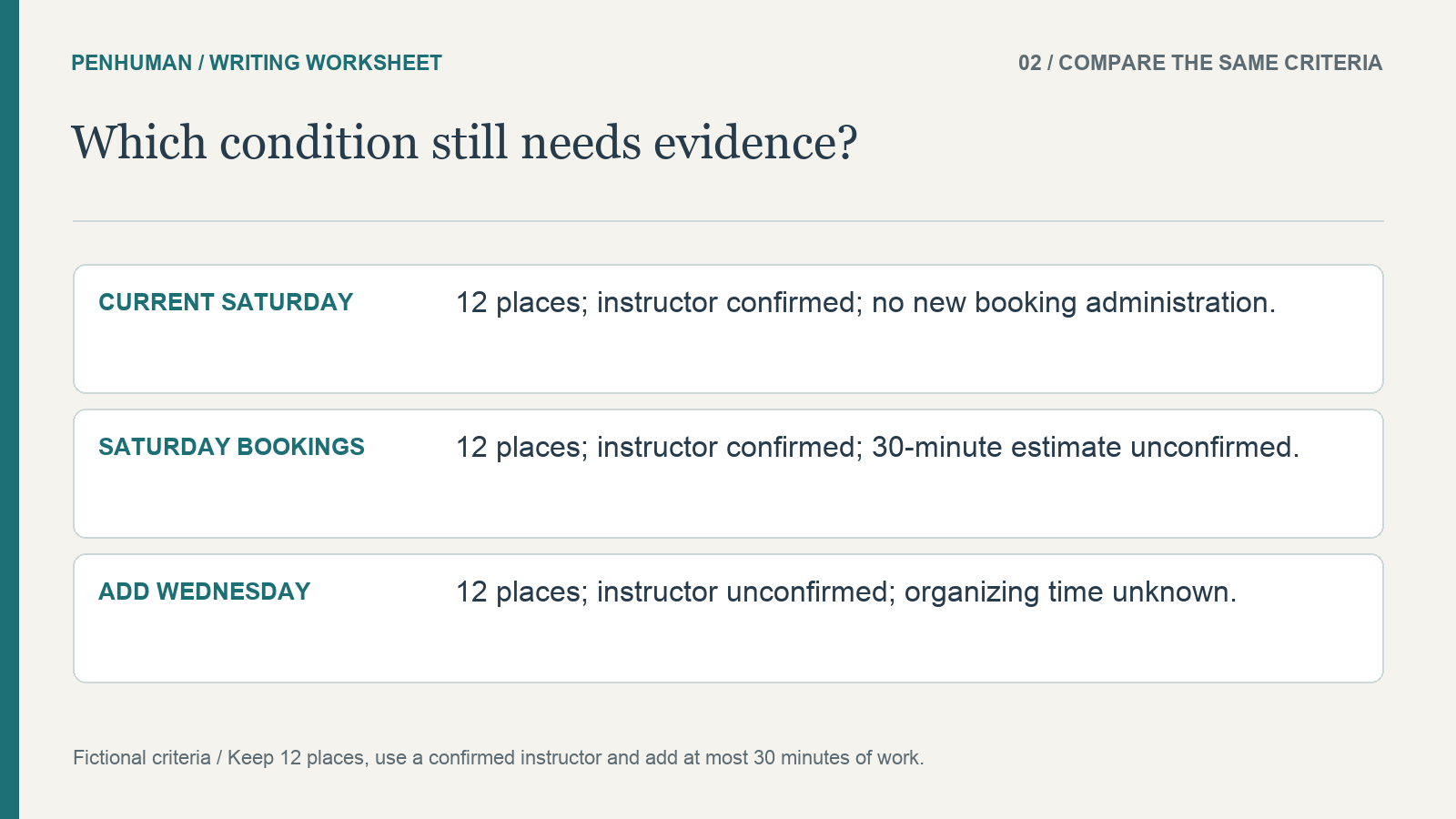
For this exercise, the coordinator has specified three criteria: keep the 12-place limit, use a confirmed instructor and add no more than 30 minutes of organizing work. These are fictional decision requirements, not universal workshop standards. List them before evaluating the options. Do not quietly give the preferred option an easier test. Keeping the current arrangement meets the capacity and instructor conditions and adds no new booking administration, but it leaves the same arrival process in place. It does not guarantee that another session will have exactly four or three people unable to join.
Advance booking keeps the 12-place limit and the confirmed Saturday instructor. Its extra administration is estimated at 30 minutes, so it may fit the workload criterion, but that estimate needs confirmation before approval of the trial. Adding Wednesday could offer an additional session with 12 places, yet it currently fails the confirmed-instructor criterion. Its organizing time has not been supplied either. Place those qualifications beside the option. An available room is not a staffed session, and an unknown workload is not zero. The comparison-table guide explains a related way to keep unanswered cells distinct from explicit exclusions.
Explain the trade-off behind the recommendation
Now make a recommendation that follows from the record. The writer recommends one Saturday advance-booking trial, conditional on confirming that its administration can fit the coordinator’s 30-minute limit. The rationale is limited: this option changes how existing places are allocated while retaining the confirmed session and instructor. It does not increase the number of places. The memo should also acknowledge what favors the current arrangement: it requires no new booking administration. That is a real advantage under these criteria, even when the writer prefers to test a different process.
Identify the uncertainty that could change the recommendation. If the volunteer cannot support the estimate, the proposed trial no longer meets the workload condition as written. The coordinator can then keep the current arrangement or explicitly reconsider that condition; the writer cannot silently expand it. Wednesday remains an option to investigate after an instructor and workload estimate are available. Do not describe it as impossible merely because it is not ready at present. This makes the recommendation conditional on visible evidence, rather than protecting a favorite option by hiding its weakness or dismissing an alternative with a stronger claim than the brief supports.
Draft the request without implying approval
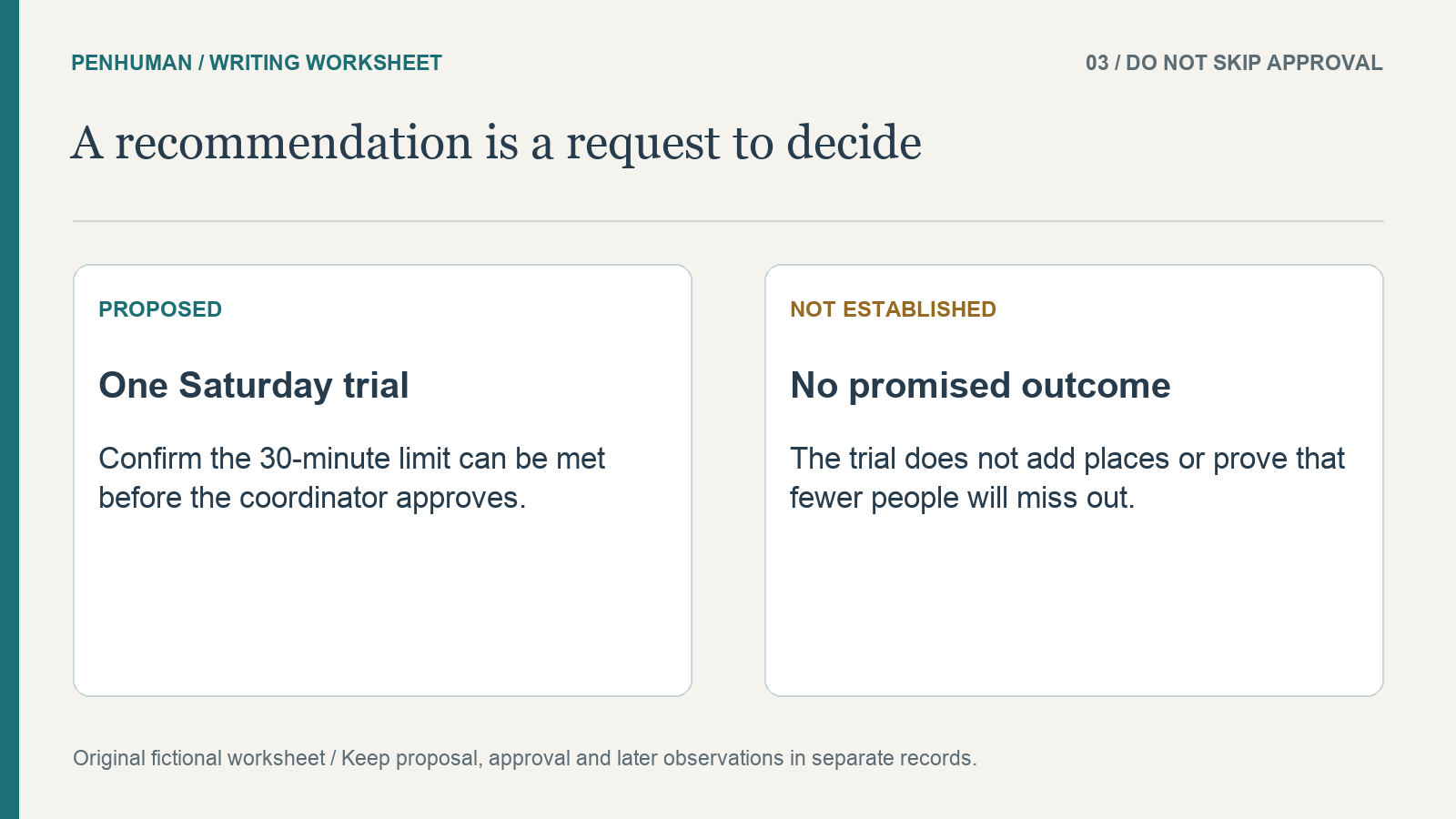
Here is a concise manual opening: "Coordinator, please decide whether to approve one Saturday advance-booking trial after the volunteer confirms that administration can fit within 30 minutes. The session would retain its confirmed instructor and 12 places. I recommend the trial to test a different allocation process, not to promise more capacity or fewer people unable to attend." This is a manually constructed example of memo wording, not a product-generated result. The request identifies the decision and its condition. It also distinguishes a proposed test from an observed benefit, so a later reader can see what has and has not been established.
Google’s documentation guidance recommends making the responsible person clear when responsibility matters. Apply that to the next step: the volunteer confirms the workload estimate, and the coordinator decides whether to approve the trial. Avoid "The trial has been agreed" when the record contains only a recommendation. Do not invent a decision deadline to make the request feel urgent; this fictional brief provides none. If a real memo needs an answer by a certain date, obtain that date from the responsible person and explain the consequence of delay using evidence the team actually has.
Separate the decision record from the proposed evaluation
Before sending the memo, include a short section explaining what would be recorded if the trial is approved. For this exercise, the writer proposes tracking booking administration time, booked places and attendance at the trial session. These are proposed observations, not collected results or an automatic measurement feature. The coordinator would still need to agree on how the information is gathered and reviewed. Do not promise that one session will establish why attendance changed; differences in the day, participants or demand could matter. A trial record can inform the next discussion without proving a causal effect.
Keep the recommendation, approval and later observations in separate dated records. An approval might cover one Saturday trial under the stated workload condition; it would not automatically authorize every future session or Wednesday expansion. If no answer arrives, the decision remains unresolved. If the coordinator changes a criterion, update the comparison explicitly rather than rewriting the old estimate to make it fit. After a decision is made, the project-update guide can help communicate the agreed next action. That follow-up serves a different purpose from this memo, which explains the choice before authorization exists.
Review the reasoning before shortening the prose
Review the draft with three questions. Can every factual sentence be traced to the brief? Does each option face the same criteria? Is the recommendation visibly separate from approval and predicted results? Check the 12-place capacity and 30-minute estimate wherever they appear. A sentence that turns estimated administration into measured time needs repair even if the numbers themselves remain unchanged. Ask a colleague to identify the condition that would stop the proposed trial. If they cannot find it, place that condition closer to the recommendation before cutting more words or adding a stronger concluding claim.
For your own eligible prose, the AI Humanizer can generate a candidate to compare with the evidence record. Basic accepts complete drafts of 80–600 words within the remaining allowance, with 3,900 included Humanizer characters and no scheduled reset. Keep the short request here as a manual exercise rather than padding it to meet an input minimum. The Word Counter can help check a written length requirement; it cannot rank options or verify assumptions. Keep the original, candidate and final editorial changes separately. This guide describes a manual reasoning workflow, not automatic decision analysis, fact verification or approval management in PenHuman.
Frequently Asked Questions
How is a decision memo different from a project update?
A decision memo explains the available choices and asks the authorized reader to decide. A project update usually tells readers what has happened, what is outstanding and what happens next. They can share facts without serving the same task. In this fictional example, the memo compares three arrangements before the coordinator approves anything. After a decision, a separate update can record the approved scope and responsible people. Do not turn the recommendation into an approved action just because the same information appears in a later message or a more polished summary.
Can I recommend an option when some evidence is missing?
You can state a conditional recommendation if the condition is clearly stated and the missing evidence does not get disguised as a fact. The advance-booking proposal depends on confirming its administration can fit within 30 minutes. Wednesday lacks a confirmed instructor and a workload estimate, so the memo cannot present it as ready. Explain which fact would change your recommendation and who needs to confirm it. If essential uncertainty cannot be bounded, ask for that information before a decision instead of ranking the options with invented scores or unsupported confidence.
Should every decision memo include a numerical score?
Use a score only when its criteria, scale and weighting have a justifiable basis that the reader can understand. This exercise does not supply such a system, so assigning each option a precise rating would add an invented method. A concise criterion-by-criterion explanation is enough to expose the trade-off: the current arrangement needs no new booking administration, advance booking has an unconfirmed time estimate, and Wednesday lacks a confirmed instructor. The useful result is a transparent choice and its limits, not a numerical winner that hides the assumptions behind it.