Concrete Examples: Explain a Point Without Inventing Proof
Give concrete examples a clear job in the paragraph
Concrete examples help readers understand what a general statement means in a specific situation. They do not automatically prove that the statement is true. If a draft says a process is flexible, an example should show the choice available to its reader, rather than merely replace flexible with adaptable. This guide develops an explanatory paragraph using an original fictional workshop note. The task is to connect a claim, a supported illustration and its limit. It is useful when reviewing an article, an internal explanation or a wording candidate that sounds fluent but leaves its main point vague.
Purdue OWL describes examples and supporting details as ways to develop a paragraph around its central idea. Google’s developer-writing guidance recommends precise, objective descriptions rather than subjective labels such as easy or quick. These recommendations inform the exercise; neither source endorses the invented workshop or establishes a result from it. The notes, rough draft and manual revisions below are teaching material, not customer testimony or untouched PenHuman output. A paragraph can become clearer through its choice of information before any sentence-level editing begins.
Separate the general claim from the information you have
The fictional source is a planning note for the Linden Print Workshop. During its beginner session, participants make a paper pattern with either a leaf stamp or a geometric stamp. They choose the stamp before making their pattern. The organizer supplies paper, ink and both stamp types. The note does not describe freehand printing, a choice of session length, participant satisfaction or measured learning outcomes. These are invented facts for this exercise only. Keep this note beside the draft so every added detail can be checked against the same limited source.
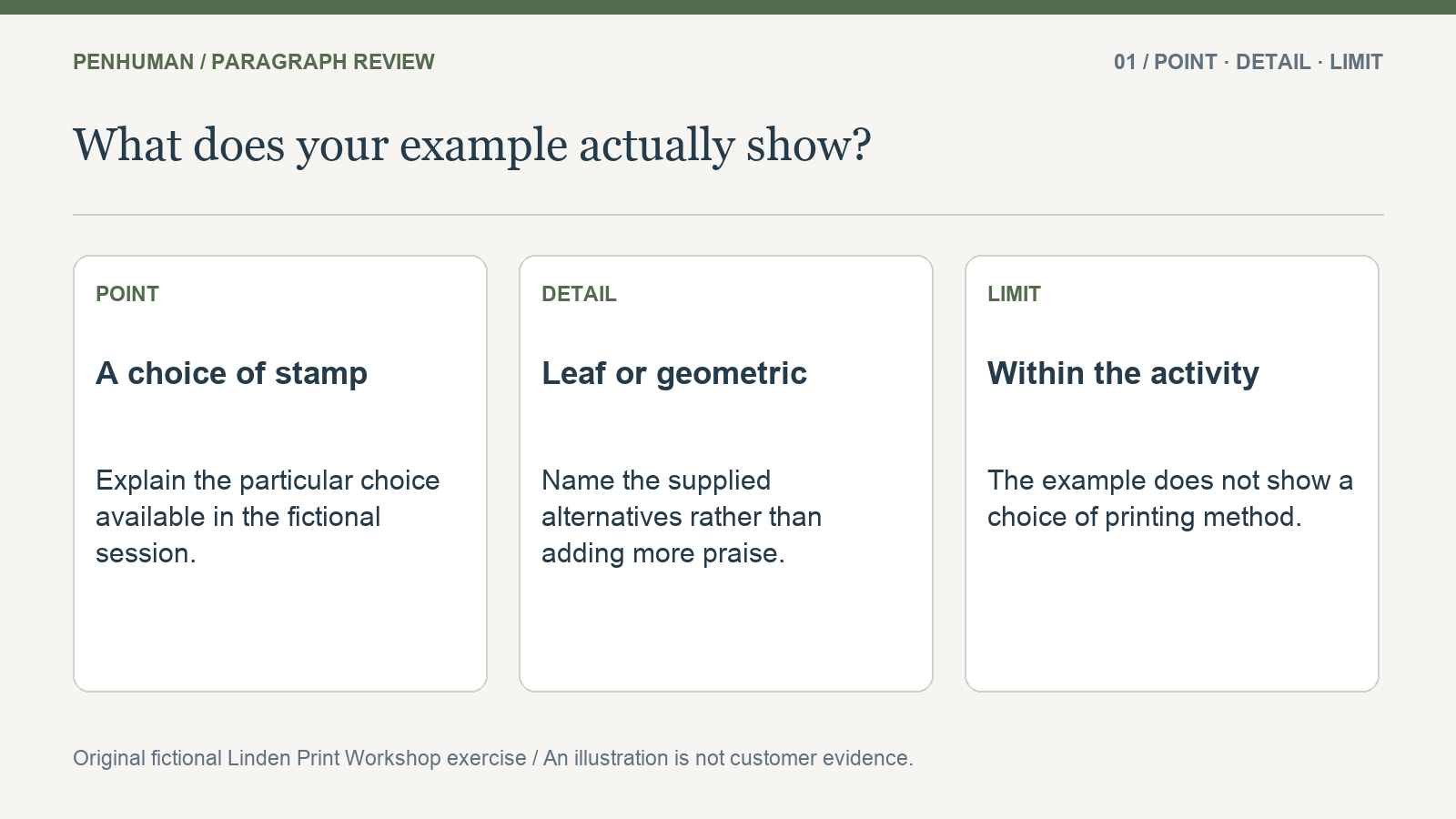
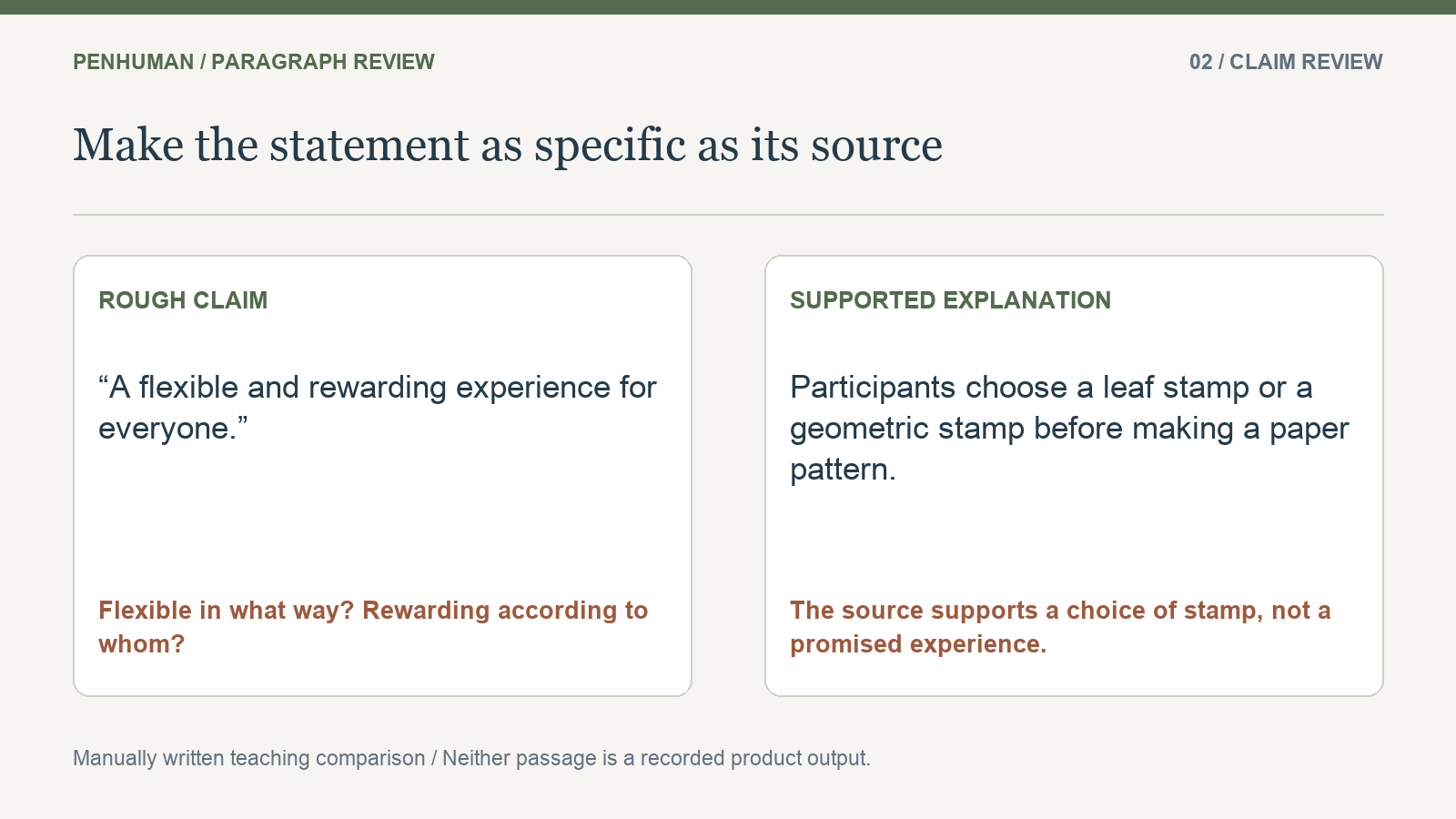
The rough paragraph reads, "The workshop offers a flexible and rewarding experience for everyone. Its thoughtful approach encourages creativity and makes participation effortless." It makes several different claims without showing what they mean. Flexible might refer to materials, timing or attendance. Rewarding and effortless describe an experience that the planning note has not measured. Before expanding the paragraph, choose the narrower point that the source actually supports: participants can choose between the supplied stamp types. That point is less sweeping, but it gives readers something definite to understand.
Choose an illustration that explains the point
An effective illustration follows the choice in the source: a participant can use a leaf stamp or a geometric stamp to make the paper pattern. It makes the available option visible without inventing a named attendee or a personal success story. The writer does not need a fictional quotation saying someone loved the session. Nor does adding a precise-looking percentage make the explanation stronger when no measurement exists. Choose a detail because it clarifies the chosen point, not because a statistic, unusual name or vivid scene makes the paragraph appear more authoritative.
Next, connect the illustration to the claim. A manual revision can read, "The beginner session gives participants a choice of stamp. Before making a paper pattern, each person selects a leaf stamp or a geometric stamp from the supplied materials." The first sentence identifies the choice; the next makes it concrete. Paper and ink belong in a separate preparation note if that is where the reader needs them. Including every available fact in this paragraph would obscure the specific choice it is meant to explain. More detail helps only when its connection to the point stays clear.
Explain the connection instead of letting the example drift
After writing an example, ask what a reader is supposed to learn from it. Here, the difference between the stamp types shows a choice within a defined activity. It does not show that participants can redesign the whole session. If the surrounding draft still calls the workshop completely flexible, the claim and example disagree. Narrow the claim rather than stretch the example to cover an unsupported promise. This is the explanatory work between a concrete detail and a general statement: tell the reader which part of the statement the detail actually illustrates.
The connection can be brief. Add, "The choice is between those supplied stamp types; the note does not offer a different printing method." This limit matters if the paragraph replaces the original broad claim about flexibility. It would be less useful to add an unrelated warning about travel or booking when those topics are absent from the source. Read the claim, illustration and explanation together. If the paragraph now changes subject halfway through, move the separate idea to its own paragraph or remove it until the required information is available.
Keep illustration, evidence and missing information distinct
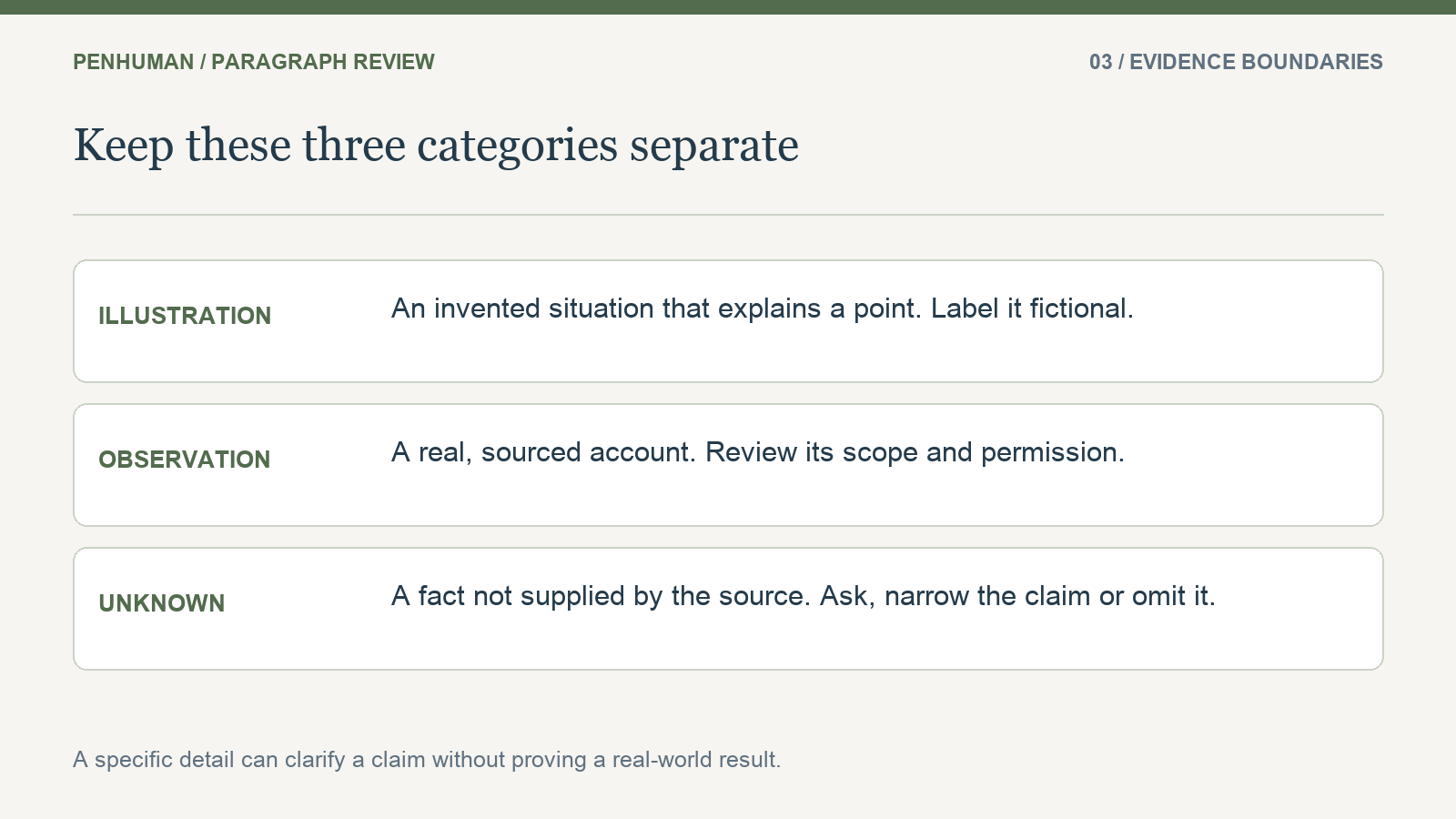
An invented situation can illustrate a concept, as this workshop exercise does, when it is plainly identified as fictional. It cannot establish what real participants experienced. An actual observation would need an identifiable source and suitable permission to use it; a claim about typical results would require evidence appropriate to that broader claim. Do not turn an illustrative participant into a real customer through wording such as our users found. The example’s status must survive shortening, captions and social excerpts, not just appear once in a note that readers may never see.
Missing information belongs in a different category. The planning note says nothing about satisfaction, so the draft should not report either happy participants or disappointed participants. It also cannot infer that the session is effortless merely because materials are supplied. Ask the owner of the source for the information if that claim is necessary; otherwise omit it or state a narrower supported point. A plausible story is still a story. Keeping that distinction visible allows a reader to understand the example without being asked to treat it as a study, testimonial or guarantee.
Compare the assembled paragraph with its source
The assembled manual revision is: "In this fictional beginner session, participants choose between two supplied stamp types. Before making a paper pattern, each person selects a leaf stamp or a geometric stamp. This is a choice within the planned activity; the source does not offer a different printing method." The passage explains the supported option and its boundary. It does not repeat every material or claim that the choice improves creativity. Compare it with the planning note, then check whether the surrounding heading still promises a broader result than the paragraph can support.
For your own draft, identify the general point, the detail that illustrates it and the sentence explaining their connection. Keep the original source close by and mark anything that remains unknown. A colleague can then identify exactly where the explanation becomes vague or exceeds the source. The actionable-feedback guide covers that separate reviewer task, while the rewrite-review worksheet helps inspect changed numbers, negations and conditions. This exercise proposes a way to inspect writing; it does not report a user study or claim that adding an example will produce more traffic, clients or sales.
Use a wording candidate after the example is grounded
If you use the AI Humanizer on an eligible draft, first decide what the example needs to communicate. Keep the source and your chosen claim beside the resulting candidate. Check that the candidate retains the supplied alternatives, the order of the choice and the distinction between illustration and evidence. A smoother sentence that invents freehand printing or reports delighted participants fails that comparison. You can repair it manually, but keep that repair separate from the raw candidate. Natural wording does not establish factual support, and a rewrite cannot supply missing observations.
Basic includes 3,900 Humanizer characters with no scheduled reset and accepts complete drafts of 80–600 words within the remaining allowance. The brief quoted revisions here are manual teaching examples; do not pad them to meet the tool minimum. Use the Word Counter if your actual draft has a length requirement, then compare any wording candidate with the source before keeping it. An account is required to use the Humanizer. End with the reader’s question: what specific choice does this paragraph explain, and what would the reader still need to verify elsewhere?
Frequently Asked Questions
Does every paragraph need a concrete example?
No. A paragraph may need a definition, a direct explanation or another form of support instead. Choose an example when it helps the reader to understand the particular point being made. In the workshop exercise, the stamp alternatives explain a choice that the word flexible leaves unclear. An unrelated anecdote would add length without doing that job. Check the purpose of the paragraph before adding material, and keep its main point easy to identify. The goal is useful development, not a fixed number of examples throughout the document.
Can I invent a scenario to explain a real concept?
You can use a clearly labeled fictional scenario as an illustration, as this guide does. Keep the invented details consistent with each other and distinguish them from any real sources used to explain the underlying principle. Do not give the scenario a fabricated customer identity, testimonial or measured outcome. A caption or shortened excerpt should preserve its fictional status. If your conclusion depends on what actual people did or experienced, an invented example cannot provide that evidence; find an appropriate source or narrow the conclusion.
What if the rewrite sounds better but changes the example?
Check the changed detail with the source before deciding whether to keep the wording. In this exercise, a leaf stamp and a geometric stamp are the supplied choices; replacing them with freehand printing changes the activity rather than merely its style. Restore the supported detail and review the rest of the paragraph for related changes. Keep the genuine candidate and your editorial correction distinct in working notes. If the source leaves a question unanswered, a confident-sounding rewrite does not resolve it, so avoid publishing the unsupported claim.